Long chains of small units
A polymer is a molecule made by joining many small, identical units end to end, like beads on a string. Polyethylene, the plastic of carrier bags and milk bottles, is a backbone of carbon atoms with two hydrogens on each, repeated thousands of times. One chain can be a hundred thousand atoms long yet only a few atoms thick.
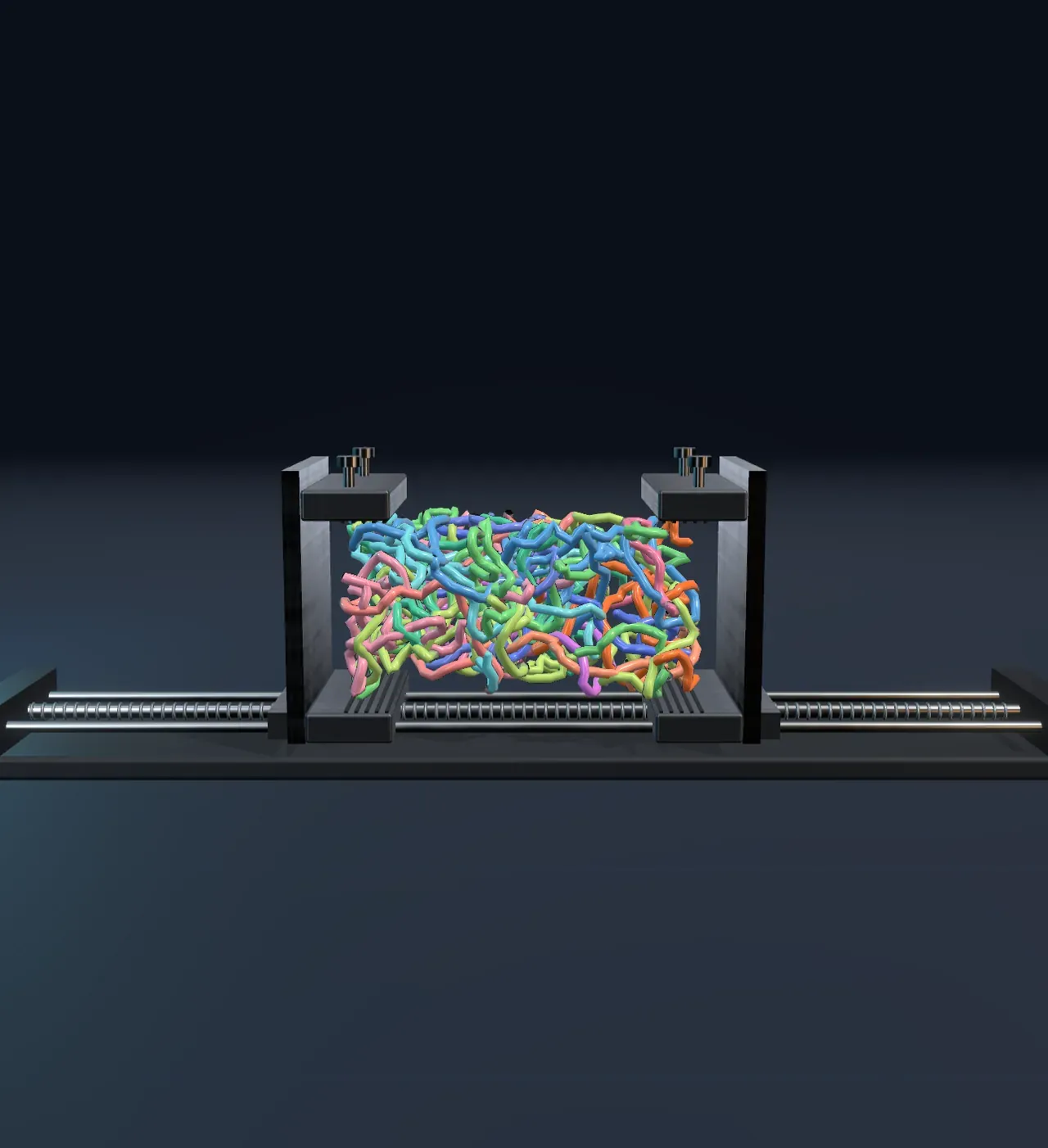
In a solid lump the chains do not lie straight. Each one wanders in a random coil, threading through its neighbours like cooked spaghetti in a bowl. Nothing but weak attractions between neighbouring chains and their tangles holds the lump together. What happens when you pull depends on whether anything else ties the chains to each other.
Free chains slide: thermoplastics
In a thermoplastic such as polyethylene, nylon or PET, the chains are not bonded to each other at all. Pull gently and the lump stretches a little and springs back. Pull harder and, at around 30 MPa in the model, the chains start to slide past each other and uncoil partly into line with the pull. The sample keeps getting longer at almost the same force. That sliding is permanent: let go and the chains stay where they slid to.
Try it: with Cross-links at None, move Stretch to Pulled to double, then press Let go. The block hardly shrinks and the chart shows almost all of the stretch kept, because nothing pulls the chains back.
The same freedom is why thermoplastics melt. Warm one and the chains slide past each other more and more easily, until it flows and can be moulded again. Thermoplastics are the plastics that can be melted down and recycled.
Why chain length matters
Candle wax and a milk bottle are made of the same units. Paraffin wax has chains only twenty to forty carbon atoms long; polyethylene’s run to many thousands. Short chains barely tangle, so a pull just separates them, and wax crumbles. Long chains wind through so many neighbours that, before one can slide free, it drags the others along, and the plastic draws out instead of breaking.
Try it: set Chain length to 10 beads and move Stretch a little way. The block parts after a few percent; whole chains come away from each other without a single one breaking. Set Chain length to about 30 beads and it holds out longer before it parts.
A few ties: rubber
Natural rubber is also a tangle of long chains, but in 1839 Charles Goodyear found that heating it with sulphur turns a sticky gum into a springy solid. The sulphur forms cross-links: short bridges of atoms, chemically bonded to two chains, that tie neighbouring chains together. This is called vulcanisation.
With a few cross-links, the chains can no longer slide past each other; they can only straighten out between the ties. A coiled chain can be straightened a long way by a small force, so rubber stretches to double its length at about 1 MPa, thirty times less than the thermoplastic. Let go and it springs back. Nothing like a spring is stretched inside: the jiggling of the atoms keeps shuffling each chain back into one of the countless crumpled shapes it can take, and there are far more of those than straight ones. That is also why a rubber band feels warm when you stretch it quickly against your lip.
Many ties: thermosets
Keep adding cross-links and the strands between them get shorter. With so many ties the chains cannot uncoil much at all, and the network locks into a hard, glassy solid. Rubber vulcanised with a lot of sulphur becomes ebonite, the hard black material of old bowling balls and pipe stems. Epoxy glue, the resin in carbon-fibre parts, and the brown plastic of old plug sockets (Bakelite) are made this way from the start.
These thermosets are stiff and strong, about 60 MPa in the model, but stretch only a few percent before they crack. Because the cross-links are chemical bonds, the crack has to break bonds: chains and cross-links snap across it. Heat cannot free the chains either, so a thermoset does not melt; heated far enough it chars. It is shaped once, as it sets, and cannot be remoulded.
Try it: choose Thermoset under Cross-links and move Stretch slowly. The line on the chart climbs steeply and ends at about 4%. Then compare Rubber, whose line hugs the bottom of the chart all the way to 100%.
What this model leaves out
Real chains are hundreds of times longer than the ones drawn here, so real plastics entangle far more. Temperature matters a great deal: below its glass transition temperature a polymer’s chains are frozen in place, which is why a rubber ball shatters after dipping in liquid nitrogen and why the thermoset here is glassy. Pulling speed matters too, since chains need time to slide. Many thermoplastics, polyethylene included, are partly crystalline, with chains folded into neat stacks between the tangled regions, and a pulled strip thins in one place, a neck, which then travels along it while the chains in the neck line up. The model stretches the block evenly instead. The cross-links here are placed at random between nearby chains; real chemistry decides where they form, and a lightly cross-linked rubber needs at least about one tie per chain before it holds together as one network.