Thousands of monomers in one chain: addition polymerisation, and why a plastic bag stretches and stays long, a rubber band springs back, and a saucepan handle does not melt.
Step 1 of 5 · Monomers
Step 1 of 5
Monomers
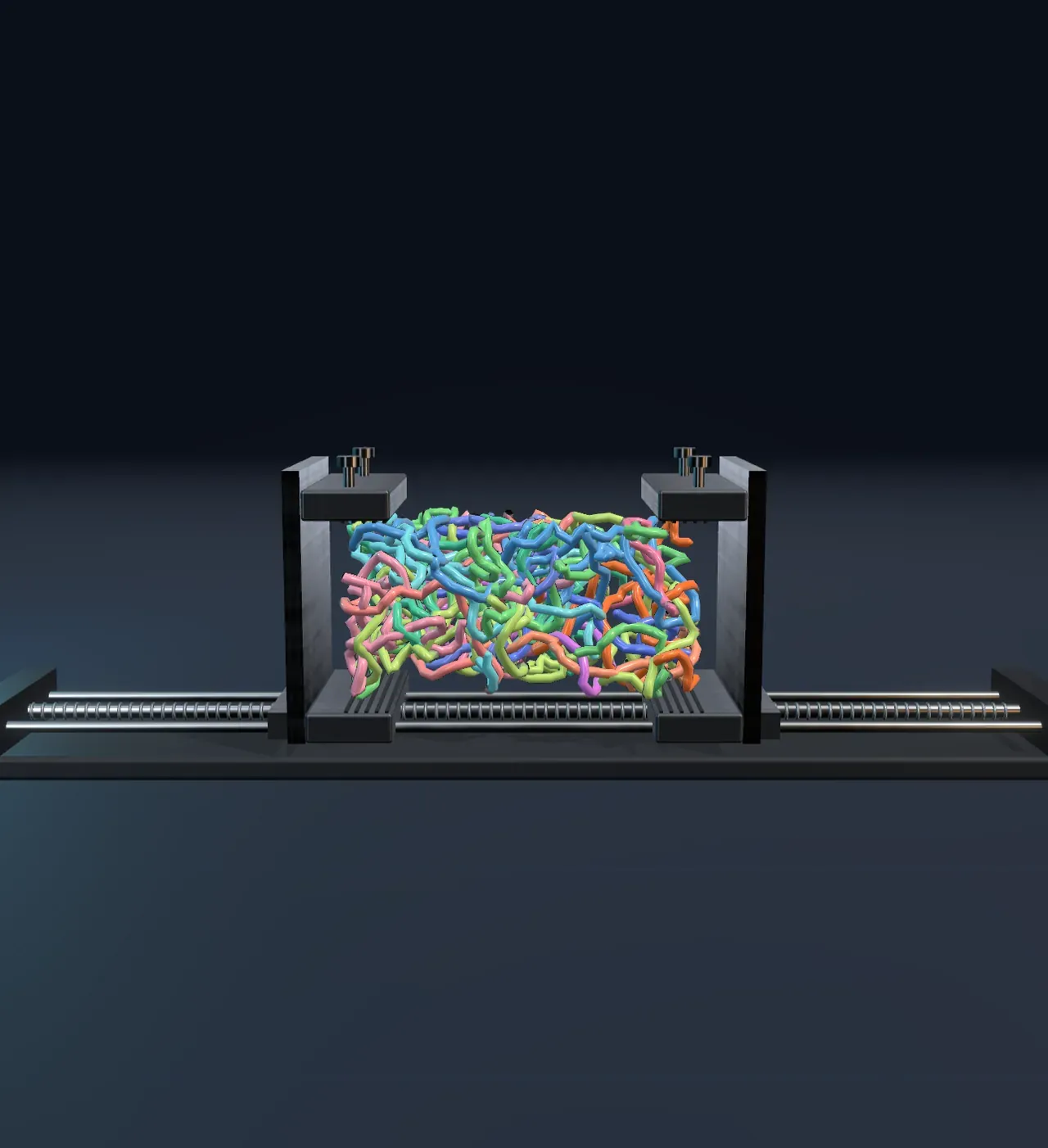
A polymer is a giant molecule built from small repeating units, monomers. Poly(ethene), the plastic of carrier bags, is built from ethene, , the simplest alkene. The double bond is what lets the monomers join. The Scene shows a small block of plastic magnified enormously: each chain is a tube of beads, and each bead stands for a short stretch of real chain.
Step 2 of 5
Long chains
One chain of poly(ethene) can hold tens of thousands of monomers. Chain length in the Scene counts beads, not monomers.
Step 3 of 5
Thermoplastic
The block is long chains with no covalent bonds between them: they are tangled together and pulled to each other by weak forces only. Such a plastic is a thermoplastic: with heat it softens and melts, and it can be moulded again and recycled. Stretch will move the grips apart and pull the block to double its length, and then the block will be let go.
Step 4 of 5
Rubber
Neighbouring chains can be tied to each other with cross-links: covalent bonds from chain to chain. Cross-links counts how many there are per hundred beads. Now the block has been pulled to double length and let go, and it stayed long.
Step 5 of 5
Thermoset
With many cross-links, all the chains in the block are tied into one dense network. Such a plastic is a thermoset: hard and strong, but it does not stretch, and cracks almost at once. The Scene has 10% cross-links.
Loading the interactive version…
Loading the interactive version…
Each step sets up the Scene for you, and a control marked “fixed” stays put for that step.
Practice · Choose
Ethene, , polymerises into poly(ethene). What happens to the double bond?
Practice · Choose
Ethene, , polymerises into poly(ethene). What happens to the double bond?
Practice · Calculate
One chain of poly(ethene) has a molar mass of 280 000 g/mol. Ethene’s molar mass is 28 g/mol. How many monomers make up the chain?
Practice · Calculate
One chain of poly(ethene) has a molar mass of 280 000 g/mol. Ethene’s molar mass is 28 g/mol. How many monomers make up the chain?
Practice · Predict, then look
The block is long chains with no cross-links: a thermoplastic, like a plastic bag. It is pulled to double its length and let go. What will happen?
Practice · Predict, then look
The block is long chains with no cross-links: a thermoplastic, like a plastic bag. It is pulled to double its length and let go. What will happen?
Practice · Reach the target
The block has been pulled to double its length and let go, and it stayed long. Change Cross-links until the block goes all the way back to its original length without breaking, then press Check.
Practice · Reach the target
The block has been pulled to double its length and let go, and it stayed long. Change Cross-links until the block goes all the way back to its original length without breaking, then press Check.
Practice · Choose
A saucepan handle is made of a thermoset: a block with many cross-links. What will happen to it if it gets very hot?
Practice · Choose
A saucepan handle is made of a thermoset: a block with many cross-links. What will happen to it if it gets very hot?
Lesson complete. Every practice question here is done.