Three squares on a triangle
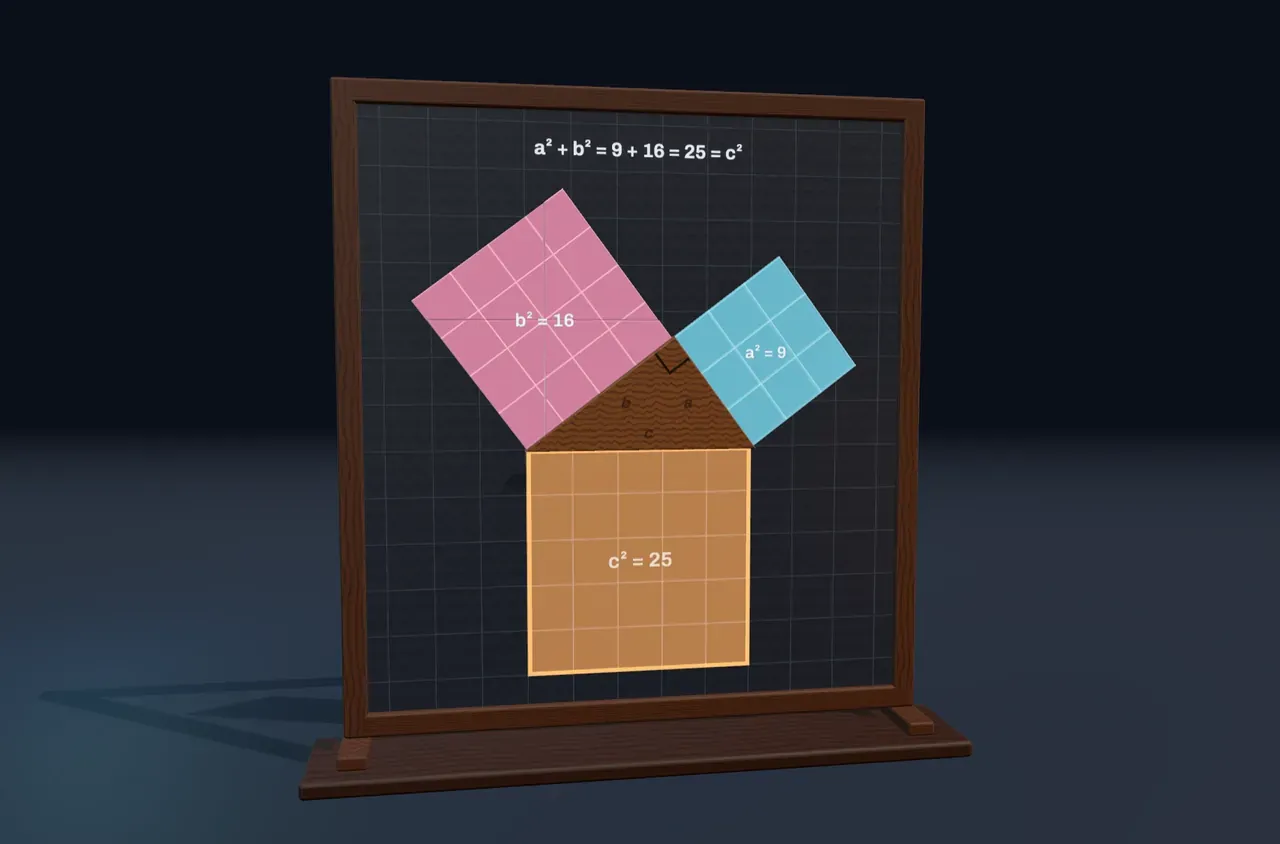
Draw a triangle with one square corner, a right angle, and build a square outwards on each of its three sides. The two sides that meet at the right angle are called the legs, a and b. The long side opposite the right angle is the hypotenuse, c.
The square on a side of length 3 holds 3 × 3 = 9 unit cells, which is why “3 squared” is written 3². With legs of 3 and 4 the hypotenuse is exactly 5, and the cells give 9 + 16 = 25. The two smaller squares hold exactly as much as the big one. That is the Pythagorean theorem:
a² + b² = c²
It holds for every right triangle, not only for whole numbers. Legs of 1 and 1 give a hypotenuse whose square is 2, so the hypotenuse is √2, about 1.414, a number that is not a fraction of whole numbers at all.
Counting is not a proof
Counting cells checks one triangle. To see why the rule holds for all of them, it helps to move the area itself. Take the larger leg square and cut it through its centre with two straight lines: one parallel to the hypotenuse and one at right angles to it. That makes four identical pieces. Now slide each piece, without turning it, into a corner of the square on the hypotenuse. The four pieces leave a square hole in the middle, and the smaller leg square slides into that hole exactly.
Try it: choose Rearranged under Rearrange, then set Side a to 5 and Side b to 12 and do it again.
The English amateur mathematician Henry Perigal published this five-piece cut in 1873. It is one of hundreds of known proofs. Euclid’s Elements, written around 300 BC, proves the theorem by comparing areas of triangles inside the figure, and many other proofs rearrange copies of the triangle instead.
Only for right angles
The rule needs the right angle. Bend the corner and the hypotenuse changes length while the legs stay the same. A sharper corner brings the ends of the legs closer, so c² is less than a² + b², and the same pieces now overlap. A wider corner pushes them apart, so c² is more than a² + b², and gaps open between the pieces.
With the pieces rearranged, set Corner angle to 70° and then to 110° to see both cases.
The general rule is the law of cosines: c² = a² + b² − 2ab·cos C, where C is the corner angle. At 90° the cosine is zero and the extra term vanishes, leaving Pythagoras. The rule also works backwards: if the three sides satisfy a² + b² = c², the corner between a and b must be a right angle. A loop of rope knotted into lengths of 3, 4 and 5 makes a square corner when it is pulled tight.
Where it turns up
The theorem is named after Pythagoras, a Greek thinker of the sixth century BC, but it is older than him. A Babylonian clay tablet from around 1800 BC, known as Plimpton 322, lists sets of numbers built from such triangles, and Indian and Chinese texts state the rule independently.
Whole-number solutions such as 3, 4, 5 and 5, 12, 13 are called Pythagorean triples, and there are infinitely many. The theorem also gives the straight-line distance between two points on a grid: walk 3 blocks east and 4 north, and you are 5 blocks from where you started, as the crow flies. A screen’s size is quoted as its diagonal, found the same way from its width and height, and the same sum, extended to three directions, gives the length of the longest stick that fits in a box.
What this model leaves out
The board is flat, and the theorem is a fact about flat geometry. On a curved surface such as the Earth, a large triangle’s angles add up to more than 180° and a² + b² = c² no longer holds. The Scene measures sides in whole grid cells or half cells; real lengths can be any number, and the theorem holds for all of them. The corner angle stops at 60° and 120° so that the squares and pieces stay readable, though the law of cosines works for any angle.