Pushing on nothing
A rocket does not push against the ground or the air. It works best in empty space. It throws mass, its burning propellant, out of the nozzle at enormous speed, and the rest of the rocket is pushed the other way, the way a skateboarder who throws a heavy bag backward rolls forward. The faster the gas leaves, the harder each kilogram pushes. That speed, the exhaust speed, is the single most important number about a rocket engine.
To get into orbit just above the atmosphere, a spacecraft must move sideways at about 7.8 kilometres per second, fast enough that as it falls toward Earth the ground curves away beneath it. Climbing through the air and against gravity costs about another 1.5 km/s, so a launcher needs to gain about 9.4 km/s in all.
The rocket equation
Here is the catch. At liftoff, each kilogram of exhaust has to push not only the payload but all the propellant still waiting to burn. Late in the flight, with the tanks nearly empty, the same kilogram pushes far less mass and adds far more speed. Adding up all those pushes gives the rocket equation, worked out by Konstantin Tsiolkovsky in 1903:
Δv = vₑ × ln(m₀ ÷ m_f)
Δv is the speed gained, vₑ the exhaust speed, m₀ the mass full of propellant and m_f the mass once it is used up. The natural logarithm, ln, is what makes rocketry hard. Every time you double the ratio of full mass to empty mass, you gain the same fixed amount of speed, no more. To reach three times the exhaust speed, a rocket must start out twenty times heavier than it ends, which means 95 % of it must be propellant.
Why rockets come in stages
A rocket’s tanks and engines have to be big and strong enough for all the propellant at liftoff. Once most of it is burnt, that empty structure is dead weight that the rest of the propellant must keep pushing. So rockets are built as a stack of smaller rockets. When the bottom one runs dry, it falls away with its empty tanks and heavy engines, and the next one starts from a much lighter rocket.
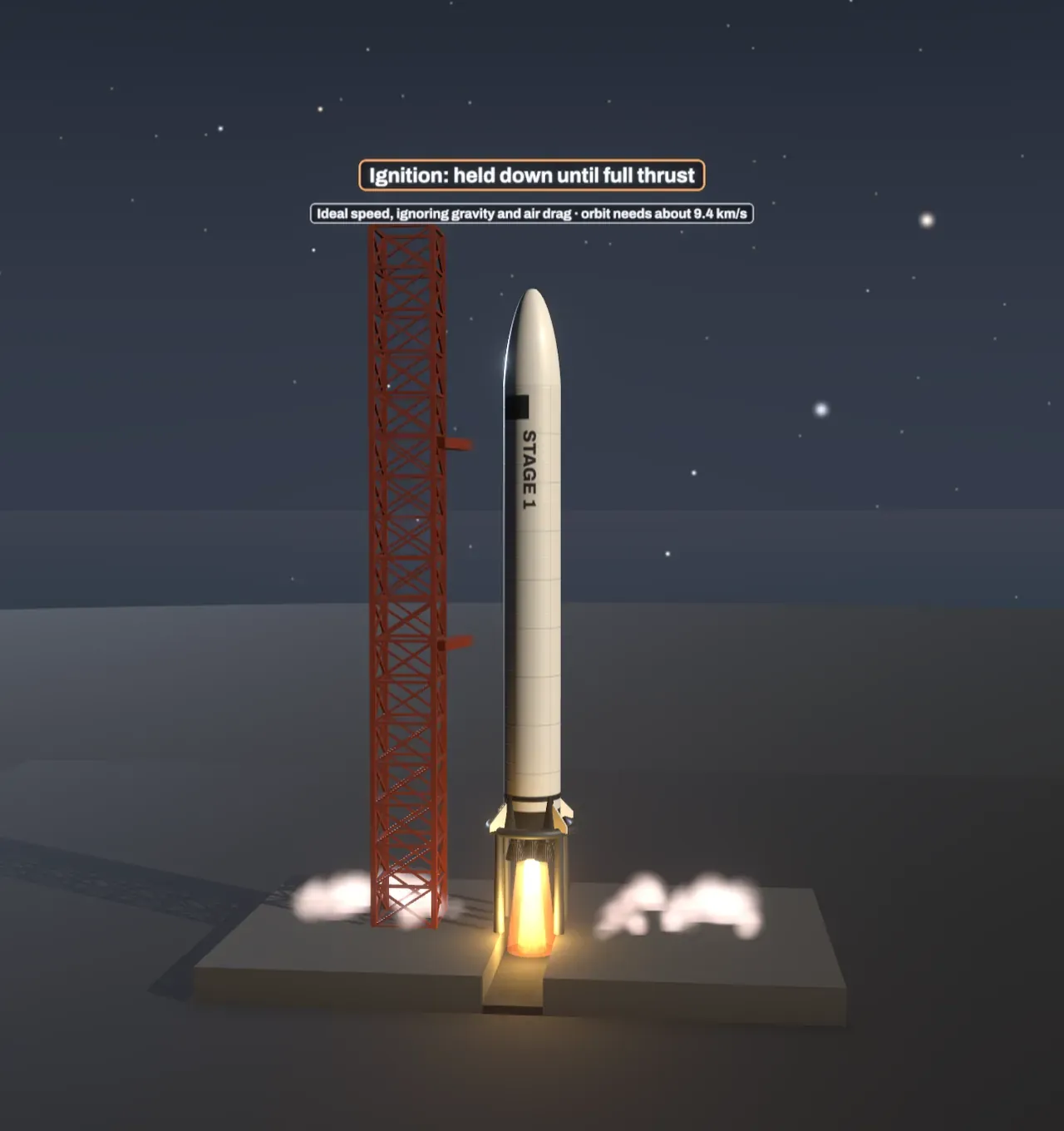
Try it: with Exhaust speed on Kerosene, change Stages from 1 to 2 and choose On under Show the equation. The same propellant, split in two, now reaches the orbit line.
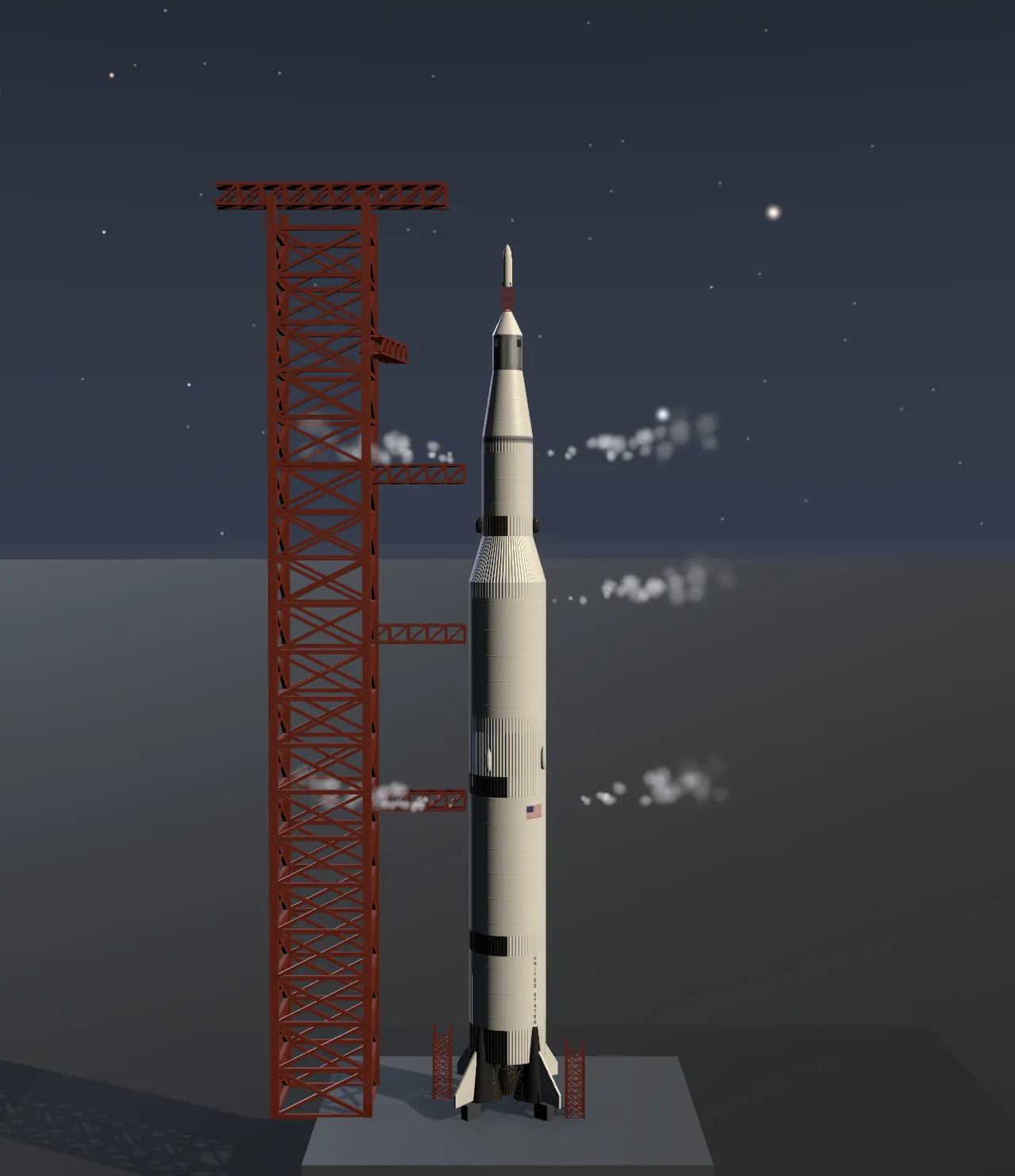
In the scene, a single kerosene rocket that is 88 % propellant reaches about 6.8 km/s, well short. Split the same propellant and structure into two stages and the speed at burnout rises to about 9.4 km/s; three stages gives about 10.2. Each added stage helps less than the one before, and each adds engines, separation hardware and things that can go wrong, which is why most launchers today use two stages, sometimes with strap-on boosters.
Faster exhaust
The other way to more speed is a better propellant. Solid-fuel motors, like big fireworks, are simple and give a huge shove, but their exhaust leaves at only about 2.5 to 2.8 km/s. Kerosene burned with liquid oxygen manages about 3.0 to 3.3 km/s. Liquid hydrogen with liquid oxygen gives about 4.4 km/s, the best of any chemical rocket in regular use. Hydrogen is so light that it needs huge, insulated tanks kept at −253 °C, which makes the structure heavier and wipes out part of the gain. In the scene, a single hydrogen stage passes the orbit line once it is about 89 % propellant. No rocket has yet reached orbit with a single stage, because real tanks, engines and losses leave too little margin.
What this model leaves out
The speed shown is the ideal speed from the rocket equation, as if the rocket were in empty space. The cost of climbing against gravity and pushing through the air is not simulated; it is added to the target instead as a rough allowance. Real exhaust speed is lower at sea level than in a vacuum, and real stages use different engines and propellants. The stages here are sized by a simple rule, each the same multiple of the mass it carries, and drawn shorter or longer than they would be so that small upper stages stay visible. The launch, the falling stages, the clouds, the rush of air and the sky darkening toward space are drawn to show the sequence, not real heights, times or distances, and the hold-down on the pad lasts longer than the few seconds a real one does.