A rocket throws mass backward and gets momentum forward. Tsiolkovsky's rocket equation, why each last per cent of propellant is worth more, the exhaust speed, stages, and what it takes to reach orbit.
Step 1 of 8 · Nothing to push on
Step 1 of 8
Nothing to push on
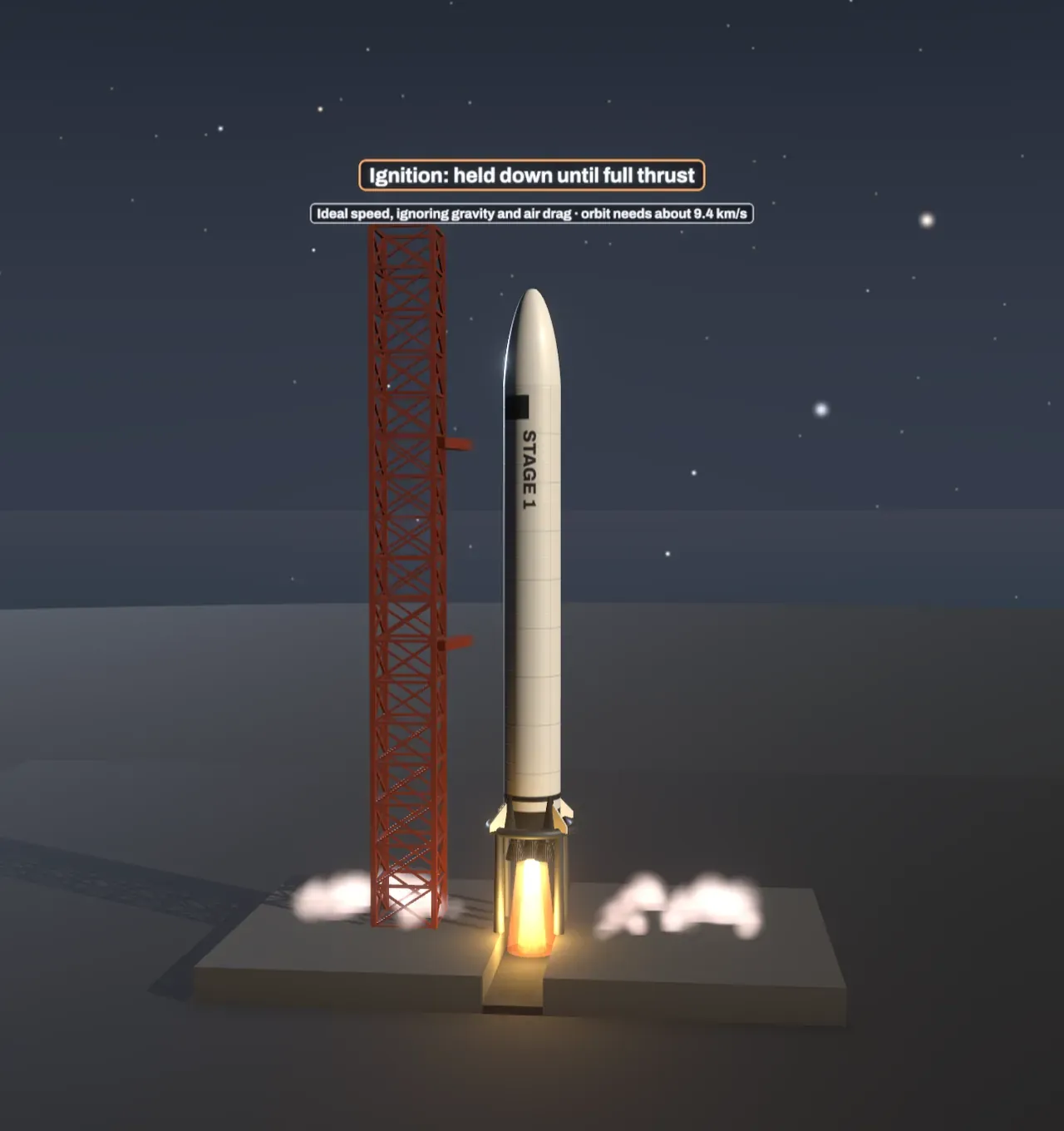
In the Scene a rocket stands on its launch pad. Run the motion: it lifts off, burns its propellant, and flies on. Above the atmosphere there is no air and no ground. What does it push off?
Step 2 of 8
Momentum out of the back
In the Unit on momentum we saw that with no outside force, the total momentum is conserved. A rocket and its propellant are one system. When the engine throws hot gas backward at high speed, the gas takes momentum backward, and the rocket gets exactly the same momentum forward, like a skater on ice throwing a heavy ball.
Every second the engine throws out more mass, and the rocket gets lighter. So the same amount of gas speeds it up more as the burn goes on.
Step 3 of 8
The rocket equation
Adding up all those small throws from the start of the burn to its end gives Konstantin Tsiolkovsky’s rocket equation, from 1903:
Here is the exhaust speed, the speed of the gas relative to the rocket; the liftoff mass, with the propellant; the mass at burnout; and the natural logarithm. The ratio is called the mass ratio. , “delta-v”, is the change in speed the rocket can make in empty space. Gravity and air take some of it on the way.
Show the equation has cut the skin away, and the chart beside the Scene plots against Propellant share. All the controls are locked.
Step 4 of 8
The last kilograms
Propellant share sets the mass ratio: if of the liftoff mass is propellant, is left at the end, so . Exhaust speed and Stages are locked.
Step 5 of 8
Exhaust speed
is in proportion to : an engine whose exhaust is twice as fast gives twice the speed from the same propellant. Exhaust speed depends on the propellant: a solid motor’s exhaust leaves at about 2.6 km/s, kerosene and oxygen at about 3.2, and hydrogen and oxygen, the fastest chemical propellant, at about 4.4 km/s. Propellant share and Stages are locked.
Step 6 of 8
Stages
Until now the tanks and engines rode all the way, even when empty. In a staged rocket each stage is dropped when its propellant runs out, and each stage adds its own . Exhaust speed and Propellant share are locked.
Step 7 of 8
To orbit
All the controls are free. There are three ways left to raise : more propellant, faster exhaust and more stages.
Step 8 of 8
The mass ratio
The question can also be turned round: how much propellant does a given take? From the equation, the mass ratio is a power:
Twice the takes the mass ratio squared. This is “the tyranny of the rocket equation”: a little more speed costs a great deal more propellant.
Loading the interactive version…
Loading the interactive version…
Each step sets up the Scene for you, and a control marked “fixed” stays put for that step.
Practice · Choose
Beyond the atmosphere there is no air. What pushes a rocket forward when its engine runs in space?
Practice · Choose
Beyond the atmosphere there is no air. What pushes a rocket forward when its engine runs in space?
Practice · Calculate
A spacecraft of mass 1000 kg, propellant included, is at rest in space. Its engine throws 10 kg of gas backward at 3000 m/s. How fast will the spacecraft move afterwards?
Practice · Calculate
A spacecraft of mass 1000 kg, propellant included, is at rest in space. Its engine throws 10 kg of gas backward at 3000 m/s. How fast will the spacecraft move afterwards?
Practice · Calculate
A single-stage rocket, Exhaust speed 3.2 km/s (kerosene and oxygen), and Propellant share of the liftoff mass. How much speed can it gain in empty space, with no gravity and no air?
Practice · Calculate
A single-stage rocket, Exhaust speed 3.2 km/s (kerosene and oxygen), and Propellant share of the liftoff mass. How much speed can it gain in empty space, with no gravity and no air?
Practice · Predict, then look
Going from to propellant adds about 0.7 km/s to the rocket. Now Propellant share is . How much will going to , ten per cent more, add?
Practice · Predict, then look
Going from to propellant adds about 0.7 km/s to the rocket. Now Propellant share is . How much will going to , ten per cent more, add?
Practice · Reach the target
Propellant share is locked at and Stages at one. Change Exhaust speed until the rocket gains 8 km/s, and press Check.
Practice · Reach the target
Propellant share is locked at and Stages at one. Change Exhaust speed until the rocket gains 8 km/s, and press Check.
Practice · Predict, then look
The same rocket, propellant and exhaust speed 3.2 km/s, gains about 6.8 km/s with one stage. The same propellant and the same structure are split into three rockets stacked on top of each other. What will happen to the final speed?
Practice · Predict, then look
The same rocket, propellant and exhaust speed 3.2 km/s, gains about 6.8 km/s with one stage. The same propellant and the same structure are split into three rockets stacked on top of each other. What will happen to the final speed?
Practice · Reach the target
Reaching low Earth orbit takes about 9.4 km/s: 7.8 km/s of orbital speed, and about 1.5 km/s more that gravity and the air take on the way. Change the rocket, any way you like, until it gets there, and press Check.
Practice · Reach the target
Reaching low Earth orbit takes about 9.4 km/s: 7.8 km/s of orbital speed, and about 1.5 km/s more that gravity and the air take on the way. Change the rocket, any way you like, until it gets there, and press Check.
Practice · Calculate
A single-stage rocket with a hydrogen and oxygen engine, exhaust speed 4.4 km/s, has to gain 9.4 km/s. What must its mass ratio, , be?
Practice · Calculate
A single-stage rocket with a hydrogen and oxygen engine, exhaust speed 4.4 km/s, has to gain 9.4 km/s. What must its mass ratio, , be?
Lesson complete. Every practice question here is done.