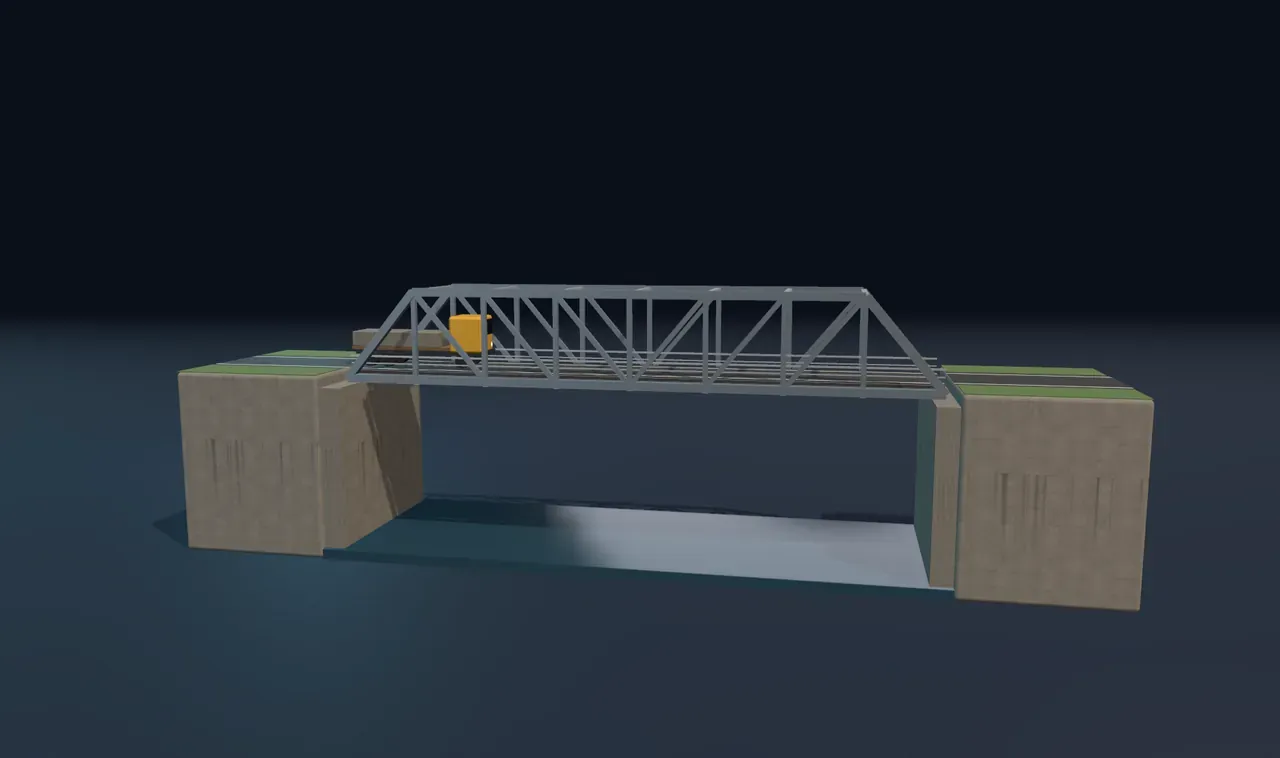
Weight has to reach the ground
Lay a plank across a stream and stand on it. It sags, and if you are heavy enough it snaps. A bridge has the same job as the plank: take the weight of whatever is on it, plus its own weight, sideways through the air to the banks. The banks then push back up with exactly that much force. Engineers call these push-backs the reactions at the supports.
Every piece of a bridge does one of two things while it passes the weight along. It is either squeezed, pushed shorter, which engineers call compression, or stretched, pulled longer, which they call tension. The four classic shapes of bridge differ in which pieces are squeezed, which are stretched, and how much.
The beam: one piece doing both jobs
A beam bridge is the plank made of steel: two deep girders resting on bearings at each bank. As the load bends them, the top edge of each girder gets shorter and the bottom edge longer. The middle of the depth is neither squeezed nor stretched.
Bending is hardest at the middle of the span, so that is where the flanges, the top and bottom plates of the girder, work hardest. This is why steel beams are shaped like a capital I: the metal sits at the top and bottom, where it does the most good, joined by a thin web.
Try it: choose Beam for Bridge, choose On under Show the forces, and watch the top flange turn orange and the bottom one blue as the lorry reaches the middle.
The truss: giving each job its own piece
A truss replaces the solid girder with a frame of triangles. A triangle cannot change shape unless one of its sides changes length, so each bar ends up mostly pushed or pulled along its length rather than bent. Under a load, the top chord along the top is squeezed and the bottom chord, which carries the road here, is stretched, just like the top and bottom of a beam. In this layout, called a Pratt truss, the sloping diagonals pull and most of the uprights push. Because every bar is working along its length, a truss carries the same load as a beam with far less steel.
The arch: everything pushes
An arch curves the structure so that the load runs along it. A rib shaped like a parabola, carrying a road spread evenly along it, is squeezed all along its length and hardly bent at all. Stone and concrete are strong when squeezed and weak when stretched, which is why the oldest surviving bridges are arches.
The price is a sideways push. An arch does not just press down on its banks; it shoves outwards on them, so it needs solid ground or heavy abutments. Look at the green arrows at the arch’s feet: they lean inwards, the banks pushing back. When the lorry is off to one side, the load is no longer even and the rib would bend; here a deep road girder on top takes that bending, so the rib can stay squeezed.
Suspension: everything pulls
A suspension bridge turns the arch upside down. The road hangs from thin steel hangers, which hang from two main cables that sag between towers. A cable can only pull, and steel wire is extremely strong in tension, so suspension bridges make the longest spans in the world.
The cables pull inwards on the tops of the towers, so they continue over them to anchorages buried in the banks, which hold them back. The towers themselves are pushed down into their foundations.
The books always balance
Whatever the shape, the green arrows add up to the weight of the bridge plus the part of the lorry that is on it. As the lorry crosses, the arrow at the nearer bank grows and the far one shrinks, like two people sharing a load on a pole. The steel is also working before the lorry arrives: a bridge spends much of its strength holding itself up.
What this model leaves out
The structure is solved as a flat frame for one side, with the other side taken as identical, and the lorry is centred in the lane. The steel stays elastic: in reality a squeezed slender bar can suddenly bow sideways, buckling, long before the steel itself gives way, and designers spend much of their effort preventing that. The analysis is linear, so a suspension cable does not get stiffer as it tightens; real suspension decks bend less than shown. There is no wind, no bounce from the lorry, no expansion with temperature, and the banks never move.