A bridge hands the lorry's weight on to the banks. Where it is squeezed and where stretched, how hard the supports push, and why an arch pushes the banks out while cables pull them in.
Step 1 of 9 · The truss
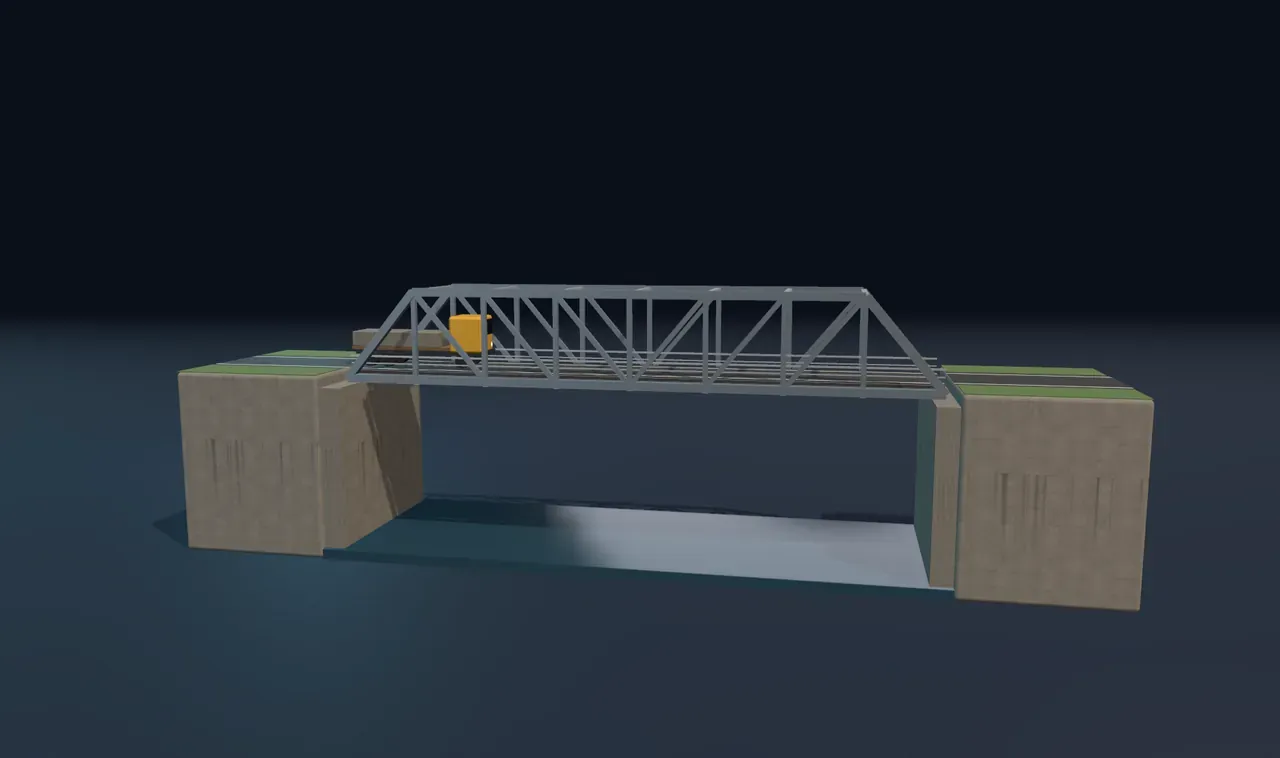
A bridge is at rest when the forces on it add up to zero: for every newton of weight, something pushes back. The only question is how the force travels from the road to the ground. The Scene shows a 40 m steel bridge with a lorry crossing it slowly. You can choose four kinds of Bridge.
Step 1 of 9
The truss
Every part of a bridge is either in compression, pushed along its length, or in tension, pulled along its length. With Show the forces switched On, orange marks compression, blue tension, and a brighter colour a larger stress.
Step 2 of 9
The supports
The bridge does not move, so by Newton’s first law the forces on it balance: the supports push up with exactly all the weight. The Lorry is now fixed at 40 t.
Step 3 of 9
The beam
A beam bridge is two deep steel girders resting on bearings at the two banks. The lorry bends them a little: the movement in the Scene is greatly enlarged, and is really a few centimetres.
Step 4 of 9
The arch
An arch is a structure entirely in compression, so it can even be built of stones, like the Romans’ bridges. The kind is fixed on Truss for now. Predict, and the Scene will then switch to the arch.
Step 5 of 9
The suspension bridge
In a suspension bridge the road hangs from cables, and the cables pass over towers and are anchored in the banks. A cable is the opposite of an arch: it can only be stretched. Predict, and the Scene will then switch to the suspension bridge.
Step 6 of 9
The least steel
A bridge has to carry itself first. The heavier it is, the more of its strength goes on its own weight, and the less is left for the traffic.
Step 7 of 9
All of the weight
Under Show the forces the arrows at the supports show how hard they push up. Back to the Beam bridge, with a 40 t lorry.
Step 8 of 9
The sag
Every bridge sinks a little as a lorry crosses it. The Scene exaggerates the sag so you can see it, but the number it gives is real.
Step 9 of 9
Top and bottom
A girder under load bends a little. Its top is squeezed, and its bottom is stretched.
Loading the interactive version…
Loading the interactive version…
Each step sets up the Scene for you, and a control marked “fixed” stays put for that step.
Practice · Choose
In the Scene’s truss the road hangs from the bottom. Which part is squeezed, pushed along its length?
Practice · Choose
In the Scene’s truss the road hangs from the bottom. Which part is squeezed, pushed along its length?
Practice · Calculate
A 40 t Lorry drives onto the bridge. By how much does the total upward force of the supports on the bridge grow?
Practice · Calculate
A 40 t Lorry drives onto the bridge. By how much does the total upward force of the supports on the bridge grow?
Practice · Choose
In the beam bridge, where are the heavy girders stretched?
Practice · Choose
In the beam bridge, where are the heavy girders stretched?
Practice · Predict, then look
Choose the Arch bridge. Its rib is only squeezed. Which way does the arch push on the banks?
Practice · Predict, then look
Choose the Arch bridge. Its rib is only squeezed. Which way does the arch push on the banks?
Practice · Predict, then look
Now choose the Suspension bridge. The cables pass over the towers and are anchored in the banks. Which way does the bridge act on the banks?
Practice · Predict, then look
Now choose the Suspension bridge. The cables pass over the towers and are anchored in the banks. Which way does the bridge act on the banks?
Practice · Reach the target
All four bridges have the same span and the same road. Choose the Bridge with the smallest weight of its own, and press Check.
Practice · Reach the target
All four bridges have the same span and the same road. Choose the Bridge with the smallest weight of its own, and press Check.
Practice · Calculate
The beam bridge weighs 924,000 N. A 40 t Lorry stands in the middle. With what total force do the supports push the bridge up? Take g = 9.81 m/s².
Practice · Calculate
The beam bridge weighs 924,000 N. A 40 t Lorry stands in the middle. With what total force do the supports push the bridge up? Take g = 9.81 m/s².
Practice · Predict, then look
A 40 t Lorry in the middle of the beam bridge lowers the middle of the road by 6.4 cm. Predict: what will happen to the sag when you choose the Suspension bridge?
Practice · Predict, then look
A 40 t Lorry in the middle of the beam bridge lowers the middle of the road by 6.4 cm. Predict: what will happen to the sag when you choose the Suspension bridge?
Practice · Predict, then look
Bridge: Beam, with Show the forces on. At the bottom of the girders the steel is stretched at a stress of up to 84 MPa. Predict: how hard is it squeezed at the top?
Practice · Predict, then look
Bridge: Beam, with Show the forces on. At the bottom of the girders the steel is stretched at a stress of up to 84 MPa. Predict: how hard is it squeezed at the top?
Lesson complete. Every practice question here is done.