A throw that misses
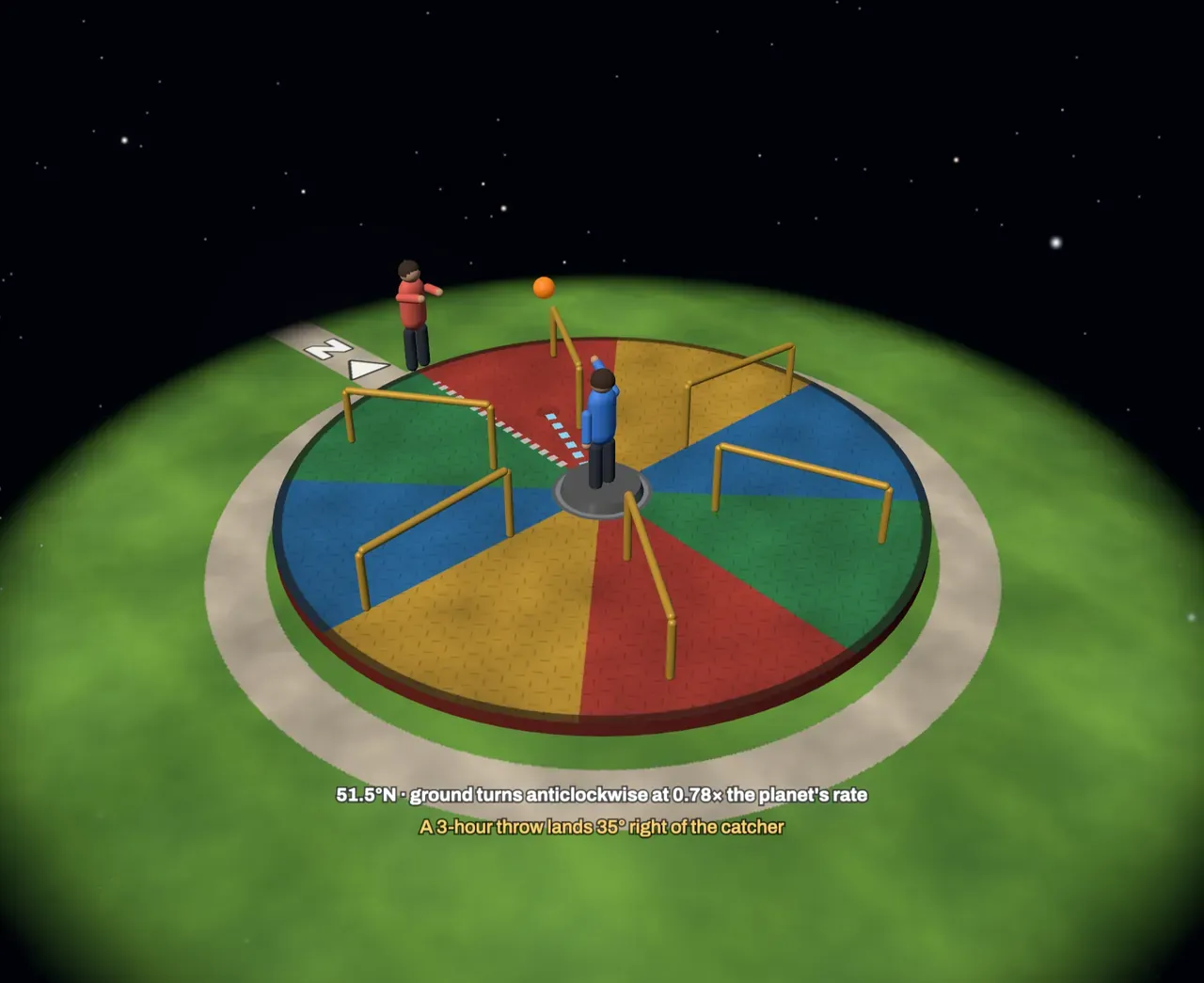
Two children stand on a playground carousel as it turns, one at the middle and one at the rim. The one in the middle throws a ball straight at the other. By the time it arrives, the catcher has been carried round, and the ball sails past. Seen from above, by someone standing still, nothing odd happened: the ball flew in a straight line, and the target moved. Seen by the children, the ball swerved.
That swerve, which appears only to someone turning with the ground, is the Coriolis effect. It is named after Gaspard-Gustave de Coriolis, a French engineer who worked out the mathematics of motion in rotating machinery in 1835. Nothing pushes the ball sideways. The bend comes from describing straight motion from a platform that is turning.
The ground turns under you
The Earth is a carousel too, but a strange one: how much the ground turns depends on where you stand. At the North Pole the ground turns about its own upright exactly as a carousel does, once a day, anticlockwise seen from above. At the equator the ground is carried round the Earth’s axis, but it does not turn about its own upright at all: a line painted north–south stays north–south. In between, the ground turns at the Earth’s rate times the sine of the latitude. In London, at 51.5° north, that is 0.78 of a turn a day. South of the equator the sine is negative and the ground turns the other way, clockwise.
The same rule sets the pace of a Foucault pendulum, whose swing slowly rotates as the floor turns under it: once a day at a pole, about once every 31.8 hours in Paris, and never at the equator.
Try it: with Earth and London, watch the ball land to the right of the catcher. Step Ride along to Riding along and the deck stops turning while the ball’s chalk trace curves. Then pick Equator and Cape Town and watch the bend vanish and then reverse.
Right in the north, left in the south
Throw in any direction and the turn of the ground carries the target the same way round, so the bend is always to the same side of the path: to the right in the northern hemisphere, to the left in the southern. The sideways acceleration a rider would measure is
where is the planet’s spin rate, the speed and the latitude. A faster planet, a faster mover or a place nearer a pole all strengthen it.
On Earth it is tiny over short times. A baseball thrown 60 metres in two seconds in London is pushed sideways by less than a centimetre. It grows with the square of the time in flight, which is why gunners firing over tens of kilometres have to allow for it, and why it shapes anything that keeps moving for hours or days. The scene lets each throw coast for three hours, long enough for the ground to turn by a few tens of degrees. Air is the obvious thing that does that.
Trade winds and spinning storms
Near the equator, warm air rises, spreads toward the poles high up, sinks again around 30 degrees north and south, and flows back toward the equator along the surface. If the Earth did not spin, that return flow would blow straight from north and south. Instead it bends: to the right in the north, so it arrives from the north-east, and to the left in the south, so it arrives from the south-east. These steady easterlies are the trade winds that carried sailing ships across the Atlantic.
A storm is a patch of low pressure that pulls air in from all sides. Each stream of air is bent to the right in the north, so it misses the centre and swings round it anticlockwise. In the south the bend is to the left and storms turn clockwise. Close to the equator the turn of the ground is too weak to start the spin, which is why hurricanes and typhoons almost never form within about 5 degrees of it.
Try it: step Ride along to Winds and storms, then drag Rotation rate from No spin to Jupiter. Jupiter turns in under ten hours, and its winds are drawn into bands and long-lived storms.
The famous claim that sinks drain one way in each hemisphere is not true in everyday life. Water leaves a basin in seconds, over centimetres, and the Coriolis effect is far too weak to beat the swirl left over from filling it or the shape of the plughole.
A force that is not there
Seen from the stars, no sideways force acts on the ball or the wind; they keep going straight while the ground turns. Someone who measures everything relative to the ground, as weather forecasters and engineers do, has to add a sideways push to make their equations come out right. That push is called the Coriolis force. It is real in the sense that it predicts exactly what you see from a turning platform, and imaginary in the sense that nothing is doing the pushing.
What this model leaves out
The scene treats the ground at one latitude as a flat carousel turning at the planet’s rate times the sine of the latitude, and lets the ball fly straight as seen from the sky. Over a real carousel a ball also drifts outward from the middle. Over a real planet the Earth’s slight bulge at the equator cancels that drift, so a long coast curls into a loop instead of spiralling out. At 45 degrees a parcel of air left to coast would go round a full loop in about 17 hours. For a few hours the two pictures bend at the same rate, and in the simplest version of the planet’s model the ball lands in the same direction, slightly closer in.
Time is sped up, so a planet day takes 32 seconds. The carousel, the storm and the trade-wind belt are drawn far larger than real, and their angles are illustrative: real trade winds and storms are also shaped by pressure, friction with the surface and heat. The model shows only sideways bending; a small vertical part of the effect, which makes things moving east very slightly lighter, is left out. In the planet view the globe is drawn as the riders see it, still, with an arrow showing how it turns against the stars.