Throw a ball straight across a turning carousel and it misses. On the Earth the ground turns about its upright at a rate set by the latitude, which bends winds and spins storms: right in the north, left in the south, and not at all at the equator.
Step 1 of 8 · A throw that misses
Step 1 of 8
A throw that misses
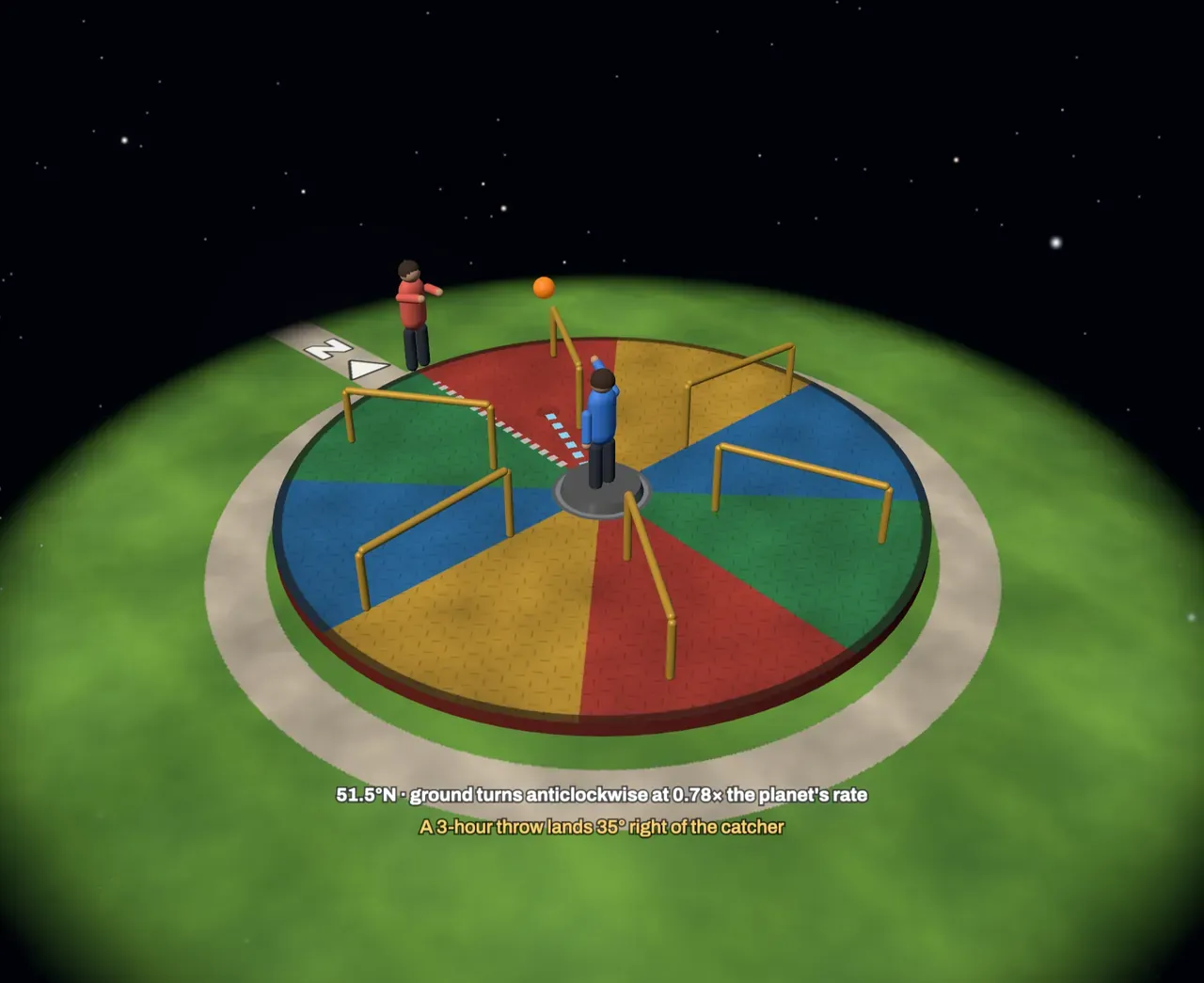
Two children stand on a turning carousel, one at the middle and one at the rim. The one in the middle throws a ball straight at the other. In the Unit on circular motion we saw that a body keeps going in a straight line unless a force turns it. In the Scene the carousel stands for the ground at one Latitude of a spinning planet, and each throw stands for hours of planet time. No motor drives the carousel: it turns because the planet beneath it does.
Step 2 of 8
Right in the north, left in the south
Ride along is at Riding along: the camera turns with the ground. The carousel seems to stand still, and the ball’s chalk trace curves. This is the Coriolis effect: a bend seen only by someone turning with the ground. In London, at 51.5° north, the ball lands to the right of the catcher.
Step 3 of 8
The sine of the latitude
At the North Pole the ground turns about its own upright just like a carousel, a full turn a day, anticlockwise seen from above. At the equator the ground is carried round the Earth’s axis but does not turn about its own upright at all: a line painted on it north–south stays north–south. In between, the ground turns at the Earth’s rate times the sine of the latitude, :
Here is the number of turns a day. The Latitude and Rotation rate are locked, and the label that prints the bend has been hidden.
Step 4 of 8
Finding a latitude
The ball lands as far round from the catcher as the angle the ground turned during the flight. At a pole, on a 3-hour throw, that is an eighth of a turn, 45°. The Latitude is now at the Equator, where the ball lands in the catcher’s hands.
Step 5 of 8
Foucault’s pendulum
In 1851 Léon Foucault hung a heavy pendulum from the dome of the Panthéon in Paris. Its plane of swing stayed fixed relative to the stars, and the floor turned beneath it, so the pendulum seemed to turn slowly. It is the same turning ground and the same rule: the Earth’s rate times . The label in the Scene shows that rate in Jerusalem.
Step 6 of 8
Spinning storms
Step Ride along to Winds and storms: the carousel draws back until it is a speck on a globe. A storm is a patch of low pressure that draws air in from all sides. Each stream of air is bent to the right in the north, misses the centre and swings round it anticlockwise; in the south it is bent to the left, and storms turn clockwise. The same bend turns the air flowing towards the equator into the trade winds, which blow from the north-east and the south-east.
Step 7 of 8
The sink myth
The Coriolis effect is very weak over short times: a baseball thrown 60 m in two seconds moves sideways by less than a centimetre. It grows with the square of the time in flight, so it matters for anything that keeps moving for hours and days.
Step 8 of 8
On Jupiter
Jupiter spins two and a half times as fast as the Earth, so its winds curve far more: they are drawn out into bands along the latitudes, and its storms turn for centuries.
Loading the interactive version…
Loading the interactive version…
Each step sets up the Scene for you, and a control marked “fixed” stays put for that step.
Practice · Choose
From the sky, Earth, London. The ball is thrown from the middle of the carousel to the catcher at the rim. What is its path, seen from above?
Practice · Choose
From the sky, Earth, London. The ball is thrown from the middle of the carousel to the catcher at the rim. What is its path, seen from above?
Practice · Predict, then look
Riding along: in London the ball curves and lands to the right of the catcher. Choose Cape Town, at 34° south, under Latitude. Where will the ball land?
Practice · Predict, then look
Riding along: in London the ball curves and lands to the right of the catcher. Choose Cape Town, at 34° south, under Latitude. Where will the ball land?
Practice · Calculate
The Latitude is locked at 30° north, and the Rotation rate at Earth, one turn a day. The label that prints the bend has been hidden. Each throw lasts hours. By how many degrees does the ground turn under the ball during the throw, that is, how far round from the catcher does it land?
Practice · Reach the target
The Rotation rate is locked at Earth. Find a latitude in the northern hemisphere where a 3-hour throw lands 30° to the right of the catcher, and press Check.
Practice · Reach the target
The Rotation rate is locked at Earth. Find a latitude in the northern hemisphere where a 3-hour throw lands 30° to the right of the catcher, and press Check.
Practice · Calculate
A Foucault pendulum swings in a plane fixed in space, and the floor turns beneath it. The Latitude is locked at 31.8° north, Jerusalem. How many hours does the floor take to turn once under the pendulum?
Practice · Calculate
A Foucault pendulum swings in a plane fixed in space, and the floor turns beneath it. The Latitude is locked at 31.8° north, Jerusalem. How many hours does the floor take to turn once under the pendulum?
Practice · Choose
Step Ride along to Winds and storms. Hurricanes almost never form within about 5° of the equator, even though the sea there is very warm. Why?
Practice · Choose
Step Ride along to Winds and storms. Hurricanes almost never form within about 5° of the equator, even though the sea there is very warm. Why?
Practice · Choose
It is said that water drains from a sink one way in the north and the other way in the south, because of the Coriolis effect. What is true?
Practice · Choose
It is said that water drains from a sink one way in the north and the other way in the south, because of the Coriolis effect. What is true?
Practice · Calculate
The Rotation rate is locked at Jupiter, 2.42 turns per Earth day, and the Latitude at 30° north. How many turns a day does the ground there make about its own upright?
Practice · Calculate
The Rotation rate is locked at Jupiter, 2.42 turns per Earth day, and the Latitude at 30° north. How many turns a day does the ground there make about its own upright?
Lesson complete. Every practice question here is done.