A layer of gas that would be a few millimetres thick if squeezed down shields life from ultraviolet light. Measure how thin it is, see how ozone absorbs light without running out, and how chlorine, a catalyst, tore a hole in it over Antarctica every spring.
Step 1 of 7 · A thin shield
Step 1 of 7
A thin shield
Most of the oxygen in the air is two atoms joined together, . High above the weather, in the stratosphere, a small share of it comes in threes: ozone, . Even where it is densest, about 20–25 km up, only a few molecules in every million are ozone. The amount of ozone above each place is measured in Dobson units.
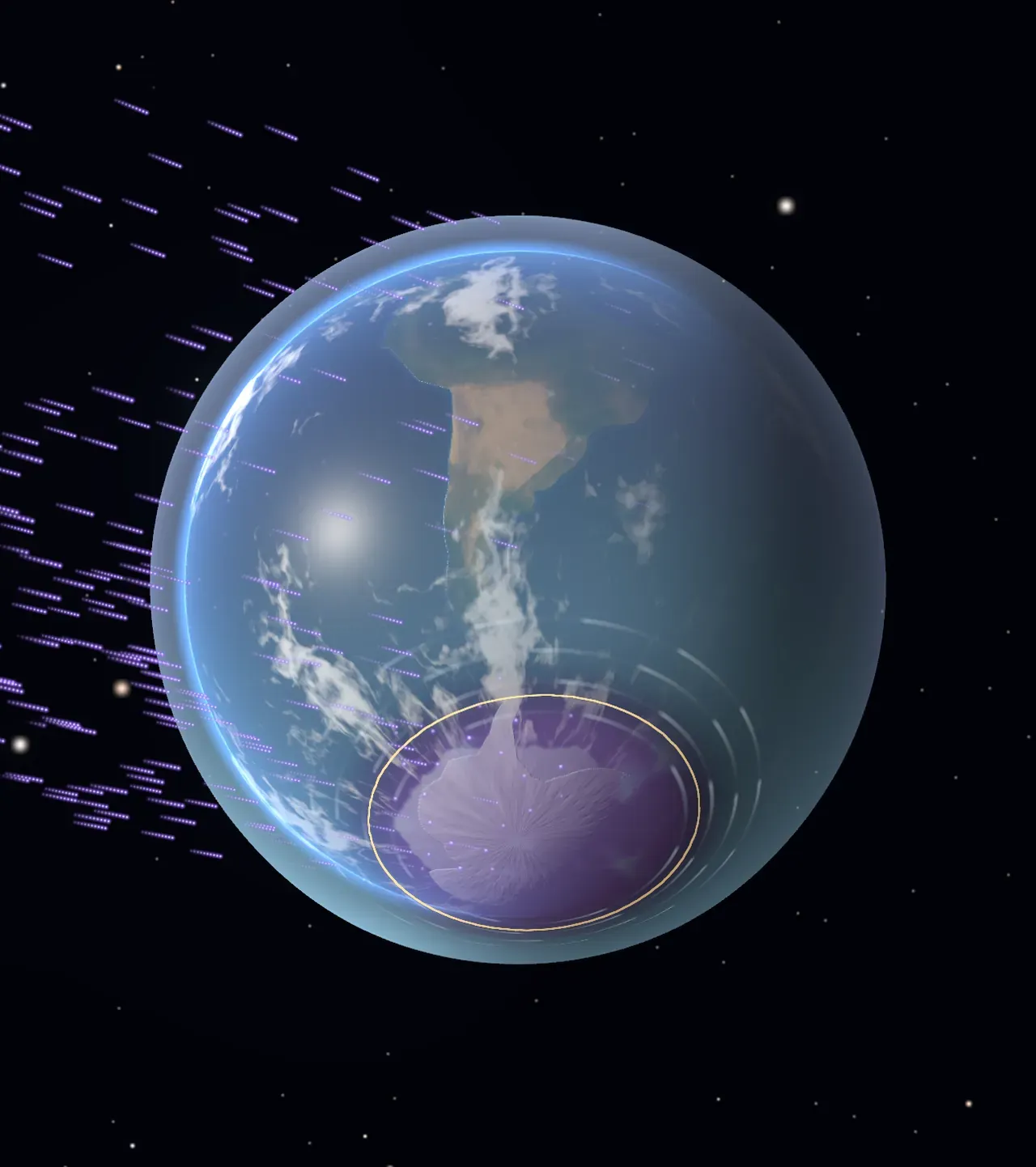
In the Scene the glowing shell round the Earth is the ozone layer: higher and brighter where there is more ozone overhead. The amber line circles where there are fewer than units. It is Before CFCs, in December.
Step 2 of 7
What ozone stops
Sunlight carries ultraviolet light, at wavelengths shorter than the violet the eye can see. The shortest, UV-C, can break apart the molecules of living cells. Ozone absorbs all of it and most of the UV-B, the light that causes sunburn and skin cancer. The longer UV-A passes almost untouched. Because the shield is so thin, even a little ozone matters: each 1% of ozone lost lets in roughly 1.2% more sunburning light.
Step 3 of 7
Polar spring
In the polar night a ring of strong west winds, the polar vortex, walls off the air over Antarctica, and it grows colder than −78 °C. Thin clouds of ice form in the stratosphere, polar stratospheric clouds. On the surface of their particles the chlorine, carried there by CFCs, is freed from its harmless forms into gas.
Step 4 of 7
How much chlorine it takes
Before CFCs the chlorine in the stratosphere, mostly from gases given off by the sea and by burning plants, was about 0.6 ppb, parts per billion. Man-made gases raised it to about 2.5 ppb by 1980, and to a peak near 3.7 ppb in the late 1990s. The Month is locked at October, in the Antarctic spring.
Step 5 of 7
A catalyst
Choose Molecules under Zoom to the molecules. A parcel of air over Antarctica opens beside the globe, and in it the chlorine can be seen at work, one step at a time.
Step 6 of 7
Fixing it
In 1987 the world agreed the Montreal Protocol, which phased out the production of CFCs. It was the first United Nations treaty ratified by every country. CFCs stay in the air for decades, so the chlorine is falling slowly, and the hole is expected to shrink back to its 1980 size around the 2060s. It is now Peak, late 1990s.
Step 7 of 7
A hole the size of a continent
The hole is measured by area: how much of the sky over the South Pole has a column of less than Dobson units of ozone.
Loading the interactive version…
Loading the interactive version…
Each step sets up the Scene for you, and a control marked “fixed” stays put for that step.
Practice · Calculate
Before CFCs, in December. One Dobson unit is a thickness of 0.01 mm of ozone squeezed to sea-level pressure. The thinnest ozone column anywhere on the globe this month is about Dobson units. How thick would that column be, squeezed like that?
Practice · Calculate
Before CFCs, in December. One Dobson unit is a thickness of 0.01 mm of ozone squeezed to sea-level pressure. The thinnest ozone column anywhere on the globe this month is about Dobson units. How thick would that column be, squeezed like that?
Practice · Choose
Choose Molecules under Zoom to the molecules. An ultraviolet photon hits an ozone molecule, and it splits with an orange flash. What happens next?
Practice · Choose
Choose Molecules under Zoom to the molecules. An ultraviolet photon hits an ozone molecule, and it splits with an orange flash. What happens next?
Practice · Predict, then look
Today, in June: polar night over Antarctica, and icy clouds have already freed the chlorine. But there is no hole. Choose October under Month. What will happen to the ozone over the pole?
Practice · Predict, then look
Today, in June: polar night over Antarctica, and icy clouds have already freed the chlorine. But there is no hole. Choose October under Month. What will happen to the ozone over the pole?
Practice · Reach the target
Month: October. The ozone hole is defined as everywhere the column falls below Dobson units. Raise the Chlorine in the stratosphere from its natural level until the hole just begins to open, and press Check.
Practice · Reach the target
Month: October. The ozone hole is defined as everywhere the column falls below Dobson units. Raise the Chlorine in the stratosphere from its natural level until the hole just begins to open, and press Check.
Practice · Choose
October, Molecules. In the parcel of air a chlorine atom takes an atom from an ozone molecule, becomes , and loses it again. Why are a few parts per billion of chlorine enough to destroy much of the ozone?
Practice · Choose
October, Molecules. In the parcel of air a chlorine atom takes an atom from an ozone molecule, becomes , and loses it again. Why are a few parts per billion of chlorine enough to destroy much of the ozone?
Practice · Choose
The Montreal Protocol banned CFCs in 1987, and the chlorine in the stratosphere has been falling slowly since the late 1990s. Is the ozone hole what causes global warming?
Practice · Choose
The Montreal Protocol banned CFCs in 1987, and the chlorine in the stratosphere has been falling slowly since the late 1990s. Is the ozone hole what causes global warming?
Practice · Reach the target
Month: October. Antarctica covers about 14.2 million km². Raise the Chlorine in the stratosphere until the ozone hole, everywhere the column falls below Dobson units, is as big as the whole continent. Press Check.
Practice · Reach the target
Month: October. Antarctica covers about 14.2 million km². Raise the Chlorine in the stratosphere until the ozone hole, everywhere the column falls below Dobson units, is as big as the whole continent. Press Check.
Lesson complete. Every practice question here is done.