A shield of rare molecules
Most of the oxygen in the air is two atoms joined together, O₂. High above the weather, in the stratosphere, a small share of it comes in threes: ozone, O₃. There is never much. Even where it is densest, about 20 to 25 km up, only a few molecules in every million are ozone. If you could bring all the ozone above your head down to the ground and squeeze it to sea-level pressure, it would make a layer only about 3 mm thick.
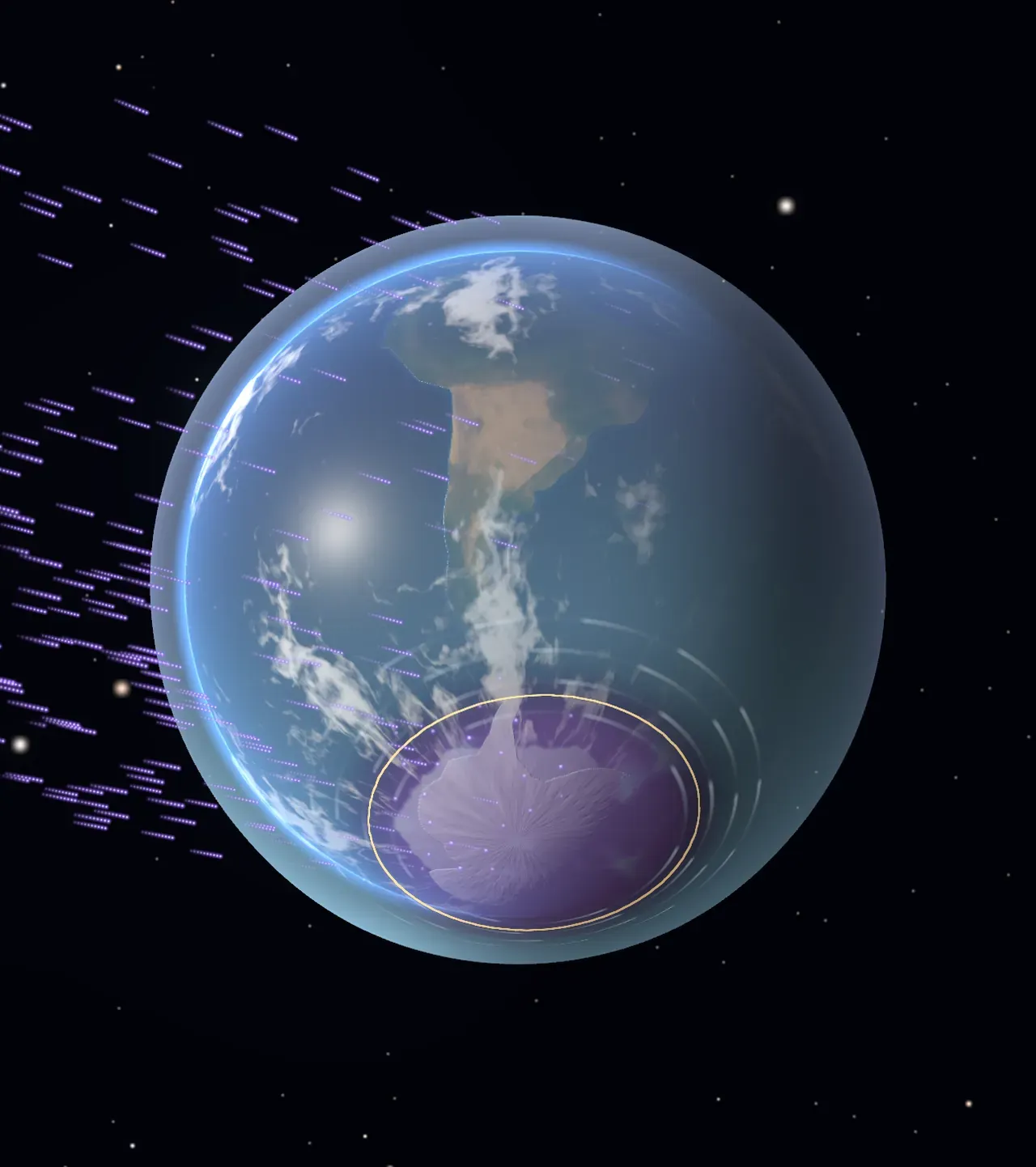
Scientists measure ozone in exactly that way. One Dobson unit (DU) is a hundredth of a millimetre of that squeezed layer, so a typical column of 300 DU is 3 mm. The Scene’s glowing shell stands for it: higher and brighter where there is more ozone overhead, lower and fainter where there is less. It is thinnest over the tropics, about 260 DU, and thickest over high latitudes in their spring, where winds high in the stratosphere pile up ozone made over the equator.
Try it: pick December under Month and look around the globe. The shell is lowest over the equator and swells towards high latitudes, with a thick collar round Antarctica.
What ozone stops
Sunlight carries ultraviolet light, with wavelengths shorter than the violet the eye can see. The shortest, UV-C, can break apart the molecules that make up living cells. Ordinary oxygen stops the shortest of it high up, and in doing so makes ozone: a UV-C photon splits an O₂ into two oxygen atoms, and each atom joins another O₂ to form O₃.
Ozone then absorbs ultraviolet over a wider band, all the rest of the UV-C and most of the UV-B, the light that causes sunburn, skin cancer and cataracts and harms crops and plankton. Each time it does, the molecule breaks into O₂ and a loose oxygen atom, and the two soon join again. Nothing is used up; the light’s energy is left behind as heat, which is what warms the stratosphere. The longer UV-A passes through ozone almost untouched.
Try it: choose Molecules under Zoom to the molecules. A parcel of air over Antarctica opens beside the globe. Violet photons come in from the Sun’s side; an ozone molecule they hit splits with an orange flash of heat and soon re-forms.
Because the shield is so thin, a little ozone makes a real difference. Each 1% less ozone lets through roughly 1.2% more sunburning ultraviolet.
Chlorine, a catalyst
Around 1930 chemists invented the chlorofluorocarbons, CFCs: molecules of carbon, chlorine and fluorine that do not burn, are not poisonous and react with almost nothing. They became the gas in fridges and air conditioners, the push in spray cans and the bubbles in foam. Being so unreactive, they do not rain out or break down in the lower air. Over years they drift up into the stratosphere, where hard ultraviolet finally breaks them apart and frees their chlorine.
A free chlorine atom is a catalyst for destroying ozone. It pulls one atom off an ozone molecule, leaving O₂ and chlorine monoxide, ClO. Then the ClO loses its oxygen atom again, in the open stratosphere to a loose oxygen atom, and the chlorine atom is free once more, unchanged. Each loop turns ozone and oxygen atoms into ordinary O₂. One chlorine atom can run the loop many thousands of times before it ends up in a harmless molecule such as hydrogen chloride.
In 1974 Mario Molina and Sherwood Rowland worked out that CFCs would carry chlorine to the ozone layer this way and slowly thin it. They shared a Nobel Prize for it in 1995 with Paul Crutzen, who had shown that nitrogen oxides can do the same.
Why a hole, and why over Antarctica
The real shock came in 1985, when Joe Farman, Brian Gardiner and Jonathan Shanklin of the British Antarctic Survey reported that the ozone over their station at Halley had been falling each October for years, by a third. That was far faster than anyone had predicted. Satellites soon showed the thinning covered the whole continent. It was called the ozone hole, and is now defined as everywhere the column falls below 220 DU.
The cause is the Antarctic winter. In the polar night, a ring of strong west winds, the polar vortex, walls the air over the continent off from the rest of the world, and it grows colder than anywhere else in the atmosphere, below −78 °C. Then thin clouds of ice and frozen nitric acid form in the stratosphere: polar stratospheric clouds, which glow mother-of-pearl in the twilight. On the surface of their particles, the chlorine’s harmless forms react with each other and turn into chlorine gas, Cl₂.
In the dark, Cl₂ just waits. When the Sun returns in late August and September, its light splits the Cl₂ into chlorine atoms, and with so much of it freed at once, the chain runs fast. Up here there are too few loose oxygen atoms, so two ClO molecules join into ClOOCl, and sunlight breaks that apart again into two chlorine atoms and an O₂. Within a few weeks almost all the ozone between about 14 and 21 km is gone. In November or December the vortex breaks up, ozone-rich air from lower latitudes floods in, and the hole closes until the next spring.
Try it: step the Month from June to December. In June the pole sits in darkness under pearly clouds and nothing happens yet. In September and October the shell caves in inside the amber line, and the chart’s line drops; in December it is gone. Choose Molecules under Zoom to the molecules in June, then in October, to see chlorine waiting by the ice and then at work.
The Arctic has a vortex too, but it is warmer and more often disturbed by winds from the south, so it seldom gets cold enough for long enough. In most years its ozone loss is far smaller; only in unusually cold springs, such as 2011 and 2020, has it come close to an Antarctic hole.
How much chlorine it takes
Before CFCs, natural chlorine in the stratosphere, mostly from methyl chloride given off by the sea and by burning plants, was about 0.6 parts per billion. It is too little to open a hole even when the clouds free it. Man-made gases brought it to about 2.5 ppb by 1980, just when the hole began to show, and to a peak near 3.7 ppb in the late 1990s.
Try it: choose Before CFCs, then 1980, then Peak, late 1990s under Chlorine in the stratosphere, with the Month at October. The hole deepens from nothing, and the chart’s foot shows the sunburning ultraviolet under it rising to several times its natural level.
The hole cannot grow much past the edge of the vortex, so beyond a point more chlorine mainly makes it deeper. Elsewhere the loss is slow but adds up: at the peak, the ozone between 60° S and 60° N was a few per cent thinner than before.
Fixing it
In 1987 the world agreed the Montreal Protocol to phase out CFCs, later tightened to ban almost every gas that carries chlorine or bromine to the stratosphere. It was the first United Nations treaty ratified by every country. Chlorine stopped rising in the late 1990s and is falling slowly, because CFCs last for decades in the air. The Antarctic hole is expected to shrink back to its 1980 size around the 2060s, and ozone elsewhere to recover sooner.
Try it: choose No ban (what if). It is a rough stand-in for where chlorine was heading had nothing been done: the hole goes deep, and the ozone everywhere else thins by several times as much as it ever did.
The fix had a second benefit. CFCs are also powerful greenhouse gases, so the ban has slowed climate change too. Some of their replacements, the HFCs, contain no chlorine and do not harm ozone, but trap heat strongly; a 2016 amendment, agreed at Kigali, phases them down as well.
What this model leaves out
- Weather and years. The ozone comes from a smooth model fitted to measured averages: every October looks the same. Real holes differ from year to year with the winds and the cold, and the hole drifts and stretches off the pole.
- Bromine. Halons from fire extinguishers and methyl bromide from farming carry bromine, which destroys ozone far more strongly per atom than chlorine. Scientists fold it into an effective chlorine figure; the Scene’s chlorine leaves it out.
- Height. The shell shows the total ozone above each place, not how it is spread with height. In the hole, it is the lower stratosphere, 14 to 21 km, that empties.
- The parcel. Molecules are drawn as balls, wildly outnumbering their real share: real air holds about 100 000 oxygen molecules for each ozone molecule. The chain is drawn one step at a time and slowed down, and each oxygen molecule split by the shortest ultraviolet, which makes new ozone, is left out.
- The ground. The violet glows show where more ultraviolet arrives, not how much. Clouds, the height of the Sun and snow, which reflects ultraviolet, all change what reaches a person on the ground.