Four layers, told apart by temperature
Climb a mountain and the air gets colder, about 6.5 °C for every kilometre on average. At the 11 km where airliners cruise, it is around −56 °C. It would be natural to guess that it keeps getting colder all the way to space. It does not. Above about 11 km the temperature stops falling, then rises again, to about 0 °C some 50 km up. Higher still it falls to the coldest air on Earth, near −90 °C, and above that it climbs to hundreds of degrees.
Each of those four stretches is a layer of the atmosphere, and the layers are named for which way the temperature goes. The troposphere (cooling with height), the stratosphere (warming), the mesosphere (cooling) and the thermosphere (warming fast). The boundary at the top of each is a “pause”: the tropopause, the stratopause and the mesopause.
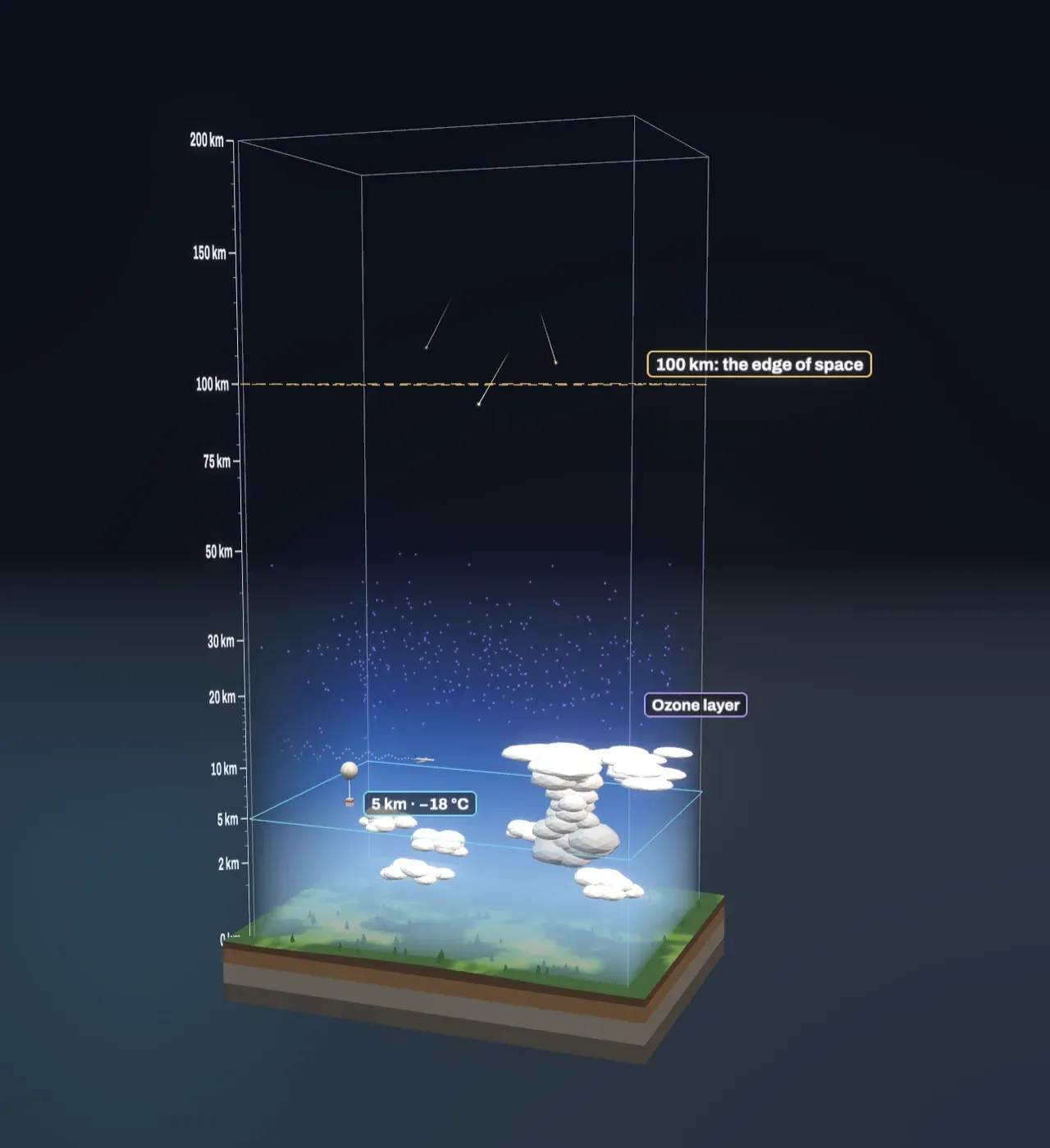
The Scene is a column of air standing on a patch of ground, 200 km tall. A probe rides up it, a weather balloon in the lower part and a sounding rocket higher up, and reads the temperature wherever you send it.
Try it: raise the Altitude slowly from the ground and watch the probe’s temperature. It falls to −56.5 °C at 11 km, stays put, and starts to climb again above 20 km.
Why the layers are warm or cold
The atmosphere is not warmed evenly. Sunlight passes through most of it untouched and is absorbed in three places: at the ground, in the ozone layer and in the thin gas at the very top. The air is warm where sunlight is caught and turned into heat, and colder in between.
Try it: slide Show the temperature towards Temperature. A colour sweeps up the column, blue for cold air and orange to red for warm, and the chart beside the Scene draws the temperature line as it goes. Trains of dots fall in from the top: yellow visible light reaching the ground, violet ultraviolet stopping in the ozone layer, pale extreme ultraviolet stopping above 100 km. Each flashes orange where it is absorbed.
The troposphere: heated from below
Air is almost transparent to visible light, so most of the sunlight that is not reflected goes straight through the troposphere and warms the ground and the sea. They warm the air touching them, and that air rises. Rising air moves into lower pressure, expands, and cools as it pushes the air around it aside. That is why mountain tops are cold even though they are nearer the Sun.
The troposphere is where almost all the weather happens. Warm air rises, cools until its water vapour condenses into cloud and falls back as rain, as on the water cycle coast. It also holds most of the air: half of all the atmosphere lies below about 5.5 km, and nearly four fifths below 11 km.
At the tropopause the cooling stops. Warmer air sitting on top acts like a lid: a rising bubble of air soon finds itself colder and heavier than its surroundings and goes no further. The Scene’s storm cloud shows it. Its tower climbs to the tropopause and spreads out sideways into a flat anvil.
Higher over the tropics, lower near the poles
The tropopause is not at one height. Over the tropics the ground is hot and storms carry air high, so the troposphere is about 16 to 17 km deep. Near the poles it is only about 8 to 9 km. And because the air over the tropics keeps cooling for so much longer on its way up, the tropical tropopause is the coldest of all, around −80 °C, colder than over the poles.
Try it: choose Tropics, then Polar, under Latitude. Watch the storm cloud’s anvil and the tropopause ring move. Then choose Airliner under Altitude: at 10.5 km the plane is deep in the troposphere over the tropics, but in the stratosphere near the poles.
The stratosphere: heated by ozone
Above the tropopause the air warms with height, and the reason is ozone. Ozone is a form of oxygen with three atoms to a molecule instead of two. There is very little of it, never more than about ten in every million molecules of air, and it is densest about 20 to 25 km up. But it absorbs ultraviolet light strongly, and each bit of ultraviolet it catches ends up as heat in the air around it.
The warmest part of the stratosphere is its top, near 50 km, even though ozone is densest lower down. Higher up there is less air for the absorbed energy to heat, so each kilogram of it warms more, and the ultraviolet that ozone absorbs most readily is caught near the top before it can get deeper. The same ultraviolet would damage living cells if it reached the ground; the ozone layer has its own story of how it forms and how it was nearly lost.
Warm air lying over cooler air does not overturn, so the stratosphere is calm and layered, and it is very dry: water vapour freezes out in the cold tropopause on its way up. Long-haul flights over the poles often cruise in it.
The mesosphere: the coldest air on Earth
Above the stratopause the ozone thins out and nothing else absorbs much sunlight, while carbon dioxide keeps radiating heat away to space. The temperature falls again, to about −90 °C near 85 km. In polar summers it gets colder still, and thin, silvery noctilucent clouds of ice can form there, the highest clouds on Earth.
The mesosphere is also where most meteors burn up. Grains of rock and dust arrive from space at tens of kilometres a second, and between about 100 and 80 km the air, thin as it is, is enough to heat them until they glow and vaporise.
Try it: choose Meteors under Altitude. The probe reads about −84 °C, and the meteor streaks around it end as they burn out.
The thermosphere: hot, but it would feel cold
Above the mesopause the gas is very thin: at 100 km a molecule travels over ten centimetres between collisions, at 200 km a few hundred metres. Here it absorbs the Sun’s most energetic light, extreme ultraviolet and X-rays, which no layer above can stop. With so few molecules to share the energy, each one ends up moving very fast: the temperature rises to hundreds of degrees, about 580 °C at 200 km in the Scene, and higher up from about 400 °C when the Sun is quiet to well over 1,000 °C when it is active. The same light knocks electrons off atoms, making the electrically charged ionosphere that reflects radio waves.
Yet you would not feel hot there. Temperature measures how fast the molecules move, but so few would hit you that your skin would gain far less heat than it radiated away. A thermometer in the shade would read far below freezing.
By convention, space begins at the Kármán line, 100 km up. The auroras glow above it, between about 100 and 300 km, and the International Space Station orbits at about 400 km, still inside the thermosphere, where its faint drag slowly pulls the station down.
Try it: choose Polar under Latitude to stand under the auroral oval, and raise the Altitude above 100 km.
Thinner all the way up
Whatever the temperature does, the air thins steadily. The pressure at any height is the weight of all the air above it, so it falls with every step up, halving about every 5.5 km. Above 50 km lies less than a thousandth of the atmosphere, and at 100 km the pressure is about a three-millionth of that at the ground.
You can see it in the weather balloon. Its gas expands as the pressure around it falls, so it swells as it rises, to about four times its launch width by 30 km. Real balloons burst somewhere above 30 km; above 34 km the Scene’s probe becomes a rocket.
Try it: raise the Altitude from 0 to 34 km and watch the balloon grow, while the chart’s readout shows how much of the air is below it.
The way the layers are heated also explains a less obvious sign of climate change. More carbon dioxide traps heat in the troposphere, warming it. But in the stratosphere and above, the same gas mainly radiates heat away to space, so those layers are cooling as it builds up.
What this model leaves out
- Seasons and weather. The column is a yearly average. Real temperatures swing with the seasons, with the weather and from day to night; the winter stratosphere over the poles is far colder, and the polar summer mesopause dips to about −130 °C.
- Latitude higher up. Only the troposphere, the tropopause and the lowest stratosphere change with latitude here; above 27 km every latitude follows the same middle-latitude profile.
- The Sun’s activity. The thermosphere’s temperature is fixed at a middle level. When the Sun is active it can be hundreds of degrees hotter and the thermosphere swells.
- The scale. Heights are on a square-root scale: the troposphere, a twentieth of the column’s height, gets a quarter of it. The clouds, plane, probe, meteors and ozone dots are drawn far larger than life, and the ozone dots stand for a gas that cannot be seen.
- The sunlight. The trains of dots show only where each kind of light is absorbed, not how much energy each layer gains. Infrared heat flowing up from the ground and out to space, which shapes the troposphere and mesosphere too, is not drawn.
- The top. The thermosphere goes on up to somewhere between 500 and 1,000 km, depending on the Sun, and the exosphere, where the last atoms drift off into space, beyond that.