Rise through the air from the ground to 200 km: it cools, warms, cools again and turns hot. Measure how fast it cools, find where half the air lies, and see why each layer is warm or cold.
Step 1 of 6 · Not colder all the way up
Step 1 of 6
Not colder all the way up
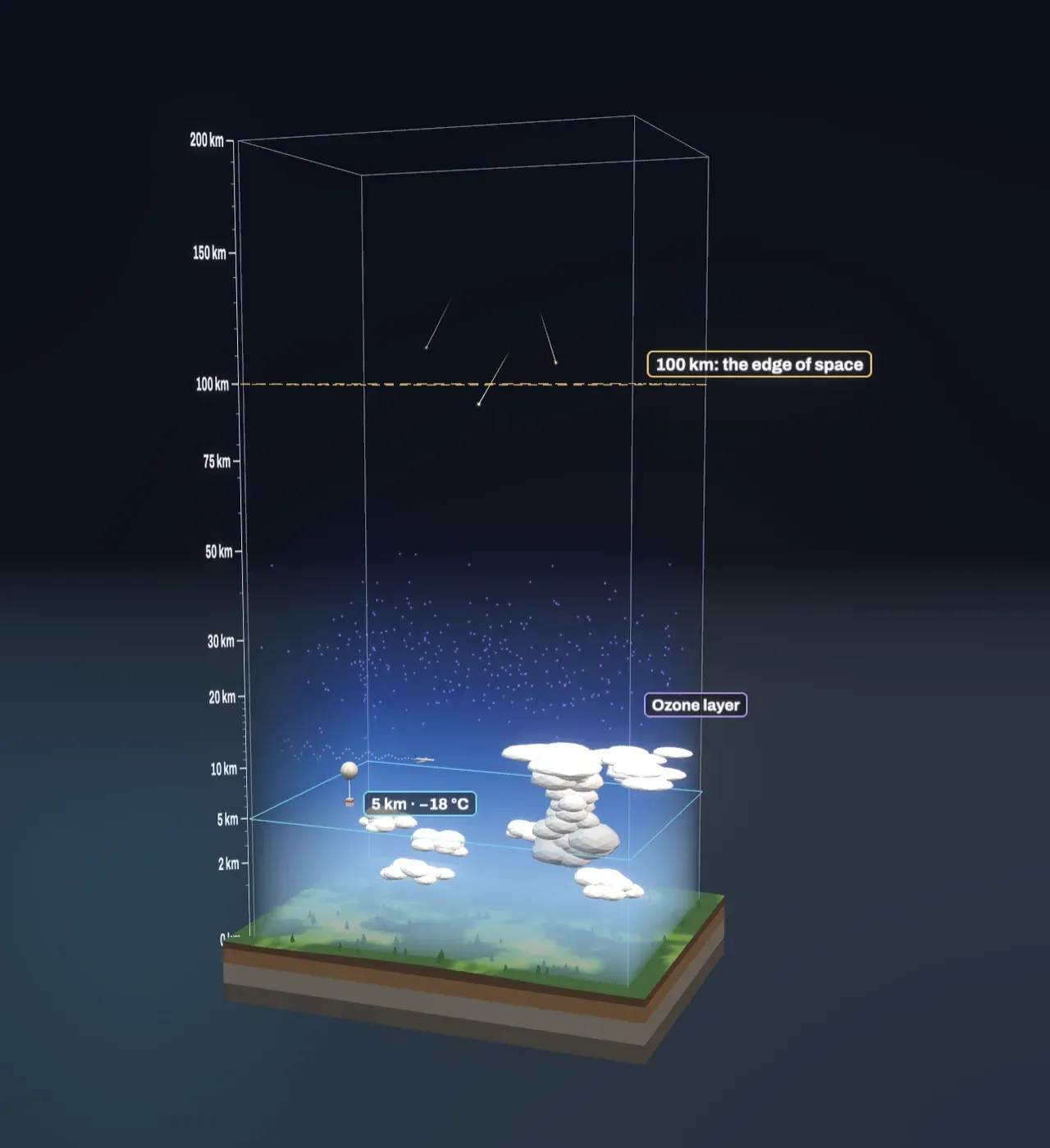
Anyone who climbs a mountain feels the air get colder. It is easy to guess that it keeps getting colder all the way to space. The Scene is a column of air standing on a patch of ground, from the ground to 200 km, with heights on a square-root scale so that the thin layer where the weather happens gets room. A probe, a weather balloon low down and a sounding rocket higher up, rides up with the Altitude and reads the temperature.
The probe is at 11 km, the height where airliners fly. Predict what will happen as it keeps rising.
Step 2 of 6
How fast the air cools
The lowest layer, where we live, is the troposphere. It is heated from below: air is almost fully transparent to visible light, so sunlight passes through it and warms the ground and the sea, and they warm the air touching them. Rising air moves into lower pressure, expands and cools.
The rate at which the temperature falls with height is called the lapse rate. The Latitude is locked at 45°, the middle latitudes. Move the Altitude between 0 and 5 km and read the probe.
Step 3 of 6
Where the air is
The pressure at any height is the weight of all the air above it. The higher you go, the less air there is above, so the pressure falls and the probe’s balloon swells. From the pressure you can tell what share of the atmosphere’s mass lies below the probe: if the pressure has fallen to half that at the ground, half the air is below.
The conventional edge of space, the Kármán line, is at 100 km. Find the height below which half of all the air lies.
Step 4 of 6
High over the tropics, low near the poles
At the top of the troposphere the cooling stops: this is the tropopause. It is not at the same height everywhere. The Latitude is at Tropics, and the Altitude is locked at 10.5 km, Airliner. Watch the tropopause ring and the storm cloud’s anvil, which spreads out under it.
Step 5 of 6
A layer that warms
Above the tropopause begins the stratosphere, where the air warms with height, to about 0 °C at 50 km. Show the temperature is at Temperature: a colour sweeps up the column, blue for cold air and orange to red for warm, and trains of dots fall from the top showing where each kind of sunlight is absorbed. Yellow, visible light, reaches the ground; violet, ultraviolet, stops in the ozone layer; pale, extreme ultraviolet, stops above 100 km.
Above the stratosphere, in the mesosphere, the air cools again, to about −90 °C near 85 km, where most meteors burn up.
Step 6 of 6
Hot, but it feels cold
Above 85 km begins the thermosphere. The gas there is very thin, and it absorbs the Sun’s harshest light, extreme ultraviolet and X-rays. The probe is at 200 km, and the temperature is hundreds of degrees. The International Space Station orbits higher still, at about 400 km, and is still inside the thermosphere.
Loading the interactive version…
Loading the interactive version…
Each step sets up the Scene for you, and a control marked “fixed” stays put for that step.
Practice · Predict, then look
At 11 km the probe reads −56.5 °C, and below, in the troposphere, the air cooled steadily with height. Raise the Altitude to 30 km. What will the temperature be there?
Practice · Predict, then look
At 11 km the probe reads −56.5 °C, and below, in the troposphere, the air cooled steadily with height. Raise the Altitude to 30 km. What will the temperature be there?
Practice · Calculate
The latitude is locked at 45°. Read the temperature at the ground, at an Altitude of 0 km, and the temperature at 5 km. By how many degrees does the air cool for each kilometre of climb in the troposphere?
Practice · Calculate
The latitude is locked at 45°. Read the temperature at the ground, at an Altitude of 0 km, and the temperature at 5 km. By how many degrees does the air cool for each kilometre of climb in the troposphere?
Practice · Reach the target
The pressure at any height is the weight of all the air above it, so it tells how much of the atmosphere lies below the probe. Raise the Altitude until exactly half of the atmosphere’s mass is below the probe, and press Check.
Practice · Reach the target
The pressure at any height is the weight of all the air above it, so it tells how much of the atmosphere lies below the probe. Raise the Altitude until exactly half of the atmosphere’s mass is below the probe, and press Check.
Practice · Predict, then look
Over the tropics the airliner, at 10.5 km, flies deep in the troposphere. Choose Polar under Latitude. Which layer will the plane fly in there?
Practice · Predict, then look
Over the tropics the airliner, at 10.5 km, flies deep in the troposphere. Choose Polar under Latitude. Which layer will the plane fly in there?
Practice · Choose
The Altitude is 40 km, and Show the temperature is at Temperature, showing where sunlight is absorbed. Above 20 km the air warms with height, to about 0 °C at 50 km. Why?
Practice · Choose
The Altitude is 40 km, and Show the temperature is at Temperature, showing where sunlight is absorbed. Above 20 km the air warms with height, to about 0 °C at 50 km. Why?
Practice · Choose
At an Altitude of 200 km, in the thermosphere, the probe reads about 580 °C. What would an astronaut’s hand feel there, in the shade?
Practice · Choose
At an Altitude of 200 km, in the thermosphere, the probe reads about 580 °C. What would an astronaut’s hand feel there, in the shade?
Lesson complete. Every practice question here is done.