One afternoon ends with a few white puffs, another in a thunderstorm. See how the ground's heat, the moisture and the wind decide what grows: thermals, the cloud base, the latent heat that feeds a storm, and the wind shear that sets how long it lives.
Step 1 of 6 · Thermals
Step 1 of 6
Thermals
The Sun heats the ground far more than it heats the air, so the air is warmed from below. A bubble of warm air over a sunlit field, a thermal, is lighter than the cooler air around it and floats up. As it rises the pressure on it falls, so it expands and cools, always by 9.8 °C for every kilometre. It keeps rising as long as it is warmer than the air around it.
The Scene is a block of farmland 24 km by 16 km and the air above it to 16 km. The air aloft is fixed; only the Ground temperature, the Dew point and the Wind shear change. It is a cool day now, 20 °C.
Step 2 of 6
The surrounding air’s gradient
On a hot day the thermals stir the lowest kilometres until the air there cools with height almost as fast as a thermal does. That rate, the lapse rate, is the first ingredient of a storm: the steeper it is, the more readily air rises. In the chart beside the Scene the black line is the surrounding air, and the amber line the rising air.
Step 3 of 6
The cloud base
Every thermal carries the water vapour of the air it left. Its dew point is the temperature at which that vapour will start to condense. As the thermal rises and cools, it closes on its dew point by about 8 °C every kilometre. At the height where it reaches it, the vapour condenses into droplets and a cloud begins. Every thermal reaches that height together, which is why cumulus clouds have flat bases, all at one level.
Step 4 of 6
Without moisture
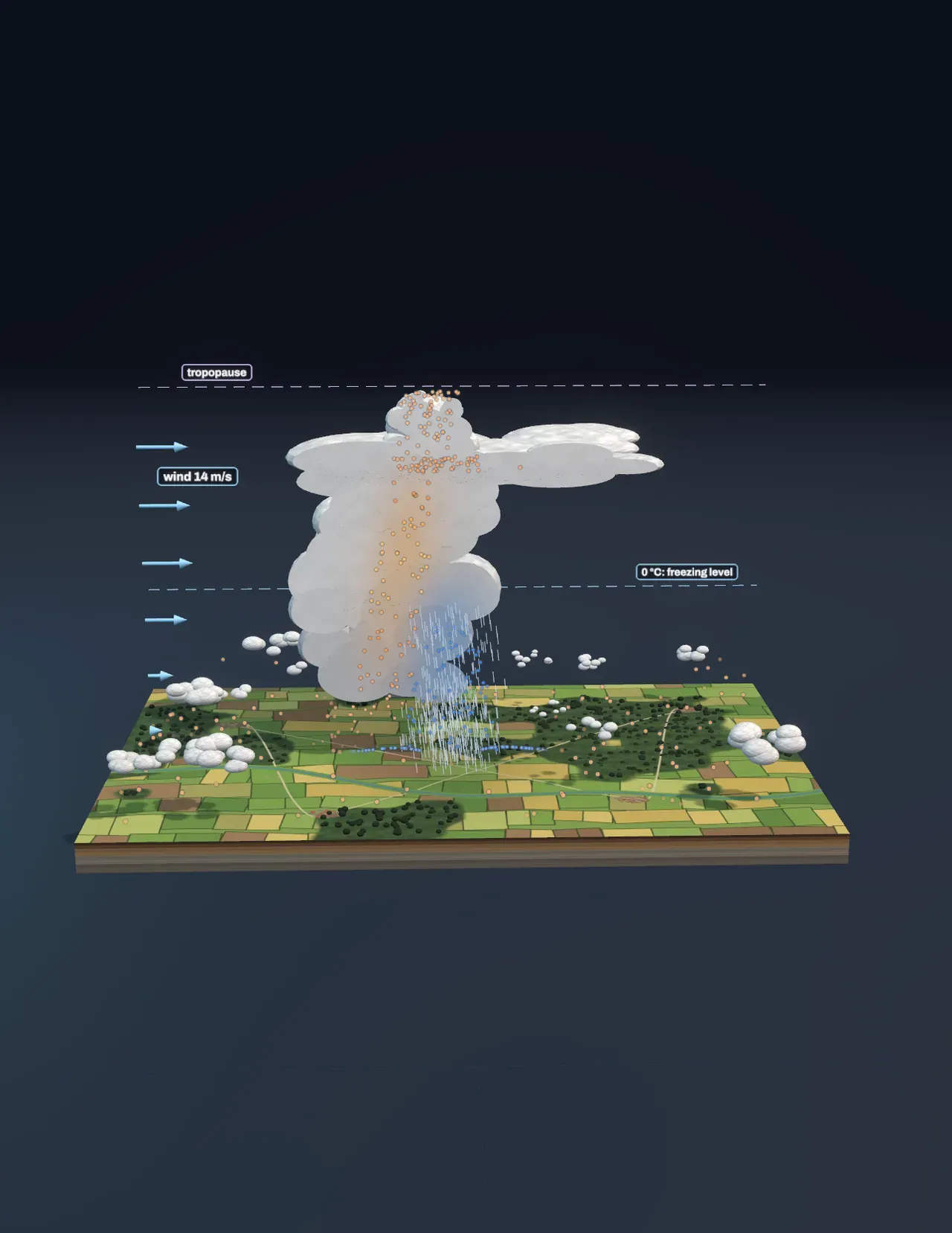
It is a hot day now, 33 °C, with a dew point of 18 °C: a cloud towers up to the tropopause. Predict what will happen if the air is dry, at exactly the same heat.
Step 5 of 6
The fuel
Cloudy air cools more slowly than dry air as it rises, about 4–7 °C per kilometre instead of 9.8, so it can stay warmer than its surroundings all the way up. In the cut-open cloud, the updraft’s amber beads brighten from the cloud base upwards: the brighter they are, the warmer the air is than its surroundings. Forecasters measure that energy as CAPE, the amber area in the chart.
Step 6 of 6
Wind shear
Wind shear is how much the wind changes with height: in the Scene, the difference between the wind at the ground and the wind 6 km up, shown by the arrows at the left. Rain and hail falling from the cloud drag cold air down with them, and it spreads along the ground as a gust front. Build the storm is at An hour on, and the shear is 0 m/s.
Loading the interactive version…
Loading the interactive version…
Each step sets up the Scene for you, and a control marked “fixed” stays put for that step.
Practice · Predict, then look
On a cool day, 20 °C, the thermals stop a few hundred metres above the ground. Slide Ground temperature up to 33 °C. What will happen to the thermals?
Practice · Predict, then look
On a cool day, 20 °C, the thermals stop a few hundred metres above the ground. Slide Ground temperature up to 33 °C. What will happen to the thermals?
Practice · Calculate
A hot day, 33 °C at the ground. The thermals have stirred the low air. The chart beside the Scene shows the temperature of the surrounding air with height. By how many degrees per kilometre does that air cool over the lowest 3 km?
Practice · Calculate
A hot day, 33 °C at the ground. The thermals have stirred the low air. The chart beside the Scene shows the temperature of the surrounding air with height. By how many degrees per kilometre does that air cool over the lowest 3 km?
Practice · Reach the target
The Ground temperature is locked at 31 °C. A thermal closes on its dew point by about 8 °C per kilometre, so the cloud base is about 125 m above the ground for every degree between the temperature and the dew point. Change the Dew point so that the cloud base is 1 km up, and press Check.
Practice · Predict, then look
A hot day, 33 °C, and a dew point of 18 °C: a thunderstorm. Slide Dew point down to 5 °C, without changing the heat. What will happen?
Practice · Predict, then look
A hot day, 33 °C, and a dew point of 18 °C: a thunderstorm. Slide Dew point down to 5 °C, without changing the heat. What will happen?
Practice · Choose
Step Build the storm from Cumulus to Towering. Above the cloud base the amber beads brighten: the rising air is warmer and warmer than its surroundings. What warms it?
Practice · Choose
Step Build the storm from Cumulus to Towering. Above the cloud base the amber beads brighten: the rising air is warmer and warmer than its surroundings. What warms it?
Practice · Choose
Build the storm is at An hour on. Slide Wind shear between 0, 14 and 25 m/s. Which storm is still going an hour later?
Practice · Choose
Build the storm is at An hour on. Slide Wind shear between 0, 14 and 25 m/s. Which storm is still going an hour later?
Lesson complete. Every practice question here is done.