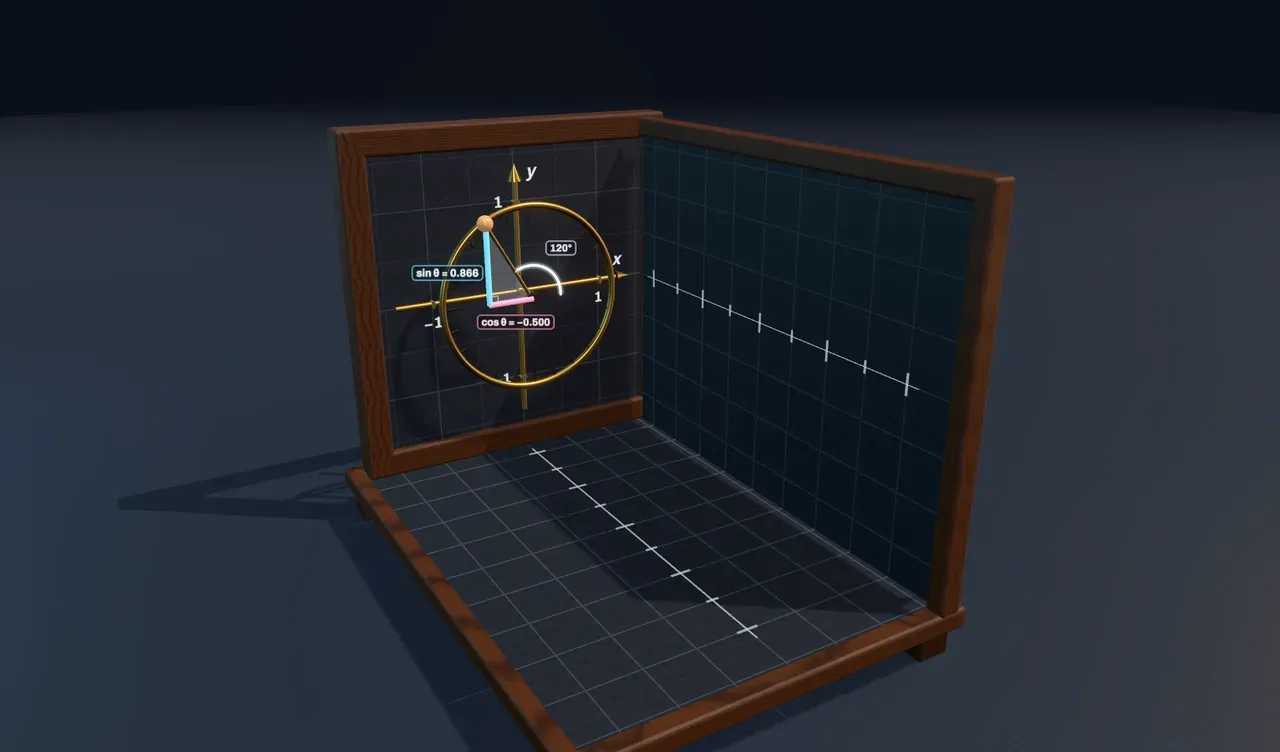
A point on a wheel
Mark a bead on the rim of a wheel whose radius is 1 and turn the wheel. Measure the turn as an angle θ (theta), starting from the bead’s position on the right and counting anticlockwise. As θ grows, the bead’s height above the centre and its distance to the right of the centre both change.
Those two numbers have names. The height is the sine of the angle, written sin θ. The sideways distance is the cosine, cos θ. In the Scene the height is the blue rod and the width is the pink rod. Because the radius is 1, the bead sits at the point (cos θ, sin θ).
A right triangle inside the circle
The two rods and the spoke make a right triangle. The spoke is its longest side, the hypotenuse, and its length is always 1. So sine and cosine are also the two short sides of a right triangle with a hypotenuse of 1, which is how they are first met in school: in any right triangle, the sine of an angle is the opposite side divided by the hypotenuse, and the cosine is the adjacent side divided by the hypotenuse. Scaling the triangle up does not change those ratios.
Pythagoras’ theorem applies to that triangle at every angle, which gives the most used identity in trigonometry: sin²θ + cos²θ = 1.
A few angles give exact values worth remembering. At 30° the height is exactly one half. At 60° the width is one half instead. At 45° the two are equal, both √2/2, about 0.707.
Signs and turns
Past 90° the bead moves to the left of the centre, so its width becomes negative: cosine is negative for angles between 90° and 270°. Below the centre the height is negative: sine is negative between 180° and 360°. At 360° the bead is back where it started, and every value repeats. Sine and cosine are periodic: they repeat every full turn, forever.
Angles are often measured in radians instead of degrees. One radian is the angle at which the arc the bead has travelled is as long as the radius, so a full turn, the circumference of a circle of radius 1, is 2π radians, about 6.28.
Unrolling the turning into waves
Now let the wheel creep forward along an axle as it turns, like a screw. The bead traces a helix, the shape of a spring. Look at that helix from the side, ignoring how far left or right the bead is, and you see only its height against the distance travelled: the sine wave. Look down on it from above and you see only its width: the cosine wave, the same shape shifted by a quarter turn.
Try it: slide Angle all the way to 720°, then choose Waves under Unroll into waves and compare the blue trace on the wall with the pink one on the floor.
This is why sine waves are everywhere. Anything that goes round steadily, or swings back and forth like a pendulum making small swings or a mass on a spring, has a position that follows a sine wave in time. Sound, the alternating current in a mains socket and the vibration of a guitar string are all described with sines and cosines.
Where the words come from
Astronomers built trigonometry to work out the positions of the Sun, Moon and planets. Hipparchus drew up a table of chords in circles in the second century BC. Indian mathematicians, including Aryabhata around AD 500, used the half-chord instead, which is the sine. Their Sanskrit word passed into Arabic, where its written form was read as the Arabic word for a fold or pocket. Latin translators in the twelfth century rendered that as sinus, which means a fold or a bay, and it became “sine”. The cosine is the sine of the complementary angle, the one that makes up 90°.
What this model leaves out
Along the axle a full turn is drawn two units long instead of its true 2π, so the waves on the wall and floor are squeezed sideways compared with a true graph of sine against radians; their heights are exact. The angle runs from 0° to 720° and only anticlockwise. Negative angles, turning clockwise, give the same values mirrored: the sine changes sign and the cosine does not. The tangent, sine divided by cosine, is not shown.