Not an ordinary wave
The waves that break on a beach are made by wind. They stir only the top few metres of the sea, a crest passes every few seconds, and a crest is perhaps a hundred metres from the next. A tsunami is something else. It is made when a huge volume of the ocean is suddenly pushed out of place, most often by an earthquake under the sea floor, sometimes by an undersea landslide, a volcanic eruption or, very rarely, an asteroid. Its crests can be a hundred kilometres or more apart and ten minutes to an hour apart in time, and it moves the water all the way down to the sea floor.
Out in the open ocean such a wave is easy to miss: a rise of a metre or so spread over tens of kilometres. A ship sailing over it would rise and fall too gently to notice. Yet the same wave can arrive at a coast as a wall of water many metres high and run kilometres inland.
The sea floor jumps
The largest tsunamis come from megathrust earthquakes, where one tectonic plate slides beneath another along a sloping fault. For centuries the plates stay locked and the upper plate is slowly squeezed and bent. When the fault finally slips, in a minute or two, the sea floor near the fault springs up by several metres while the floor further landward drops.
Water cannot be squeezed, so the whole column of ocean above moves with the floor. In a moment the sea surface takes the same shape: a long hump above the uplift and a hollow above the drop. Gravity pulls the hump back down, and it spreads out as two waves, one heading out to sea and one towards the nearest coast, each about half as high as the original hump. Because the hollow lies on the landward side, the wave heading for the coast often leads with a trough.
Why deep water is fast
A tsunami is far longer than the ocean is deep, which makes it a shallow-water wave even in the middle of the Pacific. For such a wave the speed does not depend on how long it is. It depends only on the depth of the water, , and on gravity, :
Over 4 km of water that gives about 200 metres a second, more than 700 km/h, the cruising speed of a jet airliner. A tsunami can cross an ocean in less than a day: the 2004 Indian Ocean tsunami reached Sri Lanka, 1,600 km from the earthquake, about two hours after it began.
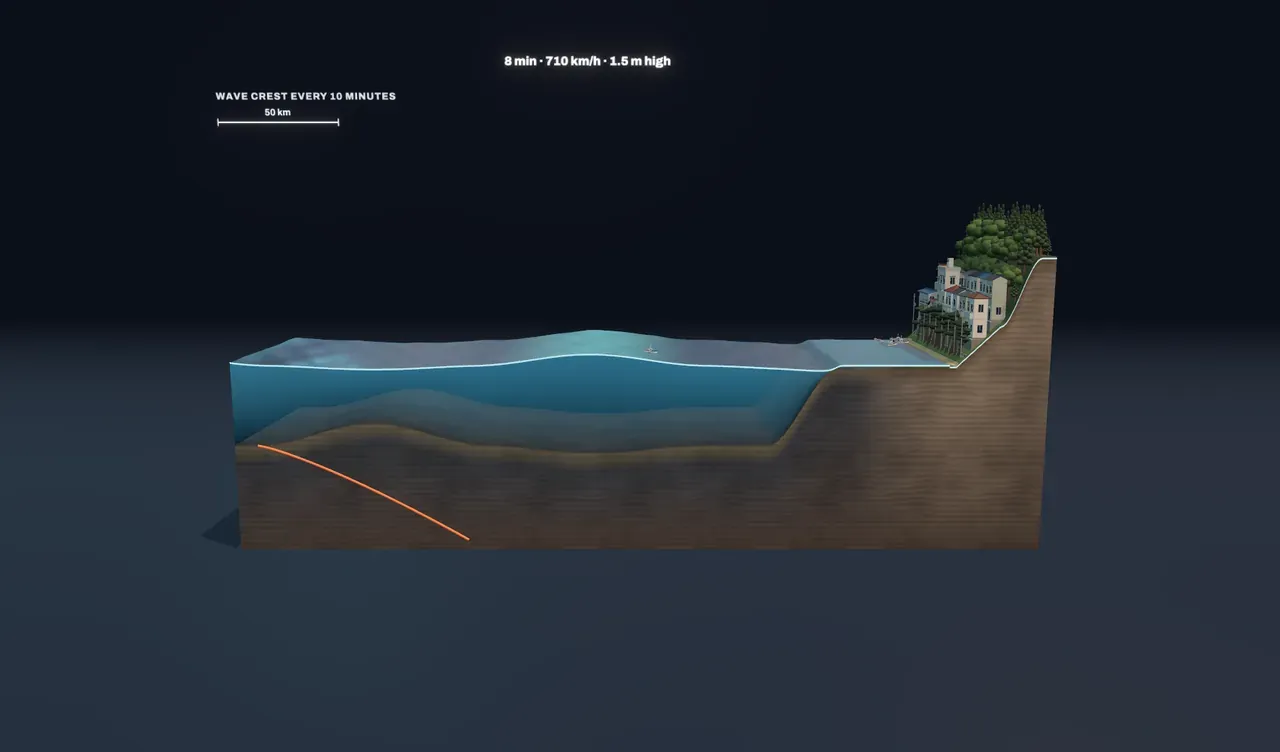
Try it: move Ocean depth from Sea of Japan to Deep Pacific and watch the next crossing. The ruler above the slice marks where the crest was every ten minutes; deeper water spreads those marks apart because the wave covers more ground in each ten minutes.
Slowing down and growing taller
As the wave climbs the continental slope and runs onto the shallow shelf, its speed drops with the depth. Over 100 m of water it goes about 110 km/h; over 10 m, about 35 km/h, the speed of a car in town. The front of the wave reaches shallow water and slows first, while the back, still in deeper water, keeps coming. The wave gets shorter, the crests pile up, and the energy the wave carries is squeezed into less and less water.
That energy has to go somewhere, so the wave grows taller. For a slowly shallowing sea the height grows as one over the fourth root of the depth, a rule known as Green’s law: water a hundred times shallower makes the wave about three times taller. Near the beach the wave becomes as tall as a large part of the water under it and can no longer hold its shape. It breaks, not as a curling surf wave, but as a churning wall of water called a bore, or as a sea level that rises quickly and keeps on rising.
Try it: watch the readout above the crest as the wave reaches the shelf. The speed falls to a few tens of km/h while the height climbs several-fold. Then raise Sea-floor jump to Magnitude 9 and see how far the flood runs into the town.
Because the time between crests does not change as the wave slows, a tsunami flood is not a single splash. The sea keeps pouring in for many minutes, drains back out with great force, and is often followed by more waves. The Scene shows only the first: once it has drained away, it starts again at the quake.
Warnings and minutes
When the leading part of the wave is a trough, the sea draws back first, sometimes by hundreds of metres, leaving fish and boats stranded on the sea bed. It is the most famous natural warning, and the wave follows within minutes. Strong shaking that lasts a long time near a coast is a warning too. In either case the advice is the same: do not wait for an official alarm; go to high ground or inland at once.
Warning centres locate an undersea earthquake within minutes and confirm a tsunami with tide gauges and pressure sensors on the deep sea floor, which can feel a passing wave of a few centimetres. Because the speed depends only on depth, and the depths of the oceans are mapped, they can predict when the wave will reach each coast. For towns close to the fault, the wave may arrive in less than half an hour, so the warning is short.
What this model leaves out
The slice is a two-dimensional cut. A real tsunami spreads sideways as well, and the shape of the coast can focus it into bays or spread it along open shores. The sea floor here is a smooth basin, slope and shelf; real ones have ridges, canyons and islands that bend and reflect the wave, and part of a real wave reflects from the slope instead of carrying on. Green’s law holds while the depth changes slowly and stops at the breaking point; the actual breaking, friction on the shelf and the turbulent flow over land are far more complicated. The flood is drawn as a sheet that rises and falls with the sea at the beach, so it does not show the water rushing inland or the debris it carries. The heights of the wave are drawn hugely exaggerated, or a one-metre wave over hundreds of kilometres would be invisible.