A quake lifts the sea floor, and the wave it makes travels at $\sqrt{g d}$, set by the depth alone. Work out how fast it crosses an ocean, find why the shallow water takes most of the time, and use Green’s law for how much it grows near the coast.
Step 1 of 9 · The jolt
Step 1 of 9
The jolt
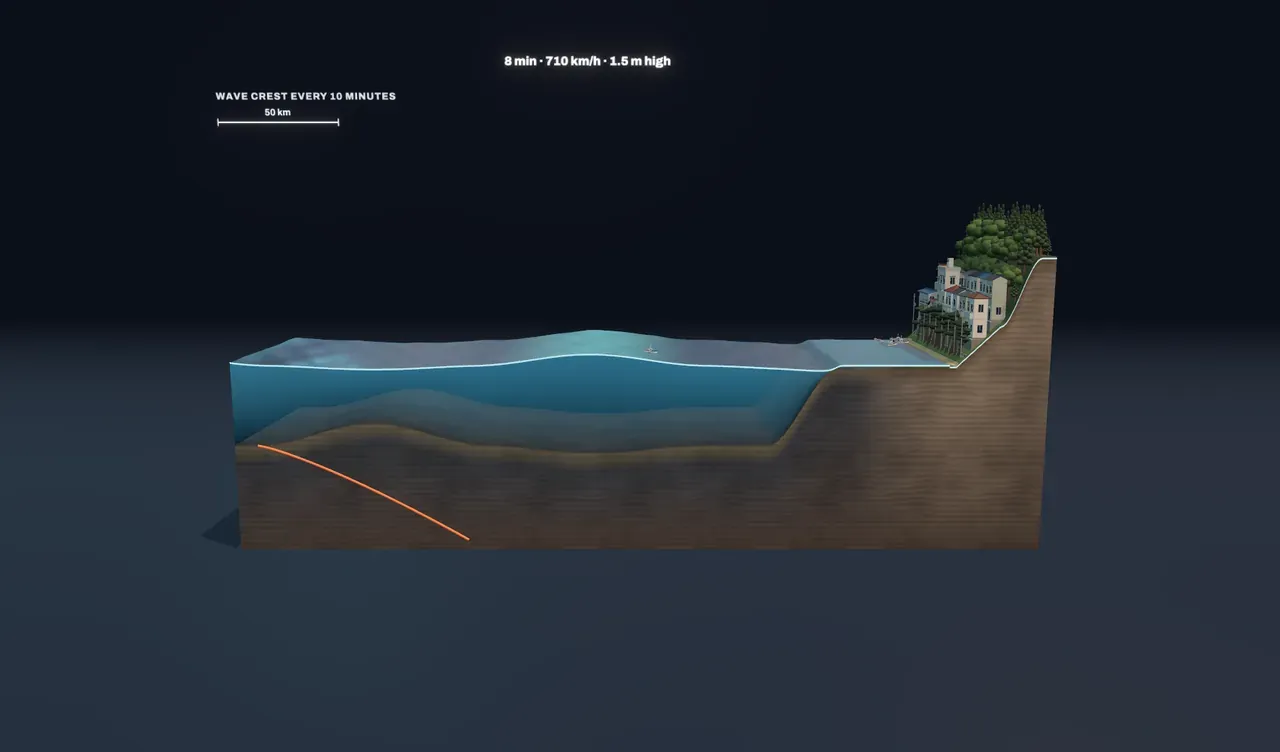
In the Scene there is a cross-section of sea from a fault in the floor to a town on the coast: a deep basin, the continental slope, a shallow shelf and a beach. Time is now at the moment of the quake. In the dynamic Earth Lessons we saw an ocean plate sinking beneath another; that is exactly where most tsunamis are made.
Step 2 of 9
A long wave
In the waves Lessons we saw that a wave’s speed is set by the medium. Water waves have a special rule: a wave far longer than the water is deep moves the whole water column, down to the floor, and its speed depends on the depth alone:
A tsunami is hundreds of kilometres long, so even in an ocean kilometres deep it is a long wave. Ocean depth is locked.
Step 3 of 9
Height and speed
In the open ocean a tsunami is low, a metre or less, and spread over hundreds of kilometres. A ship it passes under rises slowly over minutes and does not notice it. The label over the crest shows the time, the speed and the height.
Step 4 of 9
Crossing the basin
From the speed you can work out when the wave will arrive. The ruler in the Scene marks where the crest is every ten minutes.
Step 5 of 9
The shelf
Time is now at the moment the crest reaches the foot of the slope. From there the floor rises, from 4 km to only 120 m on the shelf, and then to the beach.
Step 6 of 9
The wave grows
When the front of the wave enters shallow water it slows, and the back, still in deep water, catches up. The wave shortens and the water piles up: it grows. Ocean depth and Sea-floor jump are locked.
Step 7 of 9
Landfall
Time is almost at its end. Near the coast the wave breaks into a churning wall of water, and behind it the water carries on inland and floods the land. But before that, something strange happens on the beach.
Step 8 of 9
Both ways
Drag Time a little past the quake, and watch what happens to the hump the sea floor raised.
Step 9 of 9
Where it breaks
Near the coast the wave slows and grows, until it is too tall for the water beneath it, and breaks.
Loading the interactive version…
Loading the interactive version…
Each step sets up the Scene for you, and a control marked “fixed” stays put for that step.
Practice · Choose
An earthquake under the sea floor. What exactly makes the tsunami?
Practice · Choose
An earthquake under the sea floor. What exactly makes the tsunami?
Practice · Calculate
Ocean depth is locked at 4 km. A long wave, far longer than the water is deep, travels at . What is the tsunami’s speed in the open ocean, in kilometres an hour?
Practice · Calculate
Ocean depth is locked at 4 km. A long wave, far longer than the water is deep, travels at . What is the tsunami’s speed in the open ocean, in kilometres an hour?
Practice · Predict, then look
Sea-floor jump is now 1 m, as in a magnitude quake. Predict: if the floor jumps 5 m, as in magnitude , will the wave cross the ocean faster?
Practice · Predict, then look
Sea-floor jump is now 1 m, as in a magnitude quake. Predict: if the floor jumps 5 m, as in magnitude , will the wave cross the ocean faster?
Practice · Calculate
Ocean depth is locked at 4 km. The crest sets off 30 km from the fault, and the deep basin ends 200 km from the fault, at the foot of the continental slope. How many minutes does the crest take to cross the basin?
Practice · Calculate
Ocean depth is locked at 4 km. The crest sets off 30 km from the fault, and the deep basin ends 200 km from the fault, at the foot of the continental slope. How many minutes does the crest take to cross the basin?
Practice · Predict, then look
The crest has crossed 170 km of deep ocean in about minutes. 80 km remain: the continental slope, a shallow shelf and the coast. Predict: how long will this part take?
Practice · Predict, then look
The crest has crossed 170 km of deep ocean in about minutes. 80 km remain: the continental slope, a shallow shelf and the coast. Predict: how long will this part take?
Practice · Calculate
Ocean depth is locked at 4 km and Sea-floor jump at 3 m, so the wave sets off 1.5 m high. As the wave slows, the energy it carries stays, and its height grows by Green’s law: . The wave breaks where the water is about 8.7 m deep. How tall is it there?
Practice · Calculate
Ocean depth is locked at 4 km and Sea-floor jump at 3 m, so the wave sets off 1.5 m high. As the wave slows, the energy it carries stays, and its height grows by Green’s law: . The wave breaks where the water is about 8.7 m deep. How tall is it there?
Practice · Choose
Just before the crest arrives, the sea draws back from the beach, leaving the sea floor bare and fish flapping. What should someone standing on the beach do?
Practice · Choose
Just before the crest arrives, the sea draws back from the beach, leaving the sea floor bare and fish flapping. What should someone standing on the beach do?
Practice · Calculate
Sea-floor jump is locked at 3 m: the sea floor lifts the whole column of water above it at once. The hump on the surface splits into two waves, one each way. How high is each of them as it sets off?
Practice · Calculate
Sea-floor jump is locked at 3 m: the sea floor lifts the whole column of water above it at once. The hump on the surface splits into two waves, one each way. How high is each of them as it sets off?
Practice · Predict, then look
Sea-floor jump is at 3 m, and the wave breaks where the water is about 8.7 m deep. Predict: when the floor jumps only 1 m, where will the wave break?
Practice · Predict, then look
Sea-floor jump is at 3 m, and the wave breaks where the water is about 8.7 m deep. Predict: when the floor jumps only 1 m, where will the wave break?
Lesson complete. Every practice question here is done.