Dots that make stripes
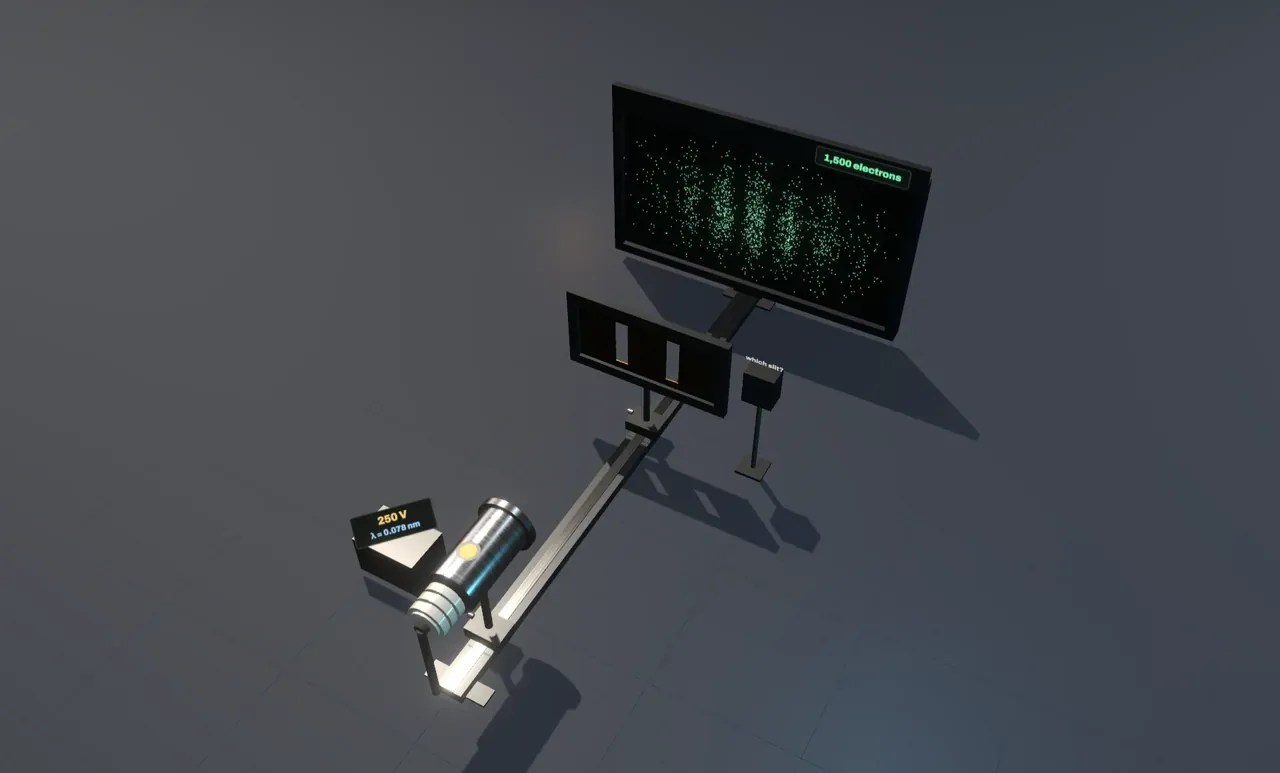
The bench in the scene is a real kind of experiment. An electron gun at one end boils electrons off a hot wire and pushes them through a few hundred volts. They fly through a thin gold foil with two narrow slits cut in it and hit a screen coated in phosphor, which glows wherever an electron lands. The electrons are sent so slowly that only one is ever on the bench at a time.
Each electron arrives whole. It makes one small dot, in one place, as a tiny particle would. Nothing about the first dot, or the first ten, looks like a pattern. You cannot say in advance where the next one will land.
Keep sending them and something strange appears. The dots crowd into some vertical stripes of the screen and stay out of others. With a few thousand electrons the screen shows clear bright and dark bands, the same pattern that two sets of ripples make when they cross on a pond. That pattern is called interference, and only waves make it.
Try it: slide Electrons sent down to 1, then up through 10, 200 and 6,000. Watch the stripes come out of what first looks like scattered noise.
A wave for every particle
In 1924 Louis de Broglie suggested that every moving particle has a wave, with a wavelength set by its momentum p (its mass times its speed):
Here h is Planck’s constant, 6.63 × 10⁻³⁴ joule seconds, a very small number. An electron leaving a 250 volt gun moves at about 9,400 kilometres a second, and its wavelength is 0.078 nanometres, smaller than an atom. Within a few years, Clinton Davisson and Lester Germer in the United States bounced electrons off a crystal, George Paget Thomson in Britain sent them through thin metal foil, and both saw them spread out in exactly the way waves of that length would.
The wave is what goes through the slits. Part of it passes through each one, and on the far side the two parts spread out and overlap. Where a crest from one slit meets a crest from the other, they add up. Where a crest meets a trough, they cancel. The wave does not carry the electron’s charge or mass smeared out across the screen. It sets the chance of finding the electron at each place: high where the wave is strong, zero where the two parts cancel. Each electron still lands in one spot, picked at random, but the spots follow the wave’s pattern.
Try it: choose Wave under Build up the pattern. The sheet shows crests and troughs leaving both slits, with dark lines where they cancel. Follow a dark line to the screen: the dots thin out exactly where it lands, and the blue curve, the chance of landing, drops to zero.
The stripe spacing depends on the wavelength. Slide Gun voltage down to 100 V: slower electrons have less momentum and longer waves, so the stripes spread apart. Slide it up to 600 V and the stripes crowd together. The readout on the gun’s supply shows the wavelength as you go.
Watching the slits
If each electron is one particle, surely it goes through one slit or the other. To check, put a lamp just behind the foil. Light bouncing off a passing electron shows which slit it came through.
Every electron is then caught in one slit, never both. And the stripes disappear. The dots pile up in one smooth band, the pattern you get by adding up what each slit gives on its own. Recording which way the electron went has destroyed the interference.
Try it: switch on Watch the slits with 6,000 electrons. Then choose Wave under Build up the pattern: now only the slit the electron was caught in sends a wave on.
This is not about a person looking. Any interaction that leaves a record of which slit the electron took, even one nobody ever reads, does the same. The electron behaves as a wave or as a particle depending on what the experiment is set up to measure, and no single experiment shows both sides at once. Niels Bohr called this complementarity.
Not just electrons
Light came first. Thomas Young saw light make interference fringes from two slits around 1801, and for a century light was a wave. Then in 1905 Albert Einstein explained why light knocks electrons out of metal in a way that depends on its colour, not its brightness: light arrives in lumps of energy, now called photons. Dim enough, a double slit with light also builds its fringes dot by dot.
Electrons were first sent through a real double slit by Claus Jönsson in 1961, and the pattern was built up one electron at a time in Bologna in 1974 and at Hitachi in Japan in 1989. Neutrons, whole atoms and molecules as large as the football-shaped carbon-60 have since shown interference too.
Electron microscopes use the short wavelength of fast electrons to see details far smaller than light can show. Everyday objects have waves too, but they are absurdly short: a cricket ball bowled at 30 metres a second has a wavelength of about 10⁻³⁴ metres, far too small for any slit to reveal.
What the model leaves out
The scene is drawn far from scale. Real electron slits are less than a micrometre apart and the fringes they make need magnifying to be seen, so here the slits, the screen and the wave share one made-up scale, with the wavelength drawn about four billion times longer than an electron’s. Where the electrons land is worked out exactly for that drawn bench, by adding up waves from every point of both slits, so the dots, the curve and the wave sheet agree with each other, but not with any particular laboratory.
The bench stands in open air; a real one sits in a vacuum, or the electrons would hit air molecules. The wave is worked out in the flat plane of the beam, so the dots are simply spread up and down the screen in the height of the slits. Every electron has exactly the same speed, and the lamp catches every electron perfectly, which real detectors only approach. The moving electron that flies down the bench replays the arrivals one by one for clarity. Nothing about it shows the path an unwatched electron took, because quantum physics does not give it one.