Single electrons that build an interference pattern: the de Broglie wavelength, how the gun voltage sets it, what happens when you check which slit each electron went through, and what this wave really is.
Step 1 of 5 · One electron at a time
Step 1 of 5
One electron at a time
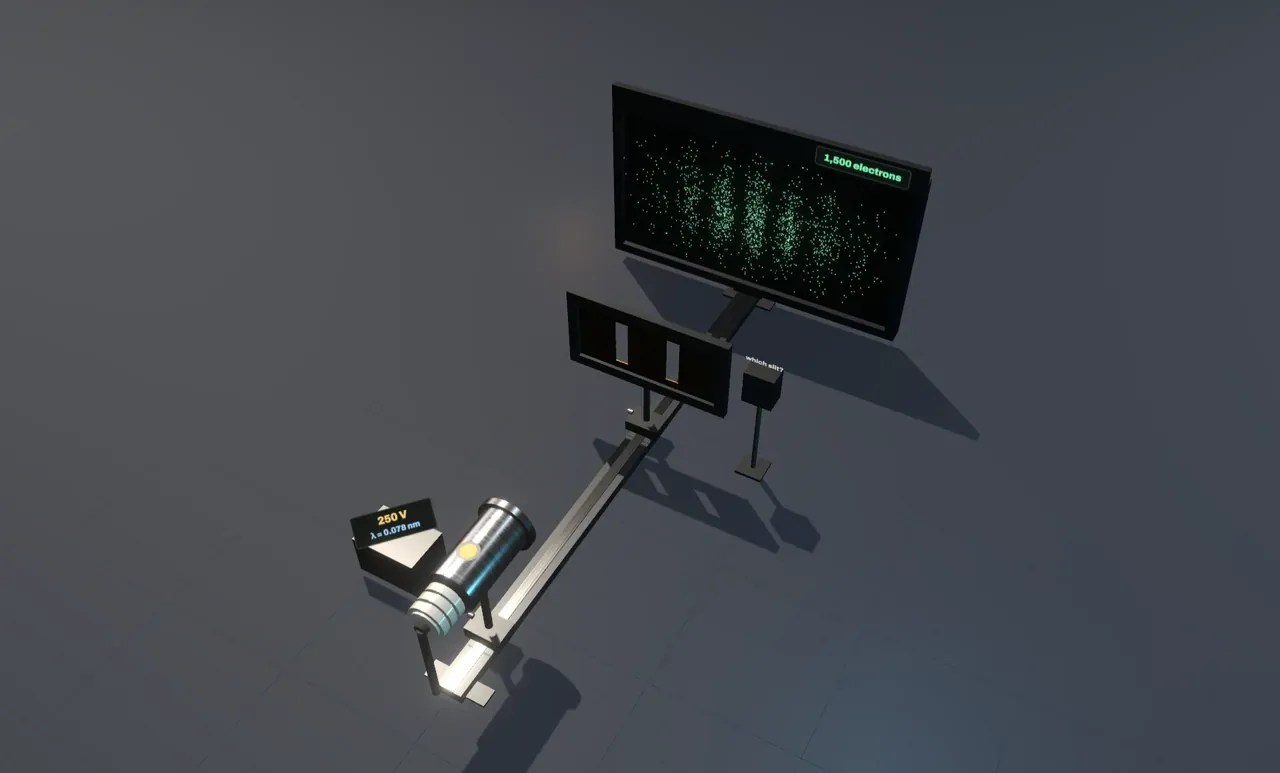
We saw that light, a wave, arrives as photons, like particles. Is the reverse true as well? The Scene has an electron gun, a foil with two slits and a screen that keeps a dot wherever an electron lands. The electrons leave one by one: at any moment there is only one electron on the bench. So far ten have been sent, and each arrived whole, as one dot.
In the waves Unit we saw what water waves or light do when they pass two slits: they interfere, and bright and dark stripes appear on the screen. Predict what the screen will show after six thousand electrons.
Step 2 of 5
The electron’s speed
The gun accelerates each electron from rest through a potential difference . The electric field does work on it, which becomes kinetic energy:
Gun voltage is locked at 100 V. An electron’s charge is and its mass .
Step 3 of 5
The de Broglie wavelength
In 1924 Louis de Broglie proposed that every moving particle has a wave, whose wavelength is set by its momentum, :
This is the same Planck’s constant as in a photon’s energy. From comes , so . At 100 V that is about 0.12 nm, the size of an atom. The gun’s power supply shows the wavelength at each voltage.
The wavelength sets the spacing of the stripes: a shorter wave gives closer stripes. Try Gun voltage at 100 V and at 600 V and compare the stripes.
Step 4 of 5
Watching the slits
If each electron arrives as one dot, surely it went through one slit only. You can check: a lamp by the slits lights up each electron that passes and shows which slit it went through. Predict what will happen to the pattern when Watch the slits is switched on.
Step 5 of 5
A wave of chance
Build up the pattern has laid the wave across the bench: part of it goes through each slit, and beyond them the two parts interfere. The blue curve on the screen is the chance that an electron lands at each place. An electron is neither a tiny ball nor a water wave: it always arrives as a particle, in one place, and the wave sets where that is likely to be. This is the double nature of matter, wave–particle duality, and light has the same double nature.
Loading the interactive version…
Loading the interactive version…
Each step sets up the Scene for you, and a control marked “fixed” stays put for that step.
Practice · Predict, then look
The electrons are sent one at a time. What will the screen show after six thousand electrons?
Practice · Predict, then look
The electrons are sent one at a time. What will the screen show after six thousand electrons?
Practice · Calculate
Gun voltage is 100 V. How fast do the electrons leave the gun?
Practice · Calculate
Gun voltage is 100 V. How fast do the electrons leave the gun?
Practice · Calculate
How many times shorter is the electrons’ wavelength at 400 V than at 100 V? Answer, then check on the label of the gun’s power supply.
Practice · Calculate
How many times shorter is the electrons’ wavelength at 400 V than at 100 V? Answer, then check on the label of the gun’s power supply.
Practice · Predict, then look
We will switch on Watch the slits: the lamp will show which slit each electron went through. What will happen to the stripes?
Practice · Predict, then look
We will switch on Watch the slits: the lamp will show which slit each electron went through. What will happen to the stripes?
Practice · Choose
What does the wave in the Scene describe?
Practice · Choose
What does the wave in the Scene describe?
Lesson complete. Every practice question here is done.