An electron can be found past a wall higher than its energy: the wave fading inside the wall, the depth at which the chance halves, a slightly thicker or higher wall letting far less through, and energy kept on the far side.
Step 1 of 5 · A wall too high
Step 1 of 5
A wall too high
A ball rolling at a hill too high for it always comes back. In classical physics there is no other way: halfway up, its kinetic energy would have to be negative. But we saw that an electron has a wave, and the wave decides where it can be found.
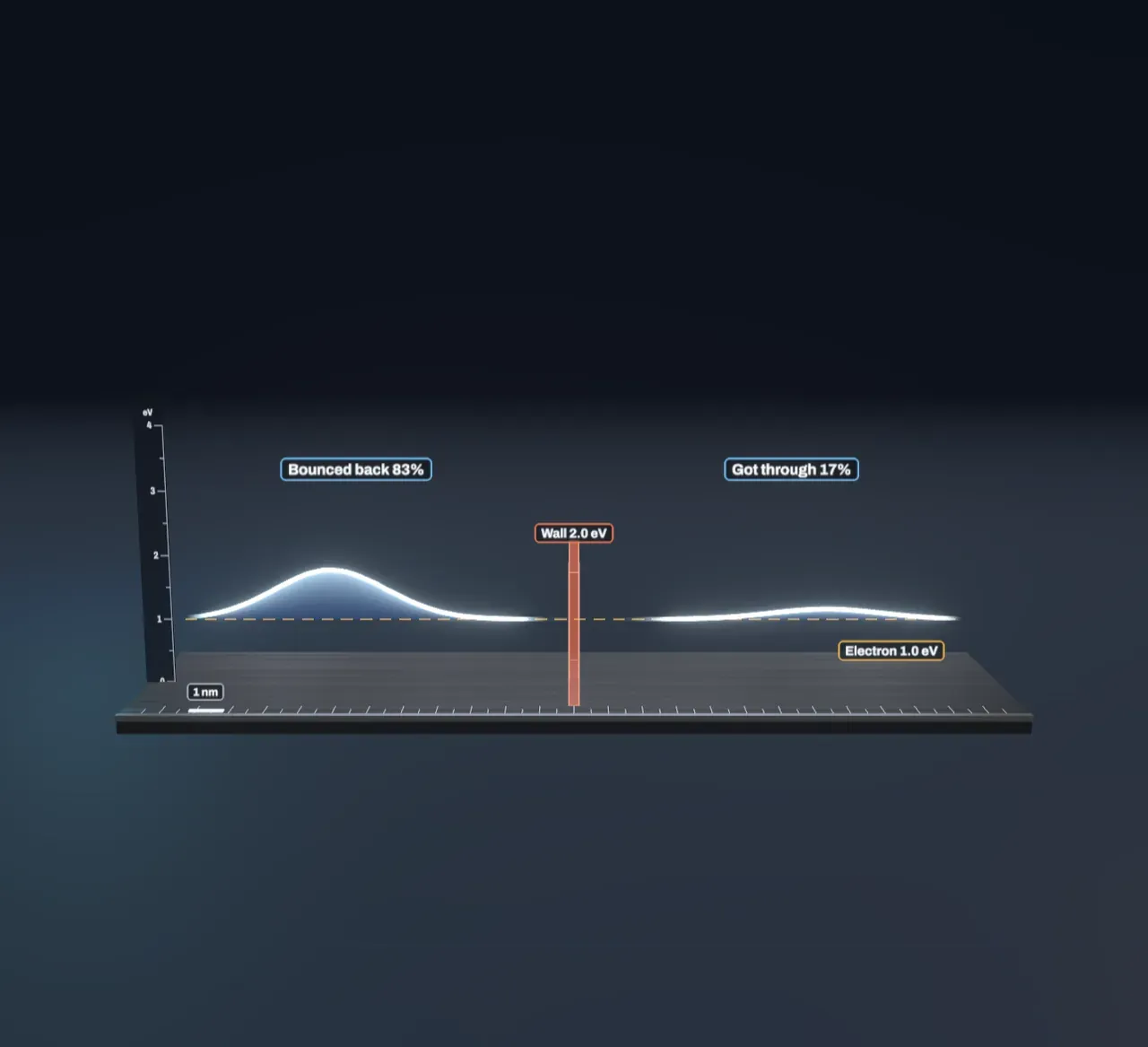
On the bench an electron with an energy of 1 eV runs at a barrier: up is energy, along is distance. The electron is a wave packet that travels, spreads and splits, and the tags show how much of it bounced back and how much got through. Right now Wall height is 0.5 eV, below its energy, and Wall thickness is fixed. Predict what will happen when the wall is higher than the electron.
Step 2 of 5
Inside the wall
Inside a wall higher than the electron’s energy the wave does not wave: it fades, an exponential decay. The wave itself fades as , and the chance of finding the electron, the square of the wave, as , where
The higher the wall above the electron, the larger and the faster the wave fades. Wall height, Wall thickness and Look into the wall are fixed.
Try it: after checking, you can step Look into the wall to Inside the wall in the next Step, and see the fading wave and the depth at which the chance halves.
Step 3 of 5
Thicker walls
A thick wall, and inside it the wave fades further and further before it reaches the far side. What gets through a thick wall shrinks roughly as , where is the thickness, so every fixed extra thickness divides it by a fixed factor. Wall height is fixed. Change Wall thickness.
Try it: after checking, step Look into the wall to Thicker walls. The chart beside the Scene shows what gets through against the thickness on a log scale: a straight line.
Step 4 of 5
Higher walls
The height enters the exponent too, through . Wall thickness is fixed. Predict what will happen when the gap between the wall and the electron grows threefold.
Step 5 of 5
The far side
At Inside the wall the Scene shows the steady wave at the electron’s energy: before the wall it is large, inside it fades, and after it carries on, smaller.
Quantum tunnelling is no laboratory curiosity. It is how an alpha particle escapes a nucleus in alpha decay, how hydrogen nuclei in the Sun get close enough to fuse, and how a scanning tunnelling microscope feels a surface: the current between the tip and the surface changes tenfold when the gap changes by less than an atom’s width.
Loading the interactive version…
Loading the interactive version…
Each step sets up the Scene for you, and a control marked “fixed” stays put for that step.
Practice · Predict, then look
The electron has an energy of 1 eV. Right now the wall is lower than that, 0.5 eV. We will raise it to 2 eV, twice the electron’s energy, 0.3 nm thick. What will happen to the wave packet?
Practice · Predict, then look
The electron has an energy of 1 eV. Right now the wall is lower than that, 0.5 eV. We will raise it to 2 eV, twice the electron’s energy, 0.3 nm thick. What will happen to the wave packet?
Practice · Calculate
Inside the wall the chance of finding the electron fades as , where . Here V − E = 1 eV, and for the electron per nanometre. At what depth into the wall has the chance halved?
Practice · Calculate
Inside the wall the chance of finding the electron fades as , where . Here V − E = 1 eV, and for the electron per nanometre. At what depth into the wall has the chance halved?
Practice · Reach the target
Wall height is fixed at 2 eV, and at 0.3 nm thick about gets through. Change Wall thickness until only about one in forty, about , gets through, and press Check.
Practice · Reach the target
Wall height is fixed at 2 eV, and at 0.3 nm thick about gets through. Change Wall thickness until only about one in forty, about , gets through, and press Check.
Practice · Predict, then look
Through a 2 eV, 0.3 nm wall about gets through. The wall is 1 eV above the electron. We will raise it to 4 eV, so 3 eV above the electron. What will happen to the share that gets through?
Practice · Predict, then look
Through a 2 eV, 0.3 nm wall about gets through. The wall is 1 eV above the electron. We will raise it to 4 eV, so 3 eV above the electron. What will happen to the share that gets through?
Practice · Choose
The part of the packet that got past the wall travels on. What is the electron’s energy on the far side?
Practice · Choose
The part of the packet that got past the wall travels on. What is the electron’s energy on the far side?
Lesson complete. Every practice question here is done.