A wall it cannot climb
Roll a ball at a hill. If it has enough energy to reach the top, it rolls over; if it does not, it rolls back down, every time. Nothing in everyday life ever slips through a hill it cannot climb.
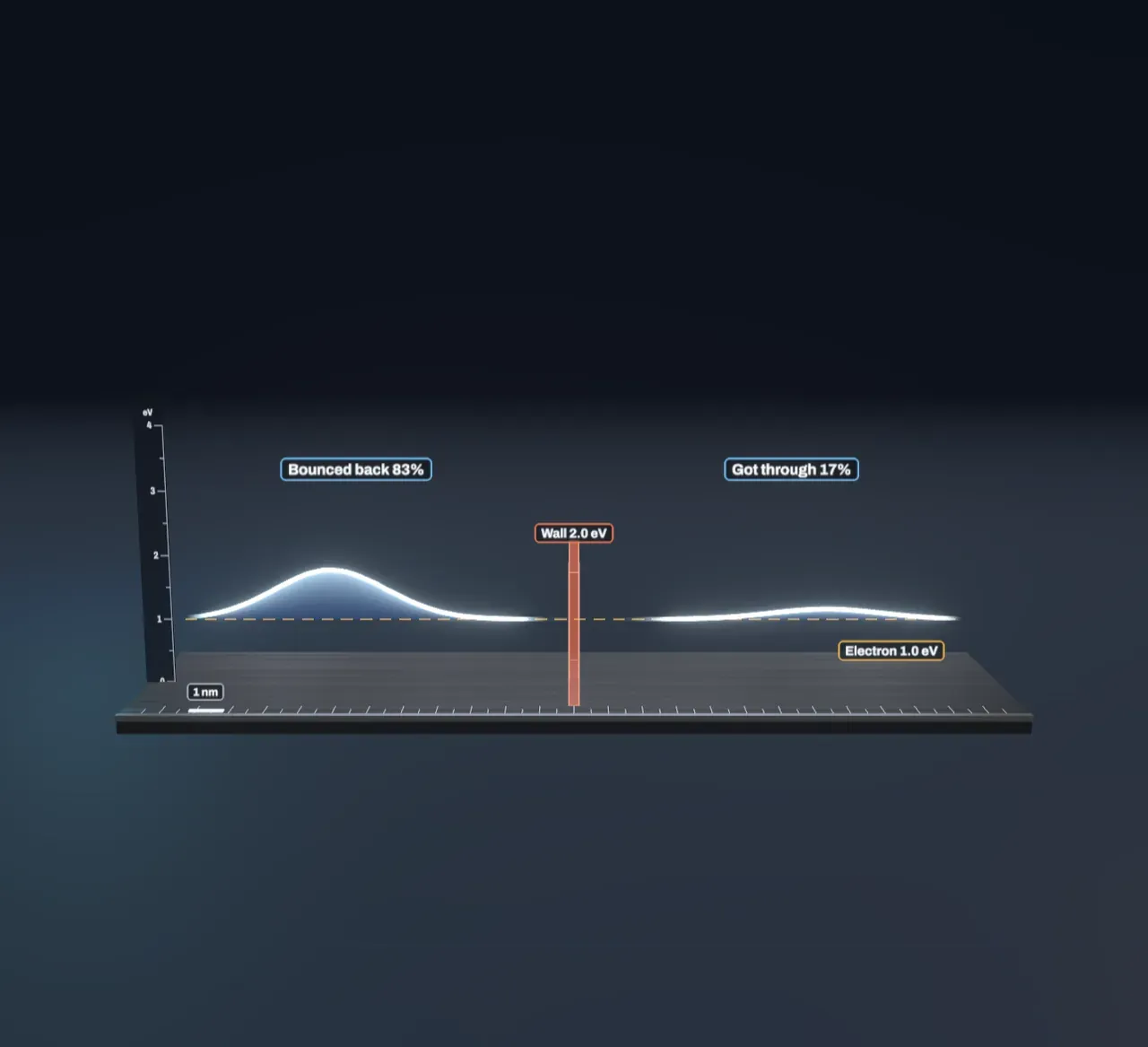
The Scene shows the same situation for an electron. It moves along a line with 1 electronvolt (eV) of energy, the energy an electron picks up crossing one volt. The gold dashed line marks that energy. Ahead of it is a barrier: a stretch 0.3 nanometres thick, about the width of one atom, where the electron would need 2 eV to be. A ball with half the energy it needs would bounce straight back. The electron mostly does too, but about 17 per cent of it comes out on the far side. This is quantum tunnelling.
A wave, not a ball
An electron does not travel like a tiny ball. It travels like a wave, spread out over a region, described by a wave function. The height of the blue curtain shows where the electron is likely to be: the taller the curtain at a place, the more likely you would find the electron there if you looked.
Watch the curtain run into the wall. Where the returning part overlaps the part still arriving, the two waves add and cancel, and the curtain breaks into ripples. Then it splits: a large lump runs back to the left and a small one carries on to the right. The tags above each side read the share of the curtain on each side of the wall, measured from the curtain as it moves.
The electron itself is not split. If you put a detector on each side, one of them would click and find a whole electron. The curtain gives the odds: here, about 17 times in every 100 the electron is found beyond the wall.
Try it: slide Wall height up to 4 eV. Now only about 1.5 per cent gets through. Then slide Wall thickness down to 0.1 nm: with the wall a third as thick, over 40 per cent gets through, even though it is still four times higher than the electron can climb.
Inside the wall
Step Look into the wall to Inside the wall. The view zooms in threefold on the wall and shows the steady wave of an electron of exactly 1 eV. Its two parts, drawn as height and depth, make a corkscrew that turns as time passes; the sleeve around it shows the wave’s size.
To the left the wave is large: the arriving and the reflected waves together. Inside the wall it does not stop dead. It stops waving and fades smoothly, shrinking by the same fraction for every step deeper. That is an exponential fade. For a 2 eV wall the chance of finding the electron halves every 0.068 nanometres. Whatever is left at the far side becomes the small, steady wave that carries on to the right.
A wall twice as high above the electron’s energy makes the fade quicker, but never sudden. The wave only reaches zero at an infinitely high or infinitely thick wall, which is why some of it always gets through.
Thicker walls let much less through
Step Look into the wall to Thicker walls. The chart beside the Scene plots the share that gets through against the wall’s thickness, for the wall you have set. Its scale goes down in steps of ten: 100 per cent, 10, 1, 0.1 and so on. On that scale an exponential fall is a straight line, and for any wall higher than the electron’s energy the curve soon becomes one.
For the 2 eV wall, each extra 0.1 nanometres divides the share by about 2.8. A wall 0.3 nanometres thick lets through 17 per cent, 0.6 nanometres about 1 per cent, and 1 nanometre two hundredths of one per cent. The rate of the fall is set by
where is the wall’s height, the electron’s energy, its mass and the reduced Planck constant. For a thick wall the share through falls in step with , where is the thickness: every extra slice of wall divides it by the same number.
Try it: with Thicker walls showing, move Wall height from 2 to 4. The line in the chart tilts much more steeply: each extra 0.1 nanometres now divides the share by about 5.9.
Why balls never tunnel
The mass is under the square root in . A proton is 1,836 times heavier than an electron, so it fades about 43 times faster in the same wall, and its chance of getting through a 0.3 nanometre wall drops below 1 in 10⁵⁶. For a tennis ball the chance has hundreds of millions of millions of zeros after the decimal point. Tunnelling is real for everything, but it matters only for the lightest particles over the shortest distances, which is why we never see it.
Even a low wall turns some back
Slide Wall height down to 0.5 eV, half the electron’s energy. A ball would roll over it every time. The electron’s wave mostly does too, but about 9 per cent of it bounces back. A sudden change in height reflects part of any wave, as a pane of glass reflects a little of the light passing through it. Step Look into the wall to Thicker walls and the chart shows that the share getting through no longer falls with thickness; it rises and falls a little as the reflections from the wall’s two faces add up or cancel.
Where tunnelling matters
- The Sun. Protons at the centre of the Sun repel each other far too strongly to touch, even at 15 million degrees. A tiny share of collisions tunnel through that repulsion and fuse, and that is enough to keep the Sun shining. Nuclear fusion follows what happens next.
- Alpha decay. In 1928 George Gamow, and separately Ronald Gurney and Edward Condon, explained why some heavy nuclei throw out an alpha particle: it tunnels out through the barrier holding it in. The exponential explains why half-lives range from fractions of a second to billions of years. Radioactive decay shows the result.
- Seeing atoms. A scanning tunnelling microscope holds a sharp metal tip a fraction of a nanometre above a surface. Electrons tunnel across the gap, and the current changes about tenfold for every 0.1 nanometres the gap changes, so the tip can feel the bumps of single atoms. Gerd Binnig and Heinrich Rohrer built the first one in 1981 and shared the Nobel Prize in Physics in 1986.
- Electronics. Flash memory stores a bit by pushing electrons through a thin insulating layer onto an isolated island of silicon, where they stay for years. And as transistors shrink, electrons tunnelling through insulating layers only a few atoms thick become a leak that chip designers have to fight.
What this model leaves out
- One line, sharp walls. The electron moves along a single line, and the wall rises and falls with perfectly sharp edges. Real barriers are rounded, and real electrons move in three dimensions. The exponential fade is the same for any wall that is wide compared with how fast the wave fades.
- One electron, alone. The electron feels nothing except the wall: no other electrons, no atoms, no heat. In a real material all of these change the energies involved.
- A spread of energies. A wave packet that has a place along the line cannot have exactly one energy. Most of this one’s energy lies between about 0.86 and 1.16 eV, around its 1 eV average, and its higher-energy parts tunnel more easily, so the share through a thick wall is a little more than for an electron of exactly 1 eV. The steady wave in the zoom has exactly 1 eV.
- The drawing. The curtain shows the chance of finding the electron, which is the size of the wave function squared; the wave function itself cannot be seen or measured directly. Up in the drawing is energy for the wall and the gold line, but chance for the curtain, which stands on the electron’s energy to show which energy it has.
- Time. Everything is slowed down enormously, and the run is cut short when the two parts reach the ends of the bench. How long tunnelling “takes” is a subtle question that the Scene does not answer.