Something moves, but not the water
Drop a stone into a still pond and a ring of ripples races away from the splash. Watch a leaf floating nearby. As the ring reaches it, the leaf rises, sinks, and rocks a little back and forth, then settles almost exactly where it was. The water under the leaf has not flowed outward with the ring. Something else has.
What travels is a disturbance: each patch of water is pushed up and pulled down by its neighbours and in turn pushes on the next patch along. The pattern moves; the water mostly stays. That is what a wave is: a way of carrying energy from one place to another without carrying the material with it. Sound in air, a shake along a rope and a ripple on a pond all work this way.
Three numbers describe a wave
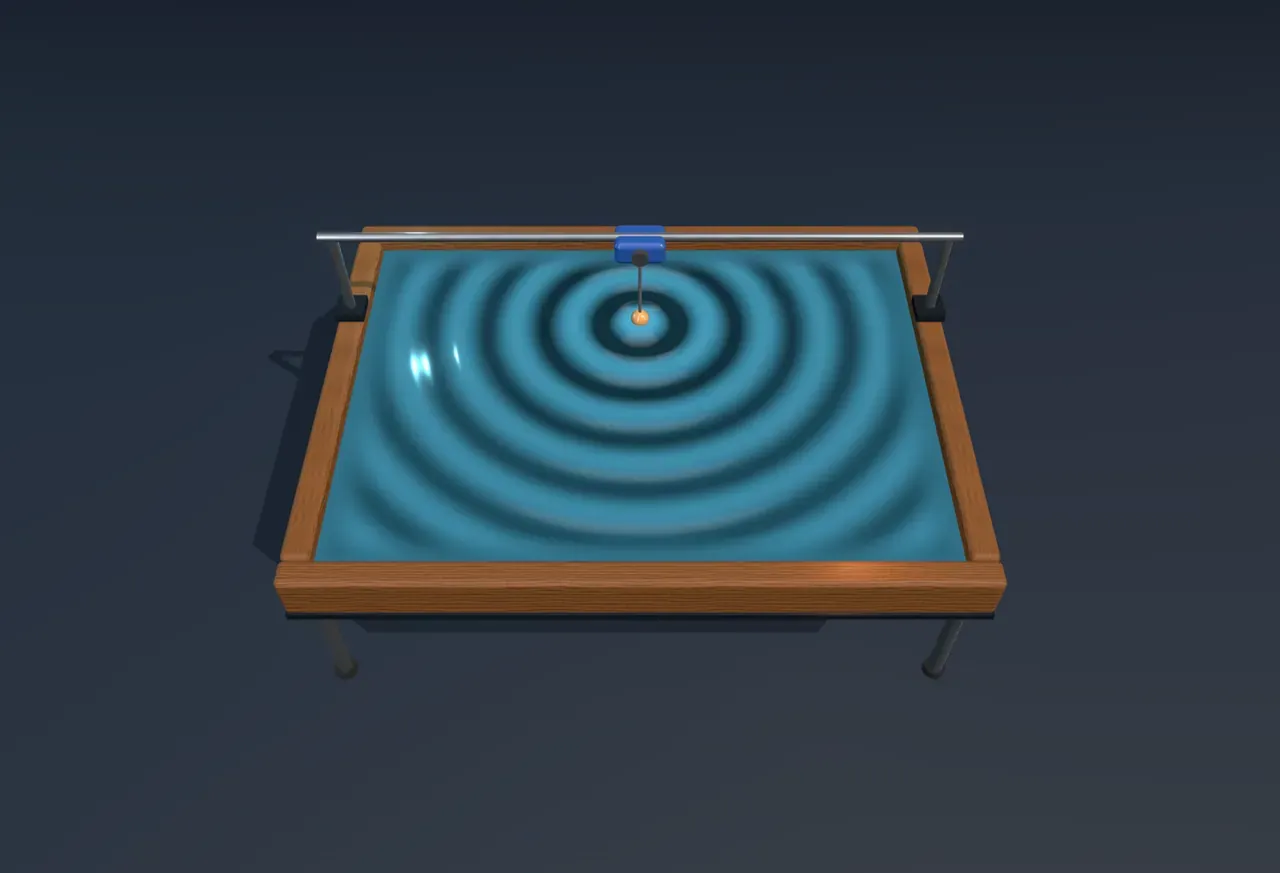
In the scene, a small bead on a vibrating arm taps the water again and again, so instead of a single ring there is a steady train of them. Three numbers describe that train.
- Frequency is how many crests leave the bead each second, measured in hertz (Hz). The bead sets it: one tap, one crest.
- Wavelength, written λ (the Greek letter lambda), is the distance from one crest to the next.
- Amplitude is how high a crest stands above the still surface. It sets how much energy the wave carries. The energy grows with the square of the amplitude, so a crest twice as tall carries four times the energy.
Why v = fλ
Here is the one rule that ties them together. In one second the bead sends out f crests, each one wavelength behind the one before. By the time the last of them leaves, the first has travelled f wavelengths. So in one second the wave covers a distance of f × λ, and that is its speed:
v = fλ
The source decides the frequency. The water decides the speed. The wavelength is whatever fits: a faster beat packs the crests closer together, and faster water stretches them apart. For sound in air at room temperature, travelling at about 343 metres a second, a 343 Hz note has crests one metre apart.
Try it: slide Frequency up to 14 Hz and watch the rings crowd together. Then slide Wave speed up to 34 cm/s, as in deeper water: the beat is the same, but the crests spread out. Choose On under Show the crests to see the spacing clearly.
What sets the speed
In a ripple tank the depth of the water matters most. In shallow water the speed grows with the square root of the depth, so ripples slow down as they run into the shallows. That is why waves arriving at a beach bunch up and turn to face it, and why turning up the tank’s Wave speed stands for deeper water. Change the material and the speed changes too: sound travels about four times faster in water than in air, and light travels nearly a million times faster than sound in air.
Changing the amplitude changes none of this. Turn Amplitude down and the crests flatten, but they keep the same spacing and the same speed. A whisper and a shout of the same note have the same wavelength.
What the model leaves out
The tank shows ideal ripples: a pure, steady beat from a single point, rings that weaken only because they spread over a bigger circle, and edges that swallow every wave. Real water also loses energy to friction, reflects from walls and, for very short ripples, has its speed set partly by surface tension, so ripples of different lengths travel at slightly different speeds. The waves are slowed down and made much taller than real ones so they are easy to see.