What a wave carries and what stays in place, and three numbers that describe it: the frequency the source sets, the speed the medium sets, and the wavelength that fits both.
Step 1 of 5 · What travels
Step 1 of 5
What travels
In the Unit on oscillations you saw a body repeat the same motion again and again about its point of equilibrium. A wave is an oscillation that passes on: each bit of the medium oscillates, and pushes its neighbour to oscillate after it.
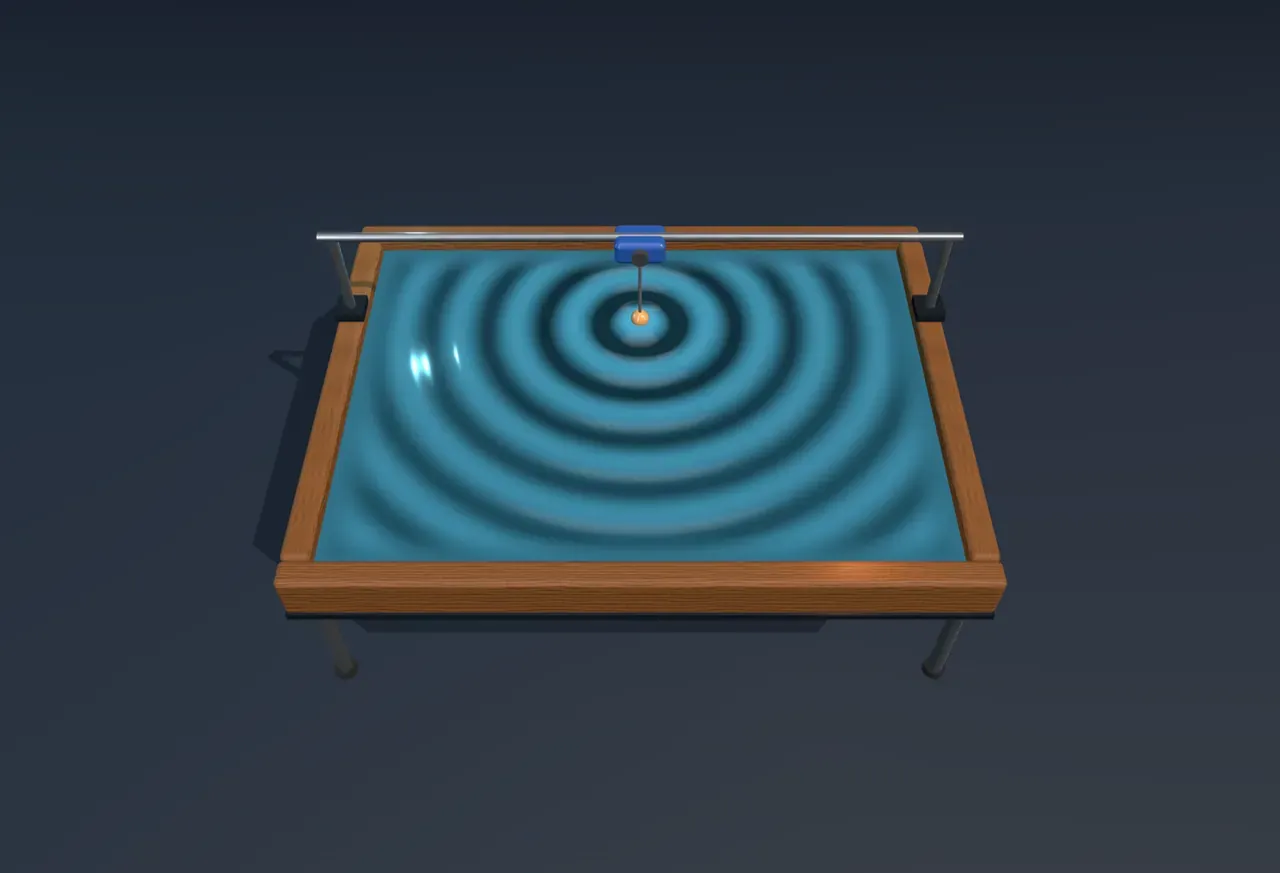
The Scene is a ripple tank, a tray of shallow water. A small bead on a vibrating arm taps the surface again and again, and each tap sends out a ring that moves away from it. Don’t watch the rings; watch one spot of water: it rises when a crest arrives, sinks when a trough arrives, and does it again. Time in the Scene runs times slower than real, and the waves are drawn taller than they are, so you can follow them.
Step 2 of 5
The wavelength
Choose On under Show the crests: each crest is marked with a bright line. The distance from one crest to the next is the wavelength, (lambda).
The bead taps times a second: that is the frequency, in hertz. In the time between one tap and the next, one cycle, the crest before moves on exactly one wavelength. So in a whole second, cycles, the wave covers wavelengths:
Frequency and Wave speed are fixed now. The numbers are real: ripples in water a few millimetres deep travel at about 25 cm/s, as they do in a classroom ripple tank.
Step 3 of 5
The period
The period is the time between two crests passing the same spot, like the period of a pendulum or a spring. As there, it is the frequency turned over:
In each period the crest moves on one wavelength, so the same rule can also be written .
Step 4 of 5
Tapping faster
What sets each of the three numbers? The source sets the frequency: one tap, one crest. The water sets the speed: in the Scene, deeper water gives faster waves. The wavelength is what is left, .
Wave speed is fixed now, because the water does not change. Predict what will happen when the bead taps faster, then look.
Step 5 of 5
Deeper water
Now the Frequency is fixed and Wave speed is free: changing it is like filling the tank with more water or less. Find the speed that gives the wavelength asked for.
Try it: after checking, move Amplitude. The crests are lower or taller, but the gaps between them do not move: the amplitude sets how much energy the wave carries, not how fast it travels.
Loading the interactive version…
Loading the interactive version…
Each step sets up the Scene for you, and a control marked “fixed” stays put for that step.
Practice · Choose
A small leaf floats on the water in the tank. What does it do when the rings reach it?
Practice · Choose
A small leaf floats on the water in the tank. What does it do when the rings reach it?
Practice · Calculate
The Wave speed is 25 cm/s and the Frequency 8 Hz. What is the wavelength?
Practice · Calculate
The Wave speed is 25 cm/s and the Frequency 8 Hz. What is the wavelength?
Practice · Calculate
At 8 Hz, how much time passes in reality between two crests passing the same spot on the water?
Practice · Calculate
At 8 Hz, how much time passes in reality between two crests passing the same spot on the water?
Practice · Predict, then look
The bead is about to tap twice as fast: 16 Hz instead of 8 Hz, in the same water. What will happen?
Practice · Predict, then look
The bead is about to tap twice as fast: 16 Hz instead of 8 Hz, in the same water. What will happen?
Practice · Reach the target
The Frequency is fixed at 8 Hz. Change the Wave speed, as if adding water to the tank or taking some out, until the wavelength is 4 cm, that is 0.04 m, and press Check.
Practice · Reach the target
The Frequency is fixed at 8 Hz. Change the Wave speed, as if adding water to the tank or taking some out, until the wavelength is 4 cm, that is 0.04 m, and press Check.
Lesson complete. Every practice question here is done.