Sound is a longitudinal wave of compressions and rarefactions: its wavelength in air, what loudness changes and what it doesn't, what happens when sound passes into water, and echoes.
Step 1 of 5 · Along the tube
Step 1 of 5
Along the tube
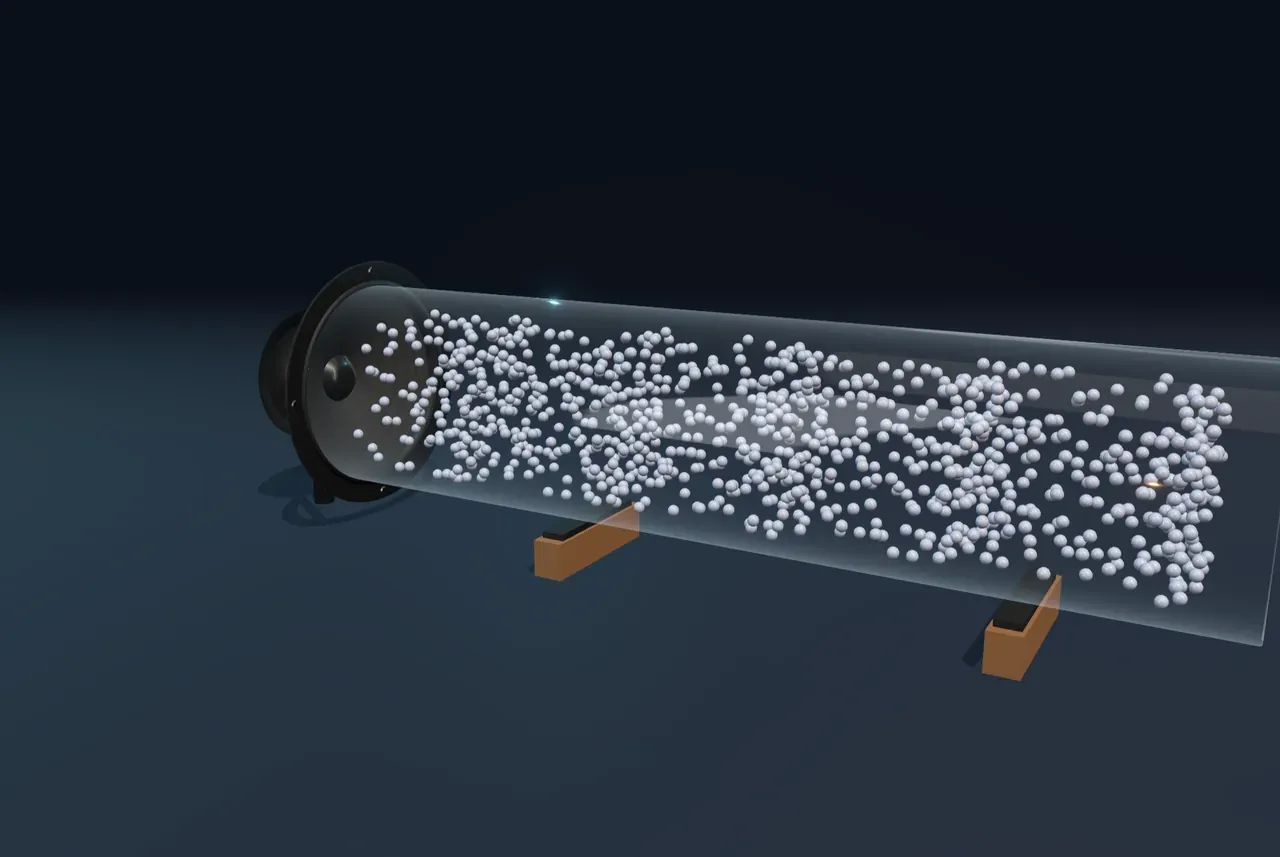
The Scene has a loudspeaker at the end of a tube of air. Each dot stands for a particle of air. The loudspeaker’s membrane moves back and forth, pushes the particles next to it, and they push the next ones. The wave is slowed down several hundred times, and the movements are greatly enlarged.
Follow one particle, not the bands.
Step 2 of 5
The wavelength in air
Where the particles crowd together the pressure is a little higher than usual: a compression. Where they spread out it is a little lower: a rarefaction. With Show the pressure set to On the compressions are tinted orange, and the curve above them is the pressure along the tube.
The wavelength of a sound is the distance from one compression to the next, and the rule is the same as for water: . The speed of sound in air at room temperature is 343 m/s. Pitch, the frequency, and Travelling through are fixed now.
Step 3 of 5
Louder
Loudness is the wave’s amplitude: how far each particle swings from its resting place, and how far the pressure in a compression rises above normal. Predict what turning the sound up will do to its speed, then look.
Step 4 of 5
From air into water
Sound needs a medium, and the medium sets its speed: about 1480 m/s in water, and about 5960 m/s in steel. Predict what will happen to a 500 Hz sound when it passes from air into water. A hint: what sets the frequency?
Try it: after predicting, choose Steel under Travelling through, and watch the compressions move further apart still.
Step 5 of 5
Echo
Sound that hits a wall or a cliff comes back: an echo. Time how long the echo takes to return, know the speed of sound, and you can work out how far away the wall is. A ship’s sonar and a bat finding its way in the dark work like this.
Loading the interactive version…
Loading the interactive version…
Each step sets up the Scene for you, and a control marked “fixed” stays put for that step.
Practice · Choose
How does each particle of air in the tube move as the sound passes through?
Practice · Choose
How does each particle of air in the tube move as the sound passes through?
Practice · Calculate
The loudspeaker plays a 500 Hz note in air, where the speed of sound is 343 m/s. What is the wavelength?
Practice · Calculate
The loudspeaker plays a 500 Hz note in air, where the speed of sound is 343 m/s. What is the wavelength?
Practice · Predict, then look
Loudness is turned up from 30% to 100%. What will happen to the speed at which the sound travels along the tube?
Practice · Predict, then look
Loudness is turned up from 30% to 100%. What will happen to the speed at which the sound travels along the tube?
Practice · Predict, then look
The 500 Hz note passes from air into water, where the speed of sound is 1480 m/s. What will happen?
Practice · Predict, then look
The 500 Hz note passes from air into water, where the speed of sound is 1480 m/s. What will happen?
Practice · Calculate
You stand facing a cliff, clap, and hear the echo 2 s later. The speed of sound in air is 343 m/s. How far away is the cliff?
Practice · Calculate
You stand facing a cliff, clap, and hear the echo 2 s later. The speed of sound in air is 343 m/s. How far away is the cliff?
Lesson complete. Every practice question here is done.