Listening for the bottom
Light hardly gets through seawater: a few tens of metres down it is dim, a few hundred metres down it is dark. Sound is different. It travels through water more than four times faster than through air and carries for kilometres, which is why whales can hear each other across an ocean basin.
So to find out what lies below, a ship does not look. It listens. A transducer on the hull, a plate that turns electrical signals into sound and back, sends a short burst of sound, a ping, straight down. Then it waits for the echo: the part of the sound that bounces off the seabed and comes back up. This is sonar, short for sound navigation and ranging, and the instrument that does it under a ship is an echo sounder.
Echo time becomes depth
The sounder knows only one thing about each echo: when it arrived. That is enough. Sound in seawater travels at about 1500 metres per second, and the ping went down and came back, so the depth is half the distance sound covers in the time it was away:
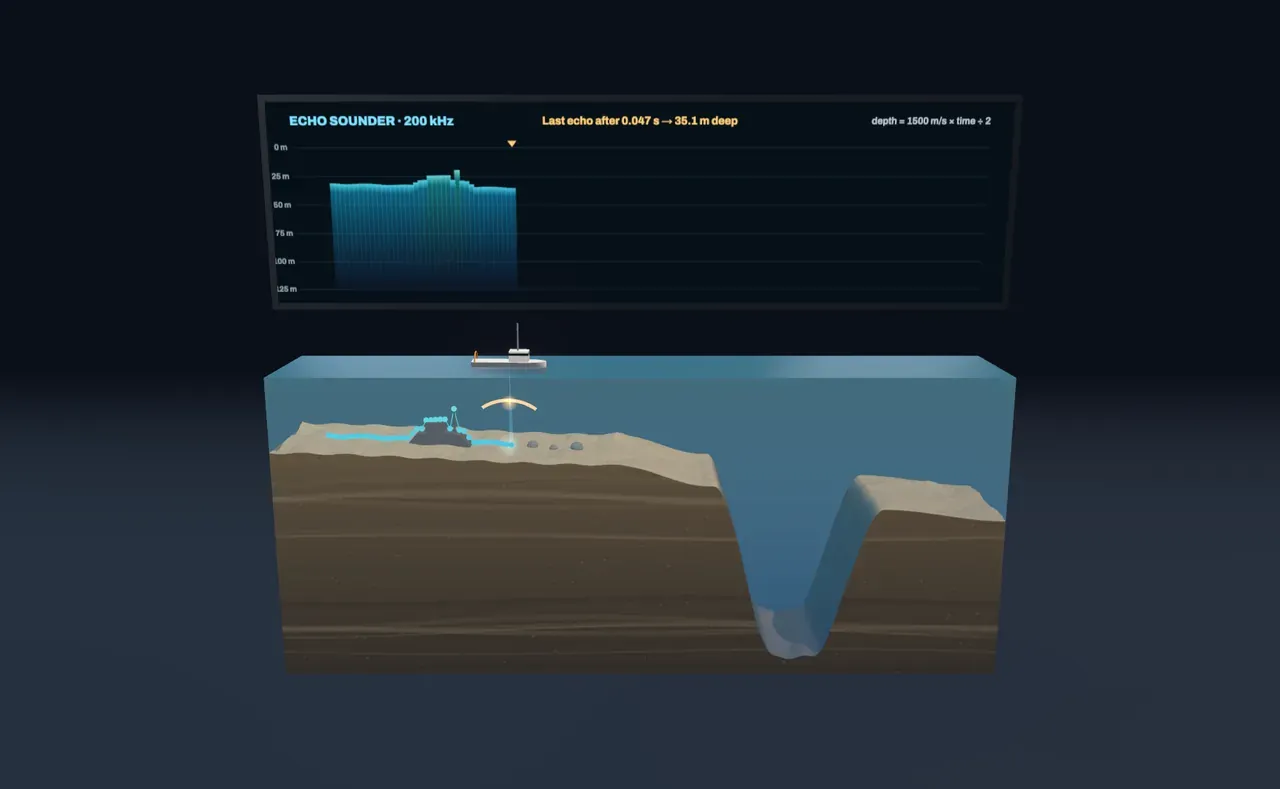
An echo that returns after 0.047 seconds came from 1500 × 0.047 ÷ 2, about 35 metres down. The sounder plots that depth straight below the ship, the ship moves on a few metres and pings again, and point by point a line of depths builds up into a profile of the seabed. That profile is a depth map.
Try it: drag Ping the sea floor back to First ping, then slowly forward. Each new bead in the water and each new column on the echo sounder’s screen is one echo’s time turned into one depth.
A beam, not a laser
A ping is not a thin ray. Sound spreads out from the transducer in a cone called the beam, and the sounder hears whatever in that cone answers first. Its width is set by the sound’s wavelength, the distance from one compression of the water to the next, compared with the width of the transducer: roughly, the beam spreads by one wavelength for every transducer width it travels. At 15 kilohertz (15 000 vibrations a second) the wavelength in seawater is 10 cm, and a hand-sized transducer sends out a cone nearly 50° wide. At 200 kilohertz the wavelength is 7.5 mm and the cone is under 4° across.
A wide cone causes a particular kind of mistake. Over bare sand next to a wreck, part of the cone already touches the wreck’s mast, which is nearer than the sand straight below. That echo comes back first, the sounder plots it as if it were straight down, and the wreck is drawn as a broad hill much wider than the ship. Over a narrow canyon the walls are nearer than the floor, so the canyon is drawn shallow, or not at all.
Try it: set Pulse frequency to 15 kHz and drag Ping the sea floor to Whole line mapped. The beads float above the sand around the wreck and cut across the canyon. Now raise it to 200 kHz: the deckhouse and the mast stand out, and the canyon floor appears.
There are two ways to narrow the beam: a higher frequency, or a wider transducer. Ships that need low frequencies fit large transducers, or rows of them, along the hull.
Try it: at 15 kHz, slide Transducer width from 12 cm, hand-sized, to 50 cm, a hull array. The same ping, sent from the wider transducer, makes a beam about a quarter as wide, and the hill shrinks back toward the wreck’s real outline.
Why not always use the highest pitch?
Because water soaks up high-pitched sound. Every metre a sound wave travels, a little of its energy is lost to the water itself, turned into heat by the molecules it shakes. The loss grows steeply with frequency: at 10 kHz seawater absorbs about 1 decibel per kilometre, at 200 kHz over 50, and at 600 kHz more than 150. On top of that, a ping spreads out as it goes, so its echo weakens with distance even in perfectly clear water.
The result is a trade. A high frequency draws fine detail but fades within a hundred metres or so. A low frequency reaches the floor of the deepest ocean, more than 10 kilometres down, but blurs everything smaller than its wide footprint. Survey ships often carry two or three sounders at different frequencies for exactly this reason.
Try it: set Pulse frequency to 600 kHz and sail the whole line. The map over the wreck is sharp, but over the canyon floor the echoes never come back, and the screen shows a gap.
Bats and dolphins did it first
Long before ships, animals were finding their way by echoes. Most bats hunt at night by calling in short, very high-pitched chirps, mostly between 20 and 100 kHz, far above what people can hear, and listening for echoes from insects. A wavelength of a few millimetres lets them pick out a moth’s wings. As a bat closes in, it calls faster and faster, so the gap between call and echo, and so the distance, updates many times a second.
Dolphins and toothed whales send trains of clicks through the water and listen with their jaws, finding fish even when the fish are buried in sand. This use of echoes by animals is called echolocation. Some blind people echolocate too, using tongue clicks to sense walls, doorways and parked cars.
From one line to a whole seabed
The sounder in this scene maps a single line. Modern survey ships use multibeam echo sounders, which send a fan of hundreds of narrow beams out to both sides at once and time each one, mapping a strip of seabed several times wider than the water is deep with every ping. Sailing back and forth in lanes, like mowing a lawn, they map the seabed in detail.
Side-scan sonar works differently: it listens to how strongly the seabed echoes rather than when, and draws pictures of wrecks, pipelines and sand ripples. Navies use passive sonar, which sends nothing and only listens, so as not to give a submarine’s position away.
What this model leaves out
The scene uses one beam, pointing straight down, with a width of one wavelength over the transducer width and a sharp edge. Real beams fade gradually toward their edges and have weaker side lobes that can pick up echoes from well off to the side. Pings are 2 m apart here, and a thin object that fell between two narrow beams would be missed altogether; the wreck’s mast happens to lie right under one ping.
The speed of sound is fixed at 1500 m/s. In the real sea it changes with temperature, saltiness and pressure, which bends sound paths and is why survey ships measure it as they go. Whether an echo is heard depends here only on distance and absorption, judged against a fixed allowance; real echoes also depend on whether the seabed is rock, sand or soft mud, on noise from the ship and the sea, and on how long the ping lasts. The wreck, boulders and canyon are invented, though their sizes are typical, and the slowed-down pulses are drawn as glowing shells so they can be seen.