A sonar maps the seabed with echoes: depth from the echo's time, a beam whose width the wavelength sets, and a frequency that trades detail against range.
Step 1 of 6 · Depth from an echo
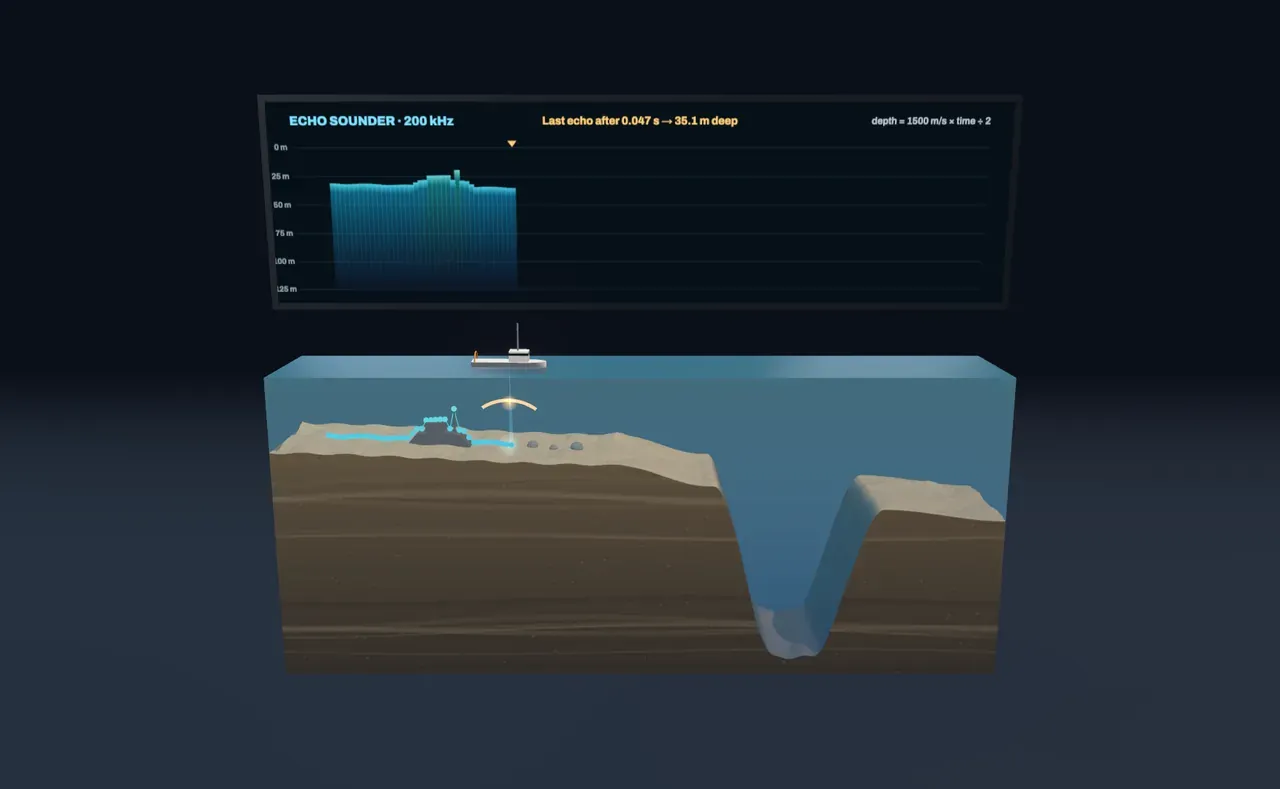
In the waves Unit you saw that sound comes back from a wall as an echo. Bats and dolphins find their way in the dark like this, and ships map the seabed. The Scene shows a research ship sailing over a sandy shelf, a wreck and a canyon, sending pulses of sound down.
Step 1 of 6
Depth from an echo
The sonar measures how long it takes from the pulse until the echo returns. The echo sounder’s screen is hidden for now: work it out yourself.
Step 2 of 6
The wavelength
The sonar’s pulses are ultrasound, sound too high for a human ear to hear. The wave rule, , holds here too, and the speed of sound in seawater is about 1500 m/s. Drag Ping the sea floor to sail the ship along the line.
Step 3 of 6
A lower pitch
The transducer is the sonar’s loudspeaker and microphone. Like a wave passing an opening, the sound leaving it spreads in a beam about radians wide, where is the Transducer width. The sonar reports the first echo to return from inside the beam.
Step 4 of 6
A narrow beam
The Pulse frequency is fixed now. There is another way to narrow the beam.
Step 5 of 6
Too high a pitch
Water absorbs sound, and absorbs more the higher the frequency. The ship is now over the canyon.
Step 6 of 6
The footprint
The beam does not hit a single point: it widens on the way down and lights up a patch of seabed.
Loading the interactive version…
Loading the interactive version…
Each step sets up the Scene for you, and a control marked “fixed” stays put for that step.
Practice · Calculate
The sonar sends a pulse straight down, and the echo returns after 0.0469 s. The speed of sound in seawater is about 1500 m/s. How deep is the water below the ship?
Practice · Calculate
The sonar sends a pulse straight down, and the echo returns after 0.0469 s. The speed of sound in seawater is about 1500 m/s. How deep is the water below the ship?
Practice · Calculate
The Pulse frequency is 200 kHz, and the speed of sound in water is 1500 m/s. What is the pulse’s wavelength?
Practice · Calculate
The Pulse frequency is 200 kHz, and the speed of sound in water is 1500 m/s. What is the pulse’s wavelength?
Practice · Predict, then look
The whole line is mapped at 200 kHz, and the wreck and its mast show. Lower the Pulse frequency to 15 kHz, with the same transducer. What will happen to the map?
Practice · Predict, then look
The whole line is mapped at 200 kHz, and the wreck and its mast show. Lower the Pulse frequency to 15 kHz, with the same transducer. What will happen to the map?
Practice · Reach the target
The Pulse frequency is fixed at 200 kHz. Change the Transducer width until the beam is narrower than 2°, then press Check.
Practice · Reach the target
The Pulse frequency is fixed at 200 kHz. Change the Transducer width until the beam is narrower than 2°, then press Check.
Practice · Predict, then look
The ship is over the canyon, about 115 m deep. Raise the Pulse frequency from 200 kHz to 600 kHz, for an even narrower beam. What will happen?
Practice · Predict, then look
The ship is over the canyon, about 115 m deep. Raise the Pulse frequency from 200 kHz to 600 kHz, for an even narrower beam. What will happen?
Practice · Calculate
Pulse frequency and Transducer width are locked, and the beam is wide in full. The seabed below the ship is 58.7 m deep. How wide is the patch of seabed the beam covers?
Practice · Calculate
Pulse frequency and Transducer width are locked, and the beam is wide in full. The seabed below the ship is 58.7 m deep. How wide is the patch of seabed the beam covers?
Lesson complete. Every practice question here is done.