Two waves that meet add up: constructive and destructive interference, the path difference that decides where the water is calm, and how many calm lines fit between two sources.
Step 1 of 5 · Two waves meet
Step 1 of 5
Two waves meet
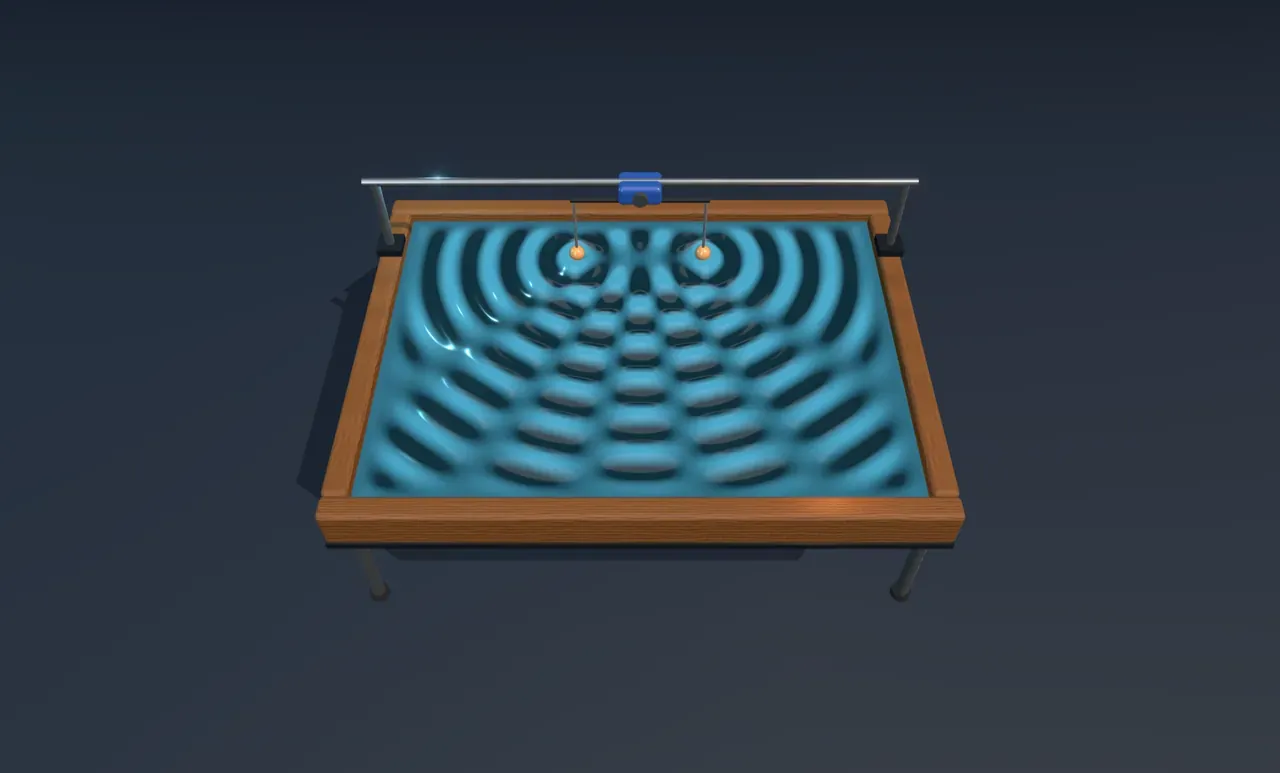
Now the tank has two beads on the same arm. They tap together, at the same frequency, and send out identical rings. The wave speed in this tank is 25 cm/s, and time is slowed down, as before.
Where two waves meet, their displacements add: the height of the water is the sum of the heights each wave would give on its own. This is the principle of superposition. Crest and crest give a double crest: constructive interference. And crest and trough?
Step 2 of 5
The path difference
Choose On under Show the calm lines: the calm water is tinted orange. To tell whether a point is calm, measure its distance from each of the two beads. The difference between the two distances is the path difference, .
- When is a whole number of wavelengths, , the two waves arrive in step: crest with crest. The water there swings strongly.
- When is half a wavelength, one and a half and so on, , a crest always arrives with a trough: destructive interference, and the water hardly moves.
At 10 Hz the wavelength is centimetres.
Step 3 of 5
How many calm lines
Each value of that gives destructive interference traces a whole curve across the water, a nodal line: a calm line that starts between the beads. But the path difference can never be larger than the distance between the beads themselves: at the extreme, a point on the line through both of them, one is further than the other by exactly the Source separation. So only values of smaller than that distance make lines.
The source separation is 8 cm. You can count the orange lines in the Scene, and you can work it out.
Step 4 of 5
Further apart
Now the beads are closer together, 4 cm, and Source separation is free. Predict what will happen to the calm lines when the beads move apart to 12 cm.
Step 5 of 5
Only two lines
Exactly the same pattern appears in sound: two loudspeakers playing the same note make loud spots and quiet spots across a room, and noise-cancelling headphones play a sound that reaches the ear exactly half a cycle after the noise. And in light, Thomas Young saw bright and dark bands when he shone it through two slits.
The Frequency is fixed. Move the beads until only two calm lines are left.
Loading the interactive version…
Loading the interactive version…
Each step sets up the Scene for you, and a control marked “fixed” stays put for that step.
Practice · Choose
A crest from one bead and an equal trough from the other arrive together at the same spot on the water. What happens?
Practice · Choose
A crest from one bead and an equal trough from the other arrive together at the same spot on the water. What happens?
Practice · Choose
The wavelength in the tank is 2.5 cm. At which point does the water hardly move?
Practice · Choose
The wavelength in the tank is 2.5 cm. At which point does the water hardly move?
Practice · Calculate
The Source separation is 8 cm and the wavelength 2.5 cm. How many calm lines are there in all?
Practice · Calculate
The Source separation is 8 cm and the wavelength 2.5 cm. How many calm lines are there in all?
Practice · Predict, then look
The beads are about to move apart, from 4 cm to 12 cm, at the same frequency. What will happen to the calm lines?
Practice · Predict, then look
The beads are about to move apart, from 4 cm to 12 cm, at the same frequency. What will happen to the calm lines?
Practice · Reach the target
The Frequency is fixed at 10 Hz. Change the Source separation until only two calm lines are left, one on each side, and press Check.
Practice · Reach the target
The Frequency is fixed at 10 Hz. Change the Source separation until only two calm lines are left, one on each side, and press Check.
Lesson complete. Every practice question here is done.