Ripples that pass through each other
Throw two stones into a pond a short way apart. Two sets of rings spread out, run into each other and carry straight on, each emerging from the crossing as if the other had never been there. Waves do not collide the way balls do. Where they overlap, the water simply does both things at once.
That rule is called superposition: the height of the water at any point is the sum of the heights each wave would give it on its own. A crest plus a crest makes a crest twice as tall. A crest plus a trough of the same size makes nothing at all.
Adding up and cancelling out
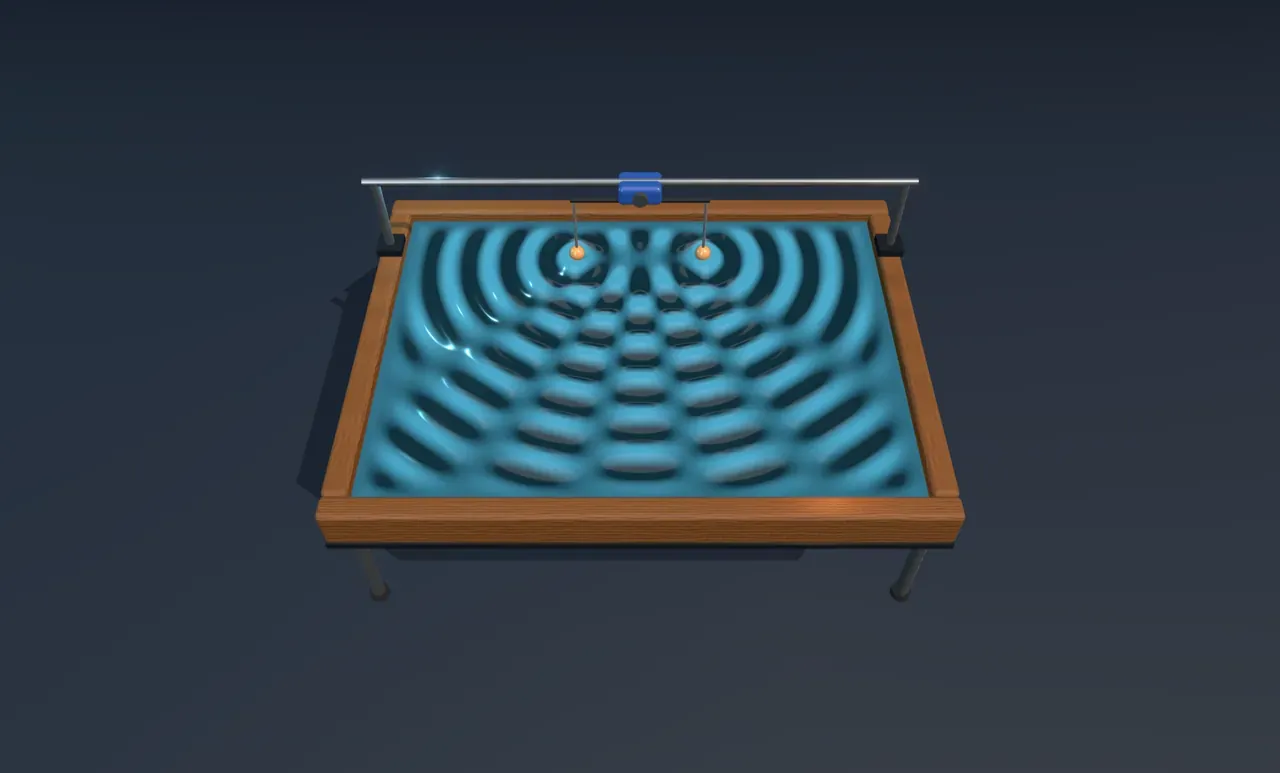
In the scene, two beads on one vibrating arm tap the water at exactly the same moments, so they send out identical rings. Look along the line straight out from between them. Every point there is the same distance from both beads, so crests from the two always arrive together and stack up. The water there heaves twice as much as either wave alone would make it. This is constructive interference.
Now find a point that is half a wavelength nearer one bead than the other. A crest from the near bead arrives just as a trough from the far one does, every time. They cancel, and the water at that point barely moves. This is destructive interference.
Calm lines
The points where the two distances differ by half a wavelength are not scattered at random. They lie along a smooth curve that fans out from between the sources. So do the points that differ by one and a half wavelengths, two and a half, and so on. Each of these curves is a nodal line: a line of calm water where the two waves always cancel. Between them lie bands where the waves always add.
Try it: slide Source separation down to 3 cm and count the calm lines. Then slide it to 13 cm and count again. Choose On under Show the calm lines to see them tinted.
The number of calm lines depends on how many wavelengths fit between the two sources. Move the sources apart and more half-wavelength differences become possible, so more lines appear, packed closer together. Raise the Frequency and the waves get shorter, which has the same effect. Lower it, or bring the sources together, and the pattern opens out into just a few wide bands.
Where else it happens
Any two waves that keep in step can interfere. Noise-cancelling headphones play a sound that is the mirror image of the noise outside, so the two cancel at your ear. Two loudspeakers playing the same tone give loud and quiet spots as you walk across a room. In the early 1800s Thomas Young made light pass through two narrow slits and saw bright and dark bands on a screen, the same pattern as the one in the tank. Because only waves can do this, it was strong evidence that light is a wave.
The cancellation does not destroy energy. Calm lines are balanced by bands where the waves add and the water swings twice as high, carrying four times the energy of one wave alone. The energy is shared out differently across the surface, not lost.
What the model leaves out
The two beads are perfectly in step and tap at exactly the same rate. Real sources drift slightly in timing, which makes the pattern wander, and sources that are not in step at all, like two ordinary light bulbs, make no steady pattern. The tank’s edges absorb every wave, so there are no reflections to add a third and fourth set of ripples. The waves are slowed and made far taller than real ones.