A wave reflected back and forth between two ends settles into a pattern that does not travel: nodes and antinodes, the wavelength of each harmonic, the frequencies of the harmonics, and how a string's length sets its pitch.
Step 1 of 5 · Nodes and antinodes
Step 1 of 5
Nodes and antinodes
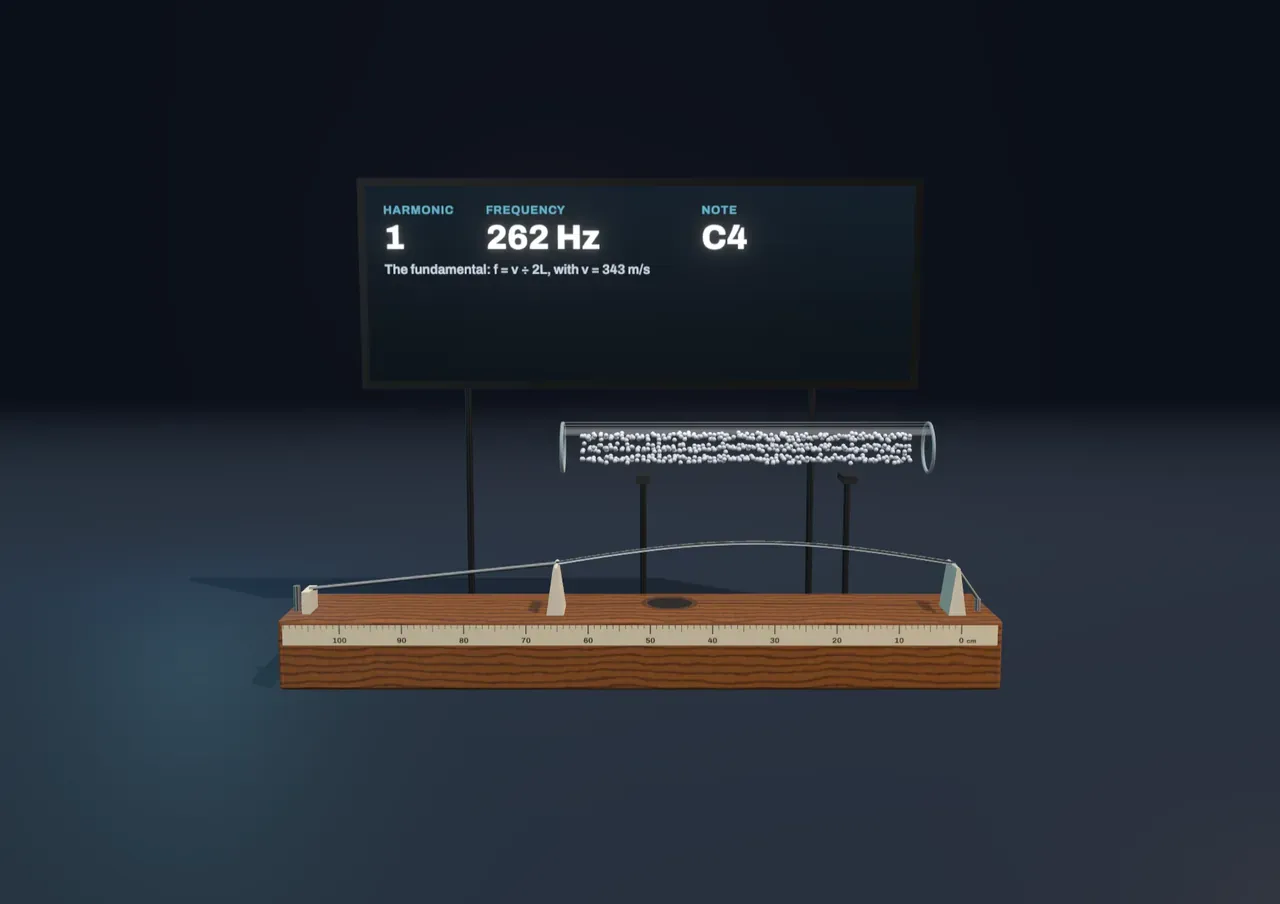
The Scene has two instruments of the same length: a steel string stretched over a wooden box, and behind it a glass pipe open at both ends. A wave running along the string is reflected at the end and comes back, and the waves going and coming add up. Only when a whole number of half-wavelengths fits the length exactly do they add up to a steady pattern that swings in place and does not travel: a standing wave.
Break down the sound is at Nodes and antinodes. The orange dots are nodes, points that never move. Halfway between two nodes is an antinode, the point that moves most. The bridges hold the ends of the string, so they are always nodes. The Harmonic is fixed at .
Step 2 of 5
The wavelength
Between two neighbouring nodes there is half a wavelength. In the -th harmonic exactly such halves fit the length :
The board behind the instruments shows half the wavelength. Length and Harmonic are fixed now.
Step 3 of 5
The harmonics
The speed of waves on a string depends on its tension and its mass, not on the harmonic. In the Scene the string is tuned so its waves travel at the speed of sound in air, 343 m/s, which is why the string and the pipe always sing the same note. By :
is the fundamental frequency, and the others are its whole-number multiples, the harmonics. The tuner on the box shows the frequency and the name of the note. Harmonic is fixed at now.
Step 4 of 5
A shorter string
A guitarist presses a string against a fret, shortening the part that vibrates. Predict what will happen to the fundamental frequency when the string is shortened from 80 cm to half that, 40 cm, then look.
Step 5 of 5
Tuning to A
The A an orchestra tunes to is 440 Hz. The Harmonic is fixed at : the string vibrates in two half-waves, an octave above its fundamental. Change Length until the tuner shows 440 Hz.
Try it: after checking, step Break down the sound to Timbre. A plucked string sounds many harmonics at once, and their mix is what tells one instrument from another on the same note.
Loading the interactive version…
Loading the interactive version…
Each step sets up the Scene for you, and a control marked “fixed” stays put for that step.
Practice · Calculate
The string vibrates in its third harmonic. How many nodes are on it, counting both ends?
Practice · Calculate
The string vibrates in its third harmonic. How many nodes are on it, counting both ends?
Practice · Calculate
The string is 65.5 cm long and vibrates in its third harmonic. What is the wavelength?
Practice · Calculate
The string is 65.5 cm long and vibrates in its third harmonic. What is the wavelength?
Practice · Calculate
The tuner shows the string’s fundamental frequency. What will the frequency of the third harmonic be, at the same length?
Practice · Calculate
The tuner shows the string’s fundamental frequency. What will the frequency of the third harmonic be, at the same length?
Practice · Predict, then look
The string will be shortened from 80 cm to 40 cm, in its fundamental. What will happen to the frequency?
Practice · Predict, then look
The string will be shortened from 80 cm to 40 cm, in its fundamental. What will happen to the frequency?
Practice · Reach the target
The Harmonic is fixed at . Change Length until the tuner shows 440 Hz, and press Check.
Practice · Reach the target
The Harmonic is fixed at . Change Length until the tuner shows 440 Hz, and press Check.
Lesson complete. Every practice question here is done.