Only some waves fit
Pluck a guitar string and it sings one clear note. Press it against a fret to shorten it, and the note rises. Blow across the top of a bottle, add water, and the note rises too. A string or a column of air can wobble in countless ways, yet it settles on a few particular notes. Why those?
A wave sent along a string runs to the end, reflects, and comes back. Waves keep running both ways, and they add together. For almost every frequency the reflections arrive out of step and wash each other out. Only when a whole number of half-wavelengths fits the length do the reflections line up, and the string settles into a steady pattern that swings in place instead of travelling. That is a standing wave.
Nodes and antinodes
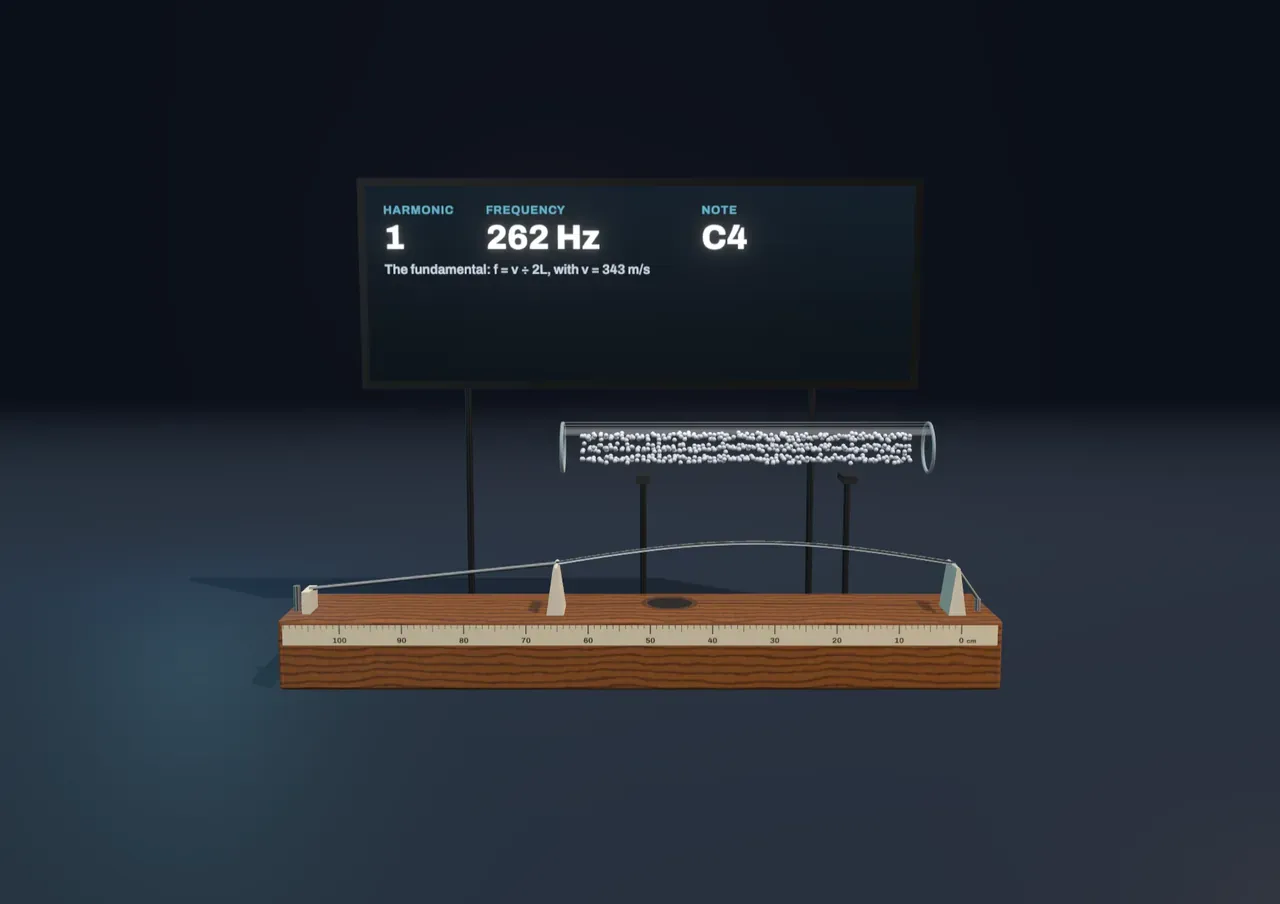
A standing wave has points that never move, called nodes, and points halfway between them that move the most, called antinodes. The ends of a string are held by the bridges, so they must be nodes. The simplest pattern that fits is one arch: half a wavelength from end to end. The next has two arches with a node in the middle, the next three, and so on.
A pipe open at both ends works the same way with the roles swapped. The air at an open end is free to rush in and out, so the ends are antinodes of movement; the pressure there stays at the room’s, because the pipe is open to it. Between them, the air surges back and forth along the pipe, piling up into compressions and thinning out at the nodes in the middle. The patterns look different, but the count is the same: one half-wavelength fits, or two, or three.
Try it: set the Harmonic to 3 and look inside at Nodes and antinodes. Count the orange dots on the string: four nodes, two of them at the bridges. The pipe has three, all in the air between its open ends.
A ladder of notes
If half-wavelengths fit the length , the wavelength is . A wave’s frequency is its speed divided by its wavelength, so
where is the wave speed. The lowest, , is the fundamental: it sets the note we hear. The others, at two, three, four times its frequency, are the harmonics (also called overtones). Doubling the frequency is an octave, so the 2nd harmonic is the note an octave up, the 3rd an octave and a fifth, the 4th two octaves. These are the same intervals that sound most consonant together, which is no coincidence: they share so many harmonics.
The formula also explains every way of tuning an instrument. A shorter string or pipe gives a higher note: that is what frets, finger holes and trombone slides do. On a string, is set by how tight it is and how heavy: , tension over mass per metre. Tighten the peg and the note rises; the thick, heavy strings play the low notes.
Try it: choose Middle C, then Concert A. The length shrinks from 65.5 cm to 39 cm and the frequency climbs from 262 Hz to 440 Hz, in proportion.
Many harmonics at once
A real string does not pick one pattern. A pluck pulls it into a sharp corner, and a corner can only be built from many standing waves added together, so a plucked string vibrates in its fundamental and many harmonics at once. All of them fit the same length, so their frequencies are exact multiples of the fundamental, and the ear hears them as one note.
How much of each harmonic you get depends on how the note is made. A pluck excites no harmonic that has a node at the plucking point: pluck at one fifth of the length, as the scene does, and the 5th harmonic is missing. Pluck close to the bridge and the high harmonics grow, which is why guitarists pick there for a bright, twangy sound and over the soundhole for a mellow one. A softly blown pipe, like a flute, puts nearly everything into the fundamental and only a little into the next few harmonics.
The timbre of an instrument, the quality that tells a flute from a guitar playing the same note, is mostly this mix. Break down the sound at Timbre: the display shows both instruments at exactly the same pitch, with different harmonic bars and differently shaped sound waves.
Try it: guitarists play “harmonics” by touching a string lightly at its middle while plucking. The finger forces a node there, which silences every harmonic that needs movement at the middle, and the note jumps an octave. Raise the Harmonic to 2 and see the node that finger makes.
What this model leaves out
The scene’s string never loses energy, while a real one fades within a few seconds, its high harmonics first, so the sound grows mellower as it dies. Real strings are also a little stiff, which nudges their high harmonics slightly sharp of exact multiples; piano tuners stretch their octaves to allow for it. A real open pipe behaves as if it were a little longer than it is, because the standing wave pokes out past each open end by about a third of the pipe’s width.
The pipe’s mix of harmonics is a typical shape for a softly blown flue pipe, not a measurement of a particular instrument, and the string’s assumes an ideal pluck at one point. Timbre also depends on how a note starts and fades, and on the body of the instrument, which favours some frequencies over others. The scene shows the string vibrating in one plane and draws the air’s swing many thousands of times larger than it really is, so the motion can be seen at all.
A pipe closed at one end follows a different rule: the closed end must be a node, so only odd harmonics fit, and its fundamental is an octave lower than an open pipe of the same length. That is part of why a clarinet sounds so different from a flute.