Muscles only pull, so they work in pairs; the biceps pulls eight times the weight because its tendon sits close to the elbow; and inside the muscle, actin and myosin filaments slide past each other and pull hardest in the middle.
Step 1 of 6 · Muscles only pull
Step 1 of 6
Muscles only pull
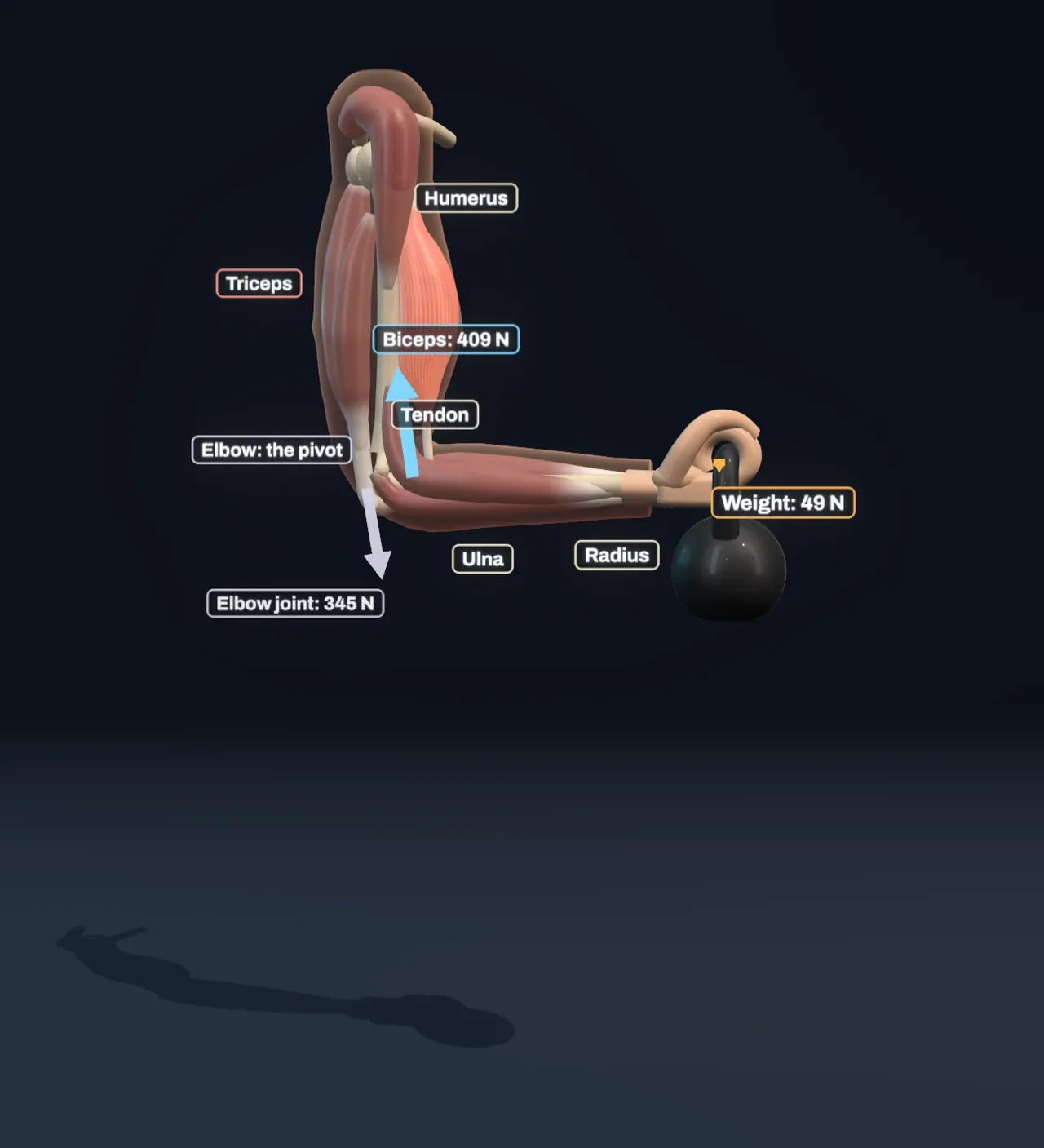
A muscle can do one thing: shorten, and pull on whatever its ends are tied to. Muscles are tied to bones by tendons, and each one crosses a joint. To put a joint back you need a second muscle on the other side, so muscles work in antagonistic pairs. At the elbow the biceps, at the front of the upper arm, bends it, and the triceps, behind, straightens it. The working muscle glows.
Step 2 of 6
A losing lever
The forearm is a lever, and the elbow is its pivot. What turns a lever is the moment of a force: the force times its distance from the pivot. When the forearm stays still, the moments on each side of the elbow balance:
With the Elbow angle at a right angle, the kettlebell hangs 33 cm from the elbow, and the biceps tendon joins the bone only 4.53 cm from it. The forearm itself, about 1.6 kg, has weight too: it adds a moment of 2.35 N·m.
Step 3 of 6
Why so close?
Every lever trades force for movement. A biceps pulling eight times the weight sounds like poor design; think what is gained in return.
Step 4 of 6
The limit
A muscle can pull only so hard, and the chart shows that limit as the blue line; the amber line is the pull the load needs. As they come together, almost every fibre in the muscle is pulling, and the arm starts to shake.
Step 5 of 6
Sliding filaments
Zoom into the muscle is at Filaments: one sarcomere, the repeating unit of a muscle fibre, from one Z disc to the next. Thin filaments of actin are anchored in the discs, and thick filaments of myosin sit in the middle. Myosin heads grab the actin, swing and drag it towards the middle, and let go; each cycle uses one molecule of ATP. Drag Elbow angle from 45° to 160°, nearly straight, and watch the filaments’ length.
Step 6 of 6
Strongest in the middle
How hard a muscle can pull depends on how much its filaments overlap: only a myosin head that reaches actin can pull. Load is locked at 16 kg, and the biceps only just holds it with the elbow at a right angle, 90°.
Loading the interactive version…
Loading the interactive version…
Each step sets up the Scene for you, and a control marked “fixed” stays put for that step.
Practice · Predict, then look
With the hand holding a kettlebell, the biceps glows: it pulls the forearm up. Predict which muscle works when Task switches to Push a cable down.
Practice · Predict, then look
With the hand holding a kettlebell, the biceps glows: it pulls the forearm up. Predict which muscle works when Task switches to Push a cable down.
Practice · Calculate
The hand holds 8 kg with the elbow at a right angle. The kettlebell is 33 cm from the elbow, the tendon 4.53 cm from it, and the forearm itself adds a moment of 2.35 N·m. How hard does the biceps pull? ( m/s²)
Practice · Calculate
The hand holds 8 kg with the elbow at a right angle. The kettlebell is 33 cm from the elbow, the tendon 4.53 cm from it, and the forearm itself adds a moment of 2.35 N·m. How hard does the biceps pull? ( m/s²)
Practice · Choose
Why does the biceps tendon join so close to the elbow, even though that makes the muscle pull eight times the weight?
Practice · Choose
Why does the biceps tendon join so close to the elbow, even though that makes the muscle pull eight times the weight?
Practice · Reach the target
Elbow angle is locked at 90°, a right angle. Find the heaviest Load the biceps can still hold, and press Check.
Practice · Reach the target
Elbow angle is locked at 90°, a right angle. Find the heaviest Load the biceps can still hold, and press Check.
Practice · Choose
Drag Elbow angle from 160°, nearly straight, to 45° and watch the sarcomere. What happens as the biceps shortens?
Practice · Choose
Drag Elbow angle from 160°, nearly straight, to 45° and watch the sarcomere. What happens as the biceps shortens?
Practice · Predict, then look
At a right angle, 90°, the biceps only just holds 16 kg. As the arm straightens, the kettlebell hangs closer under the elbow. Predict what happens when Elbow angle goes to 160°, nearly straight.
Practice · Predict, then look
At a right angle, 90°, the biceps only just holds 16 kg. As the arm straightens, the kettlebell hangs closer under the elbow. Predict what happens when Elbow angle goes to 160°, nearly straight.
Lesson complete. Every practice question here is done.