Muscles only pull
A muscle can do one thing: shorten, and pull on whatever its ends are tied to. It cannot push. The muscles that move your skeleton are tied to bones by tendons, tough cords of collagen, and each one crosses a joint, so when it shortens it turns one bone about the other.
To move a joint back again you need a second muscle on the other side, so muscles work in antagonistic pairs. At the elbow the biceps, in front of the upper arm, bends it, and the triceps, behind, straightens it. When one of the pair pulls, the other relaxes and is gently stretched. (Often both tense a little at once, which holds the joint steady.)
Try it: switch Task from Hold a weight to Push a cable down. The glow moves from the biceps to the triceps: pushing down needs the other half of the pair.
A lever that loses on purpose
The forearm is a lever, and the elbow is its pivot, just like the bar of a simple machine. What turns a lever is a force’s moment: the force times its distance from the pivot. For the forearm to stay still, the moments on either side of the elbow must balance:
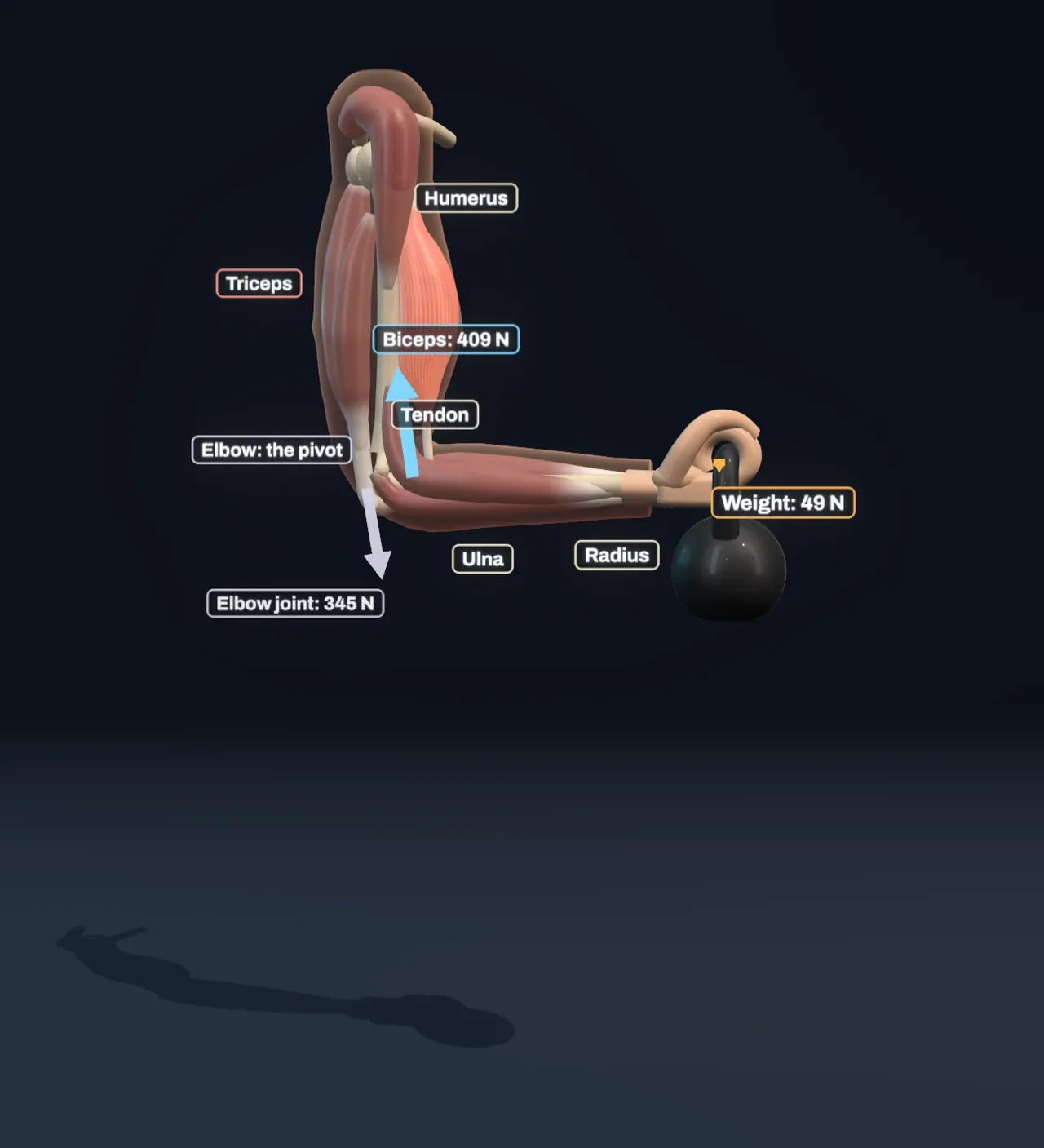
The weight in your hand is about 33 cm from the elbow, but the biceps’ tendon joins the radius only about 4.5 cm from it. So the biceps must pull roughly 33 ÷ 4.5, about seven times the weight, and a little more to hold up the forearm itself, which weighs about 1.6 kg. Hold 5 kg, a weight of 49 newtons, with the forearm level, and the biceps pulls about 410 N, as hard as you would have to pull to lift a 42 kg sack.
The forces must balance too, not just their moments, because nothing is speeding up (as in the laws of motion). The biceps pulls the forearm up far harder than the weight pulls it down, so the end of the humerus presses down on the forearm at the elbow with the difference, about 345 N. The grey arrow in the Scene shows that force on the joint.
Try it: set Load to 16 kg with Elbow angle at 90°, a right angle. The biceps must pull about 1,200 N, close to its limit, and the arm starts to shake.
Why so close to the joint?
Every lever trades force for movement. Because the tendon is 4.5 cm from the elbow and the hand is 33 cm from it, every centimetre the biceps shortens moves the hand about seven centimetres, and seven times as fast. A muscle can shorten by only about a third of its length, and not very quickly, so a tendon close to the joint is how a short muscle swings the hand through a wide arc in a fraction of a second, to throw, strike or reach. It also keeps the arm slim, with its muscles lying along the bone.
The triceps makes the same trade even more steeply. Its tendon wraps round the olecranon, the bony point of your elbow, only about 2 cm behind the joint. Pushing a 5 kg cable down with the forearm level takes about 660 N, some 13 times the cable’s pull.
The two muscles use the forearm as two kinds of lever. For the biceps the pull acts between the pivot and the load, which makes it a third-class lever, like tweezers. For the triceps the pivot sits between the pull and the load, which makes it a first-class lever, like a seesaw. Either way the body chooses speed and reach over force.
The angle changes the leverage
Straighten the arm and the weight hangs closer below the elbow, so its moment shrinks; it is largest with the forearm level. But the biceps’ line of pull also swings in towards the elbow as the arm straightens, and its lever arm shrinks almost as fast. So the pull the biceps needs changes much less than you might expect: with a few kilograms or more in the hand it stays between about six and ten times the weight until the arm is almost straight. The triceps’ lever arm stays about the same, so pushing a cable down is hardest with the forearm level and easy with the arm nearly straight.
What does change with the angle is how hard the muscle can pull, and for that you have to look inside it.
Inside a muscle
Step Zoom into the muscle to Muscle fibres. A muscle is a bundle of bundles: it is wrapped in a sheet of connective tissue, and inside are bundles of muscle fibres, each wrapped again. A fibre is a single cell, but a huge one. It forms when many cells fuse, so it has hundreds of nuclei lying just under its surface, and it can be many centimetres long while less than a tenth of a millimetre wide. Capillaries run between the fibres to bring oxygen and fuel.
Inside, each fibre is packed with myofibrils, rods about a thousandth of a millimetre thick that run its whole length. They are striped, and the stripes line up across the fibre, which is why this kind of muscle is called striated. Each stripe pattern repeats every 2 to 3 thousandths of a millimetre: that repeating unit is a sarcomere, and a 10 cm fibre has about 40,000 of them end to end in every myofibril.
A muscle only pulls when its nerve tells it to. One motor nerve cell in the spinal cord sends its fibre out to the muscle, where it branches to a group of muscle fibres scattered through it; the cell and its fibres together make a motor unit, and they all contract together when it fires (see the nervous system).
Try it: at Muscle fibres, change the Load. More fibres light up as the load grows. The nervous system grades force by switching on more motor units, the smallest first, and by making each one fire faster.
Sliding filaments
Step Zoom into the muscle on to Filaments for one sarcomere. It runs from one Z disc to the next. Thin filaments of the protein actin are anchored in each Z disc and reach towards the middle. Thick filaments of myosin sit in the middle, between them, each surrounded by six thin ones, and from them stick out hundreds of myosin heads.
When a nerve signal reaches the fibre, it releases calcium inside, which uncovers the places on actin where myosin heads can grip. Each head then runs a cycle: it grabs the actin, swings and drags it about ten millionths of a millimetre towards the middle (the power stroke), lets go, and cocks itself again. Each cycle uses one molecule of ATP, the fuel made by cellular respiration, and it is the ATP that lets the head go, which is why muscles lock stiff after death. One head pulls with only a few trillionths of a newton, but billions of them pull together.
The filaments themselves never get shorter. They slide past each other, the Z discs are drawn in, and thousands of sarcomeres in a row, each shortening a little, shorten the whole muscle. This sliding filament theory was put forward in 1954 by two pairs of researchers working separately: Andrew Huxley and Rolf Niedergerke, and Hugh Huxley and Jean Hanson.
Try it: at Filaments, drag Elbow angle from 45° to 160°. The Z discs move apart and the actin slides out from between the myosin, while every filament keeps its length.
When you hold a weight still, as in the Scene, the heads keep cycling: the muscle pulls without moving, burning ATP and making heat. That is why even holding something still is tiring.
Strongest in the middle
How hard a muscle can pull depends on how much the filaments overlap. Stretch it and the actin slides out until few heads can reach it: in the Scene, the biceps of a nearly straight arm has sarcomeres about 3 thousandths of a millimetre long. Bunch it up and the actin filaments from both ends crowd into each other and the myosin presses on the Z discs: the biceps of a bent elbow is down to about 1.9. In between, near 2.5, every head can grip and the muscle is at its strongest. This is the muscle’s length–tension curve, and the blue line on the chart follows it across the elbow’s range.
Put the leverage and the length together and you get what you feel in the gym. The biceps holds 16 kg with the elbow at a right angle, but the same weight is too heavy with the elbow bent tight or nearly straight.
Try it: with Load at 16 kg, set Elbow angle to 45°, then 90°, then 160°, and watch where the amber line on the chart climbs above the blue one.
What this model leaves out
The arm in the Scene holds still. Lifting a weight needs a little more pull to speed it up, and a muscle pulls less while it is shortening fast and more while it is being stretched, which is why lowering a weight slowly feels easier than lifting it.
The biceps stands for all three muscles that bend the elbow: the biceps itself, the brachialis underneath it and the brachioradialis in the forearm. Their pulls are added together along the biceps’ line. The triceps’ lever arm is taken as a steady 2.1 cm, the tendons as not stretching, and the upper arm as hanging straight down. The strengths, 1,300 N for the benders and 2,100 N for the triceps at their best lengths, are round numbers for a fairly strong adult; people differ widely. The length–tension curve is an idealised one built from the lengths of the filaments, and the slight tensing of the relaxed muscle is left out.
The fibres and filaments are drawn to show their structure, not their size. The fibre’s stripes are much wider apart than real sarcomeres would be at that scale, the filament lattice is spread eight times wider than it really is, there are far fewer myosin heads than in a real sarcomere, and they cycle hundreds of times more slowly.