

Nothing changes by itself
Leave a book on a table and it stays there. Slide a puck across ice and it glides a long way before stopping. These look like opposite behaviours, but they follow one rule: an object keeps doing what it is already doing, staying still or moving in a straight line at a steady speed, unless a force acts on it. Isaac Newton set this out as his first law of motion in 1687.
The puck does slow down in the end, and the book never starts moving on its own, because of forces we tend to forget: friction between the puck and the ice, and the table pushing up on the book exactly as hard as gravity pulls it down. When the forces on something cancel, its motion does not change.
A push changes speed
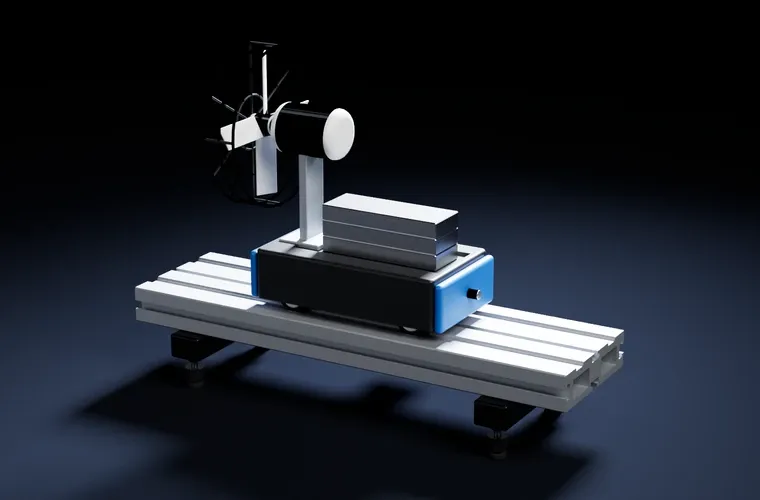
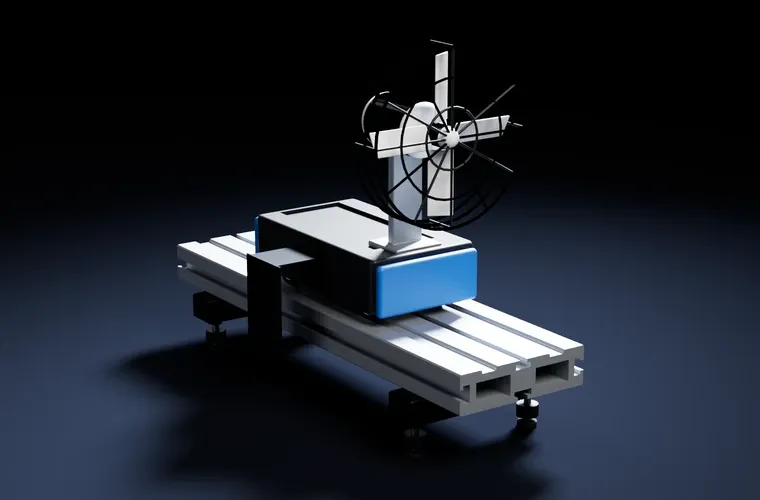
Switch on the fan in the scene. It throws air backwards, and the cart starts to roll. Watch the orange marks: they are laid down every half second, and the gaps between them keep growing. A steady push does not give a steady speed. It gives a steady change of speed, an acceleration.
Newton’s second law says how big that change is: acceleration equals the net force divided by the mass, a = F / m. Double the push and the cart speeds up twice as fast. Double the mass and the same push speeds it up only half as fast. This is the trolley in the supermarket: a full one has more mass, so your arms produce less acceleration. Mass, measured in kilograms, is a measure of exactly this reluctance to change speed.
Try it: set Fan push to 0.2 N and compare Cart mass at 0.5 kg and 3 kg. Then slide Fan push down to 0 while the cart is rolling, and notice it carries on at the speed it had.
Every push has a partner
How does a fan push a cart? It pushes on the air, shoving it backwards. The air pushes back on the fan, and so on the cart, just as hard in the opposite direction. That is Newton’s third law: forces always come in pairs, equal in size and opposite in direction, acting on two different objects.
Choose On under Show the forces to see both arrows of that pair. Because they act on different things, they never cancel each other out. The cart feels only the air’s push on it; the air feels only the fan’s push on it.
Reading the arrows
The Reveal also shows the cart’s weight pulling down and the track’s normal force pushing up. They are equal, so the cart neither sinks nor lifts. Along the track there is the fan’s push forward and a tiny rolling friction backward. Subtract one from the other and you get the net force, the only force that counts for acceleration. The green arrow shows it, with the acceleration it produces: 0.5 newtons on a 1 kilogram cart gives about half a metre per second, gained every second.
What this model leaves out
The model keeps the fan’s push perfectly constant and leaves out air resistance, which on a real cart grows with speed and would gradually limit it. Rolling friction is a small fixed fraction of the weight. Real fans push less as the cart speeds up, and real tracks are never perfectly level. The three laws themselves hold extremely well for everyday objects, failing only near the speed of light or at the scale of atoms.