How much acceleration a force gives: the link between force, mass and acceleration, the newton as a unit, and what happens when several forces act on the same cart.
Step 1 of 6 · Force and acceleration
The first law says that a net force changes the velocity. The second law says by how much.
Step 1 of 6
Force and acceleration
Newton’s second law links the net force on a body, its mass and its acceleration:
So : the same force gives a light body a large acceleration and a heavy body a small one. Mass is a measure of inertia: how hard it is to change a body’s velocity. The acceleration points the way the net force does.
There is no friction on the track, so the net force is the fan’s push. Work out the cart’s acceleration, then choose On under Show the forces: the green arrow shows the net force and the acceleration it gives.
Step 2 of 6
Twice the mass
Now the fan pushes a 1 kg cart with 0.8 N, and the acceleration is 0.8 m/s². You will load another 1 kg onto the cart, and the fan will go on pushing with the same force. Predict the new acceleration.
Step 3 of 6
The newton
The second law is also the definition of the unit of force. One newton is the force that gives a 1 kg body an acceleration of 1 m/s²:
Check the units of : kilograms times metres per second squared. That is newtons, as it should be.
The cart is loaded now, and its mass is 2 kg. Change Fan push so that the acceleration is exactly 0.25 m/s².
Step 4 of 6
Several forces together
In the second law is the net force: all the forces added up, with their directions. When forces act along one line, choose a positive direction, here forward, and add with signs, like displacements along a line.
Now the cart’s wheels are a little stiff, and the track holds it back with 0.2 N of friction. The fan pushes 1 N forward, and the mass is 2 kg. Work out the acceleration, then check with Show the forces.
Step 5 of 6
Speed after three seconds
When the net force is constant the acceleration is constant too, and everything you learned about constant acceleration applies: from rest, and . This is how the second law joins forces to motion: from the forces you find the acceleration, and from the acceleration the velocity and position at any moment.
The same cart, the same push and the same friction. What is its speed three seconds after it sets off, just before the end of the track?
Step 6 of 6
In summary
- Newton’s second law: , where is the net force. The acceleration points the way it does.
- The same force on twice the mass gives half the acceleration; twice the force on the same mass gives twice the acceleration.
- 1 N = 1 kg·m/s²: the force that gives a kilogram an acceleration of 1 m/s².
- Forces along one line add with signs: a force against the positive direction goes in with a minus. From the net force you find the acceleration, and from that the velocity and position.
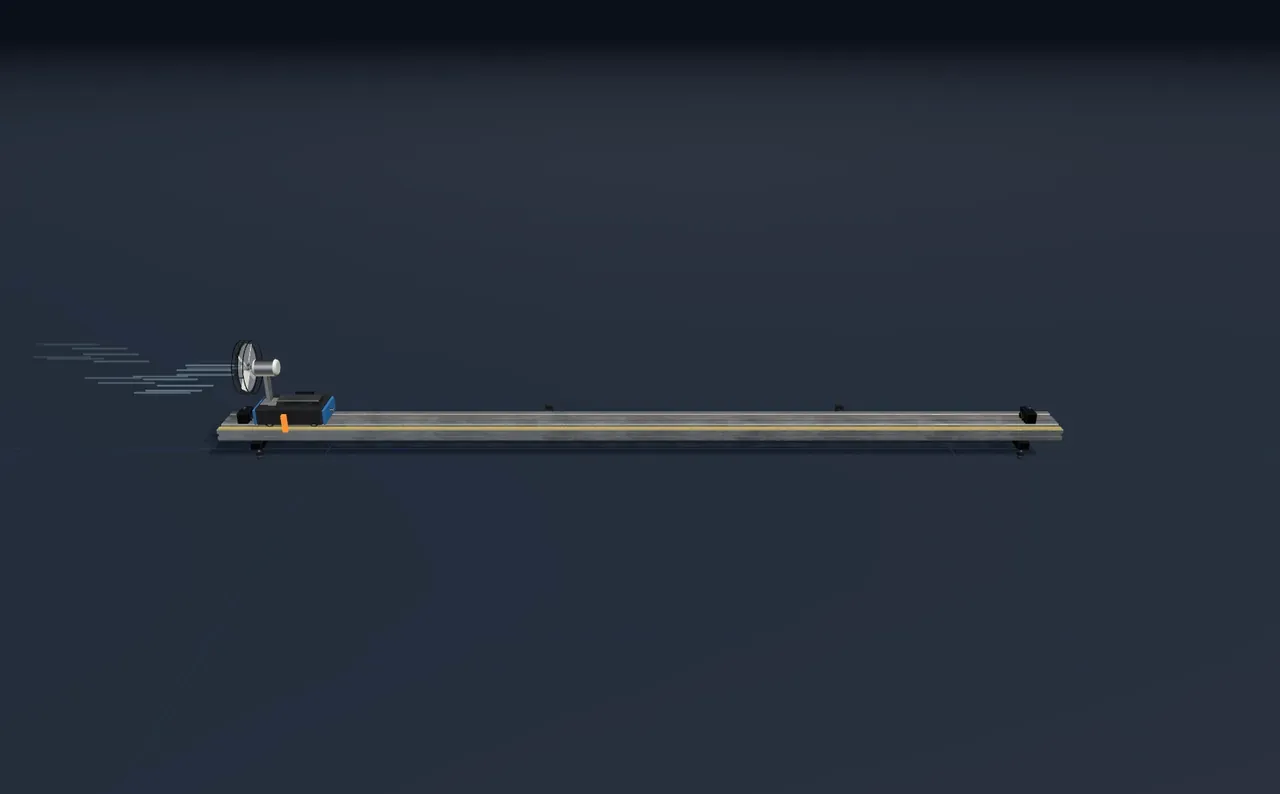
Loading the interactive version…
Loading the interactive version…
Each step sets up the Scene for you, and a control marked “fixed” stays put for that step.
Practice · Calculate
The fan pushes a 1.5 kg cart with 0.6 N, and there is no friction. What is the cart’s acceleration?
Practice · Calculate
The fan pushes a 1.5 kg cart with 0.6 N, and there is no friction. What is the cart’s acceleration?
Practice · Predict, then look
Now the acceleration is 0.8 m/s². You will load another 1 kg onto the cart, and the fan will go on pushing with 0.8 N. What will the acceleration be, in m/s²?
Practice · Predict, then look
Now the acceleration is 0.8 m/s². You will load another 1 kg onto the cart, and the fan will go on pushing with 0.8 N. What will the acceleration be, in m/s²?
Practice · Reach the target
The cart’s mass is 2 kg, and there is no friction. Change Fan push so that the acceleration is 0.25 m/s², and press Check.
Practice · Reach the target
The cart’s mass is 2 kg, and there is no friction. Change Fan push so that the acceleration is 0.25 m/s², and press Check.
Practice · Calculate
The fan pushes the cart forwards with 1 N, friction holds it back with 0.2 N, and its mass is 2 kg. What is its acceleration?
Practice · Calculate
The fan pushes the cart forwards with 1 N, friction holds it back with 0.2 N, and its mass is 2 kg. What is its acceleration?
Practice · Calculate
The same cart: a push of 1 N, friction of 0.2 N and a mass of 2 kg. It sets off from rest. What is its speed after 3 s?
Practice · Calculate
The same cart: a push of 1 N, friction of 0.2 N and a mass of 2 kg. It sets off from rest. What is its speed after 3 s?
Lesson complete. Every practice question here is done.