Forces come in pairs: the fan and the air, the Earth and the cart. Weight, the normal force, and why an action–reaction pair does not cancel itself.
Step 1 of 6 · Forces come in pairs
So far you have looked at one body and the forces on it. But every force is exerted by some other body: the fan, the track, the Earth. This lesson asks what happens to that other body.
Step 1 of 6
Forces come in pairs
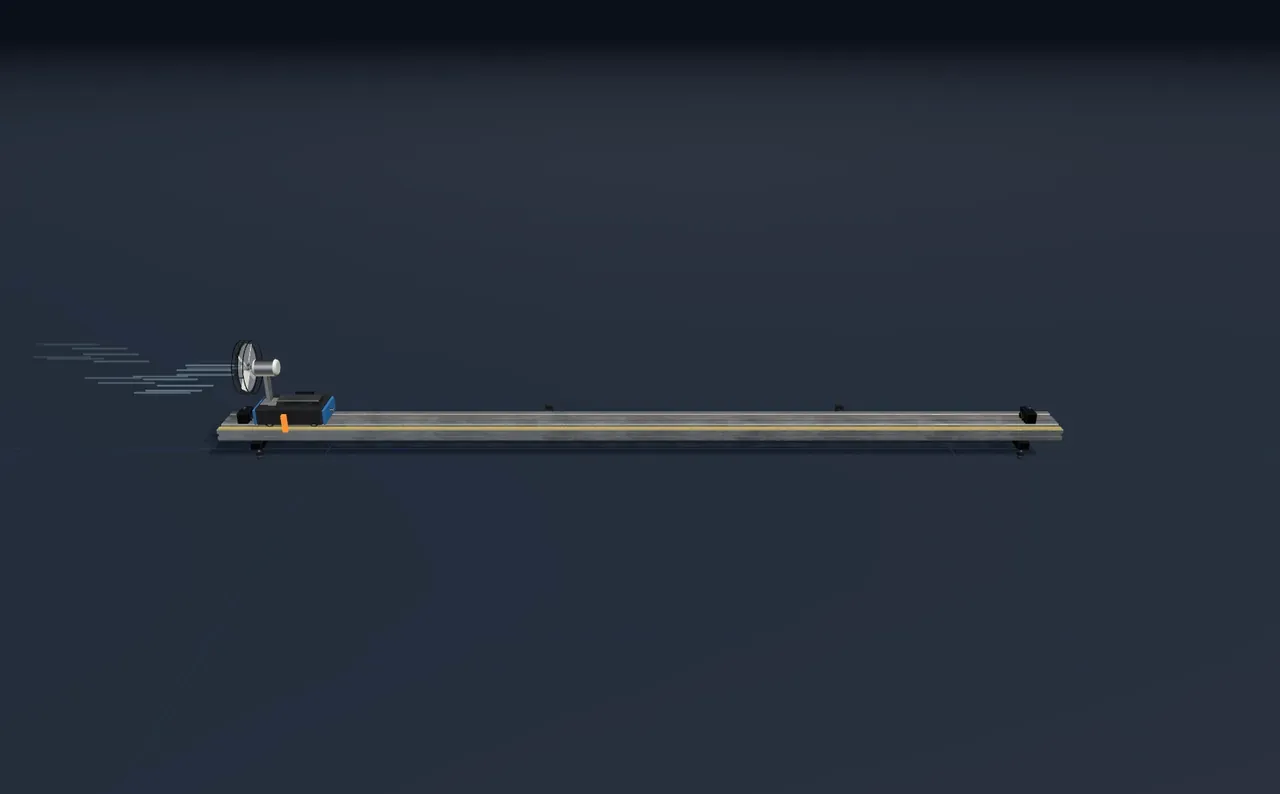
How does a fan move a cart? It pushes the air backwards, and the air pushes the fan, and the cart with it, forwards. Show the forces is On: behind the cart is the arrow of the fan pushing the air, and above it the arrow of the air pushing the cart.
This is Newton’s third law: when one body exerts a force on a second body, the second exerts a force on the first that is equal in size and opposite in direction. The two forces are called an action–reaction pair, but neither comes “first”: they appear together and vanish together.
Try it: change Fan push and follow the labels of the two arrows.
Step 2 of 6
Why the pair does not cancel
If the two forces are equal and opposite, how does the cart accelerate? Think about it before you answer: which body does each of them act on?
Step 3 of 6
Weight
The Earth pulls every body downwards. That force is the body’s weight, and it equals the mass times the acceleration due to gravity, :
Mass and weight are two different things. Mass, in kilograms, is the amount of matter in a body and a measure of its inertia, and it is the same everywhere. Weight is a force, in newtons, and on the Moon it is about six times smaller.
The cart’s mass is now 2.5 kg. Work out its weight, then choose On under Show the forces to check it on the weight arrow, pulling down.
Step 4 of 6
Falling together
A heavy body is pulled down harder: change Cart mass and watch the weight arrow grow in proportion to the mass. But a heavy body also has more mass to accelerate. When a body falls without air, its weight is the only force on it, and the second law gives
The mass cancels: every body falls with the same acceleration, 9.81 m/s². A feather falls slowly only because of the air.
Step 5 of 6
The normal force
The cart does not fall through the track, because the track pushes it upwards. That force is the normal force: the force a surface exerts on a body pressed against it, at right angles (“normal”) to the surface. Here it equals the weight, because the cart does not accelerate up or down, so by the first law the net vertical force is zero.
Notice: the weight and the normal force both act on the cart. So they are not an action–reaction pair, even when they are equal and opposite.
Step 6 of 6
In summary
- Newton’s third law: when one body exerts a force on a second, the second exerts on the first a force equal in size and opposite in direction.
- The two forces of a pair act on different bodies, so they do not cancel each other. To tell whether a body accelerates, add only the forces on it.
- Weight is the force with which the Earth pulls a body: , in newtons. Without air every body falls with acceleration .
- The normal force is a surface’s push, at right angles to it. On a level surface with no other vertical forces it equals the weight, but it is not the weight’s partner: the weight’s partner is the cart’s pull on the Earth.
Loading the interactive version…
Loading the interactive version…
Each step sets up the Scene for you, and a control marked “fixed” stays put for that step.
Practice · Choose
The fan pushes the air backwards with a force of 0.5 N. With what force does the air push the fan forwards?
Practice · Choose
The fan pushes the air backwards with a force of 0.5 N. With what force does the air push the fan forwards?
Practice · Choose
The fan pushes the air backwards with 0.5 N, and the air pushes the cart forwards with 0.5 N. Why does the cart accelerate all the same?
Practice · Choose
The fan pushes the air backwards with 0.5 N, and the air pushes the cart forwards with 0.5 N. Why does the cart accelerate all the same?
Practice · Calculate
The cart’s mass is 2.5 kg. What is its weight? Take .
Practice · Calculate
The cart’s mass is 2.5 kg. What is its weight? Take .
Practice · Choose
A 1 kg ball and a 3 kg ball are released together from the same height. There is no air. Which reaches the floor first?
Practice · Choose
A 1 kg ball and a 3 kg ball are released together from the same height. There is no air. Which reaches the floor first?
Practice · Choose
The cart’s weight is the Earth’s pull on the cart. What is its partner under the third law?
Practice · Choose
The cart’s weight is the Earth’s pull on the cart. What is its partner under the third law?
Lesson complete. Every practice question here is done.