A wooden block resting on a slope: how to draw every force acting on it, split its weight into two components, and find the normal force and the friction.
Step 1 of 5 · Drawing the forces
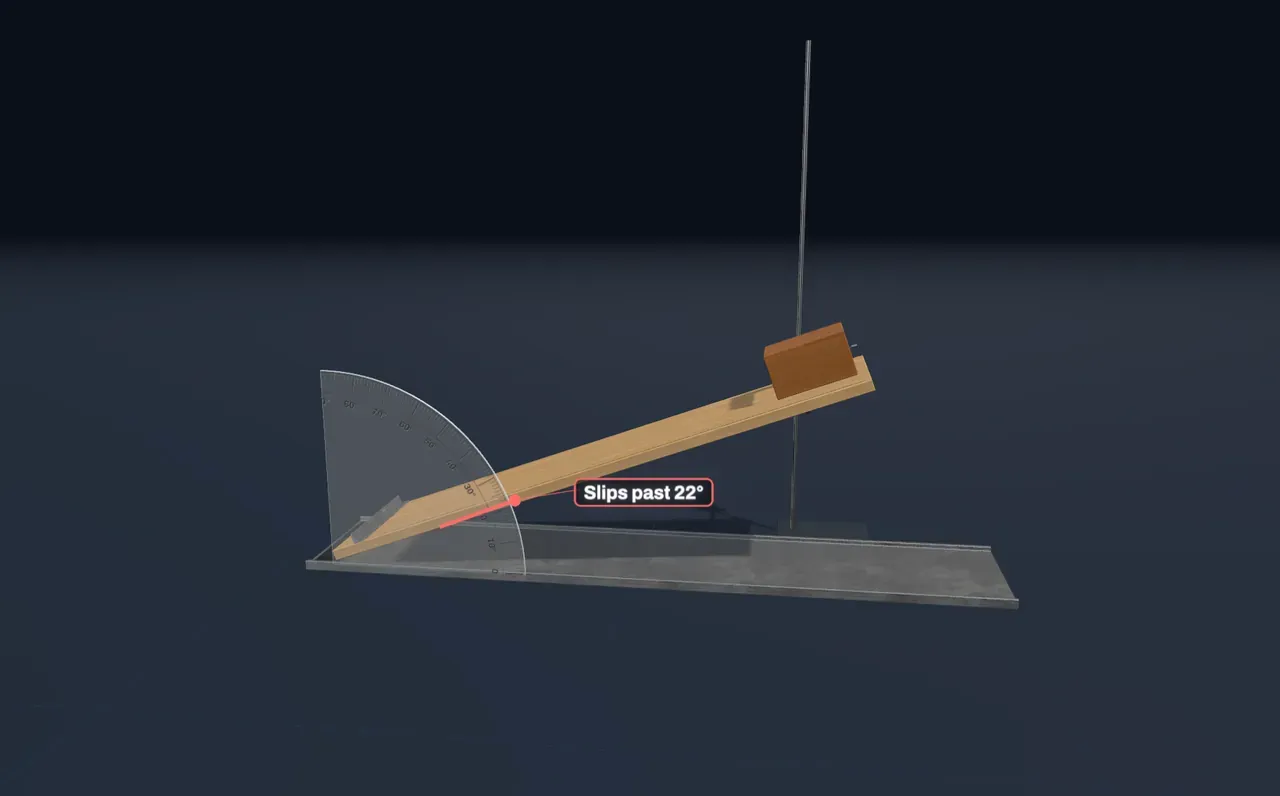
A wooden block rests on a tilted board and does not move. By the first law, the net force on it is zero. But which forces act on it, and how big is each one? To answer, you draw a free-body diagram.
Step 1 of 5
Drawing the forces
A free-body diagram shows one body and every force on it, each force as an arrow leaving the body in its direction. This is how you build one:
- Choose one body, here the block, and draw only that.
- Add the weight: the Earth pulls the block straight down, without touching it.
- Go over everything that touches the block. Here that is only the board, and it exerts two forces: a normal force pushing at right angles to the board, and friction along the board.
- Do not add forces the block exerts on other bodies, nor “forces” that no body exerts.
Before you answer, try drawing the diagram on paper. Then choose On under Show the forces and compare.
Step 2 of 5
Splitting the weight
On a slope it helps to split every force into two components: along the board, and at right angles to it. Friction lies wholly along the board, and the normal force wholly at right angles to it. Only the weight, pointing straight down, is tilted relative to the board, so you split it, as you split vectors into components:
is the slope angle. The component pulls the block down the board, and presses it into the board. To remember which one has the sine, check a level board, : there all the weight presses into the board () and none of it pulls along ().
The block neither lifts off the board nor sinks into it, so at right angles to the board the net force is zero: .
Now the board is tilted at , and the block is heavier: 2 kg. Work out the normal force, then check with Show the forces.
Step 3 of 5
The friction that holds
Along the board the net force is zero too, because the block stays put. So friction acts up the board, exactly as big as the component pulling down it. Work out how much friction acts on the block.
Step 4 of 5
A steeper slope
Show the forces is On, and the board is still at . Now the angle goes up to . The block will still hold, because the surface is rough. Predict what will happen to the normal force.
Try it: after you answer, change Slope angle between and and follow the arrows: the weight does not change, the normal force shrinks and the friction grows.
Step 5 of 5
In summary
- A free-body diagram shows one body and every force on it: the weight, and each force from a body touching it. Leave out forces the body exerts.
- On a slope, split the weight into a component along the board, , and one at right angles to it, .
- The normal force balances the component at right angles: . It equals the weight only on a level surface; on a slope it is smaller.
- A block resting on a slope: static friction equals the component pulling down the slope, , and acts up the board.
Loading the interactive version…
Loading the interactive version…
Each step sets up the Scene for you, and a control marked “fixed” stays put for that step.
Practice · Choose
A wooden block rests without moving on a tilted board. Which forces act on it? Choose all of them.
Practice · Choose
A wooden block rests without moving on a tilted board. Which forces act on it? Choose all of them.
Practice · Calculate
The block, 2 kg, rests on a board tilted at . What normal force does the board exert on it?
Practice · Calculate
The block, 2 kg, rests on a board tilted at . What normal force does the board exert on it?
Practice · Calculate
The same block, 2 kg, rests on the board at . Surface grip is . How big is the friction force acting on it?
Practice · Calculate
The same block, 2 kg, rests on the board at . Surface grip is . How big is the friction force acting on it?
Practice · Predict, then look
The board will go up from to , and the block will still hold. What will happen to the normal force?
Practice · Predict, then look
The board will go up from to , and the block will still hold. What will happen to the normal force?
Lesson complete. Every practice question here is done.