The force you only notice when it fails
Friction is everywhere and mostly invisible. It lets you walk without slipping, holds a knot tight and keeps a parked car on a hill. You tend to notice it only when it runs out: a rug that skids on a polished floor, a tyre on ice, a book that suddenly slides off a tilted shelf.
Friction is the force that resists one surface sliding over another. It always acts along the surfaces and against the slipping, or against the slipping that would happen without it.
Why rough meets rough
Even polished surfaces are jagged at a small enough scale. When two touch, they rest on the tips of countless tiny bumps, and the true area of contact is a small fraction of what it looks like. At those tips the materials press together so hard that they cling and interlock. Sliding means shearing or riding over all those contacts at once.
Press the surfaces together harder and the bumps flatten into more contact, so friction grows in proportion to how hard the surfaces are pushed together, the normal force. The ratio of the two is the coefficient of friction, written μ. Ice gives roughly 0.1, wood on wood something like 0.25 to 0.5, and rubber on a dry surface often 0.6 to 1 or more.
Holding still: static friction
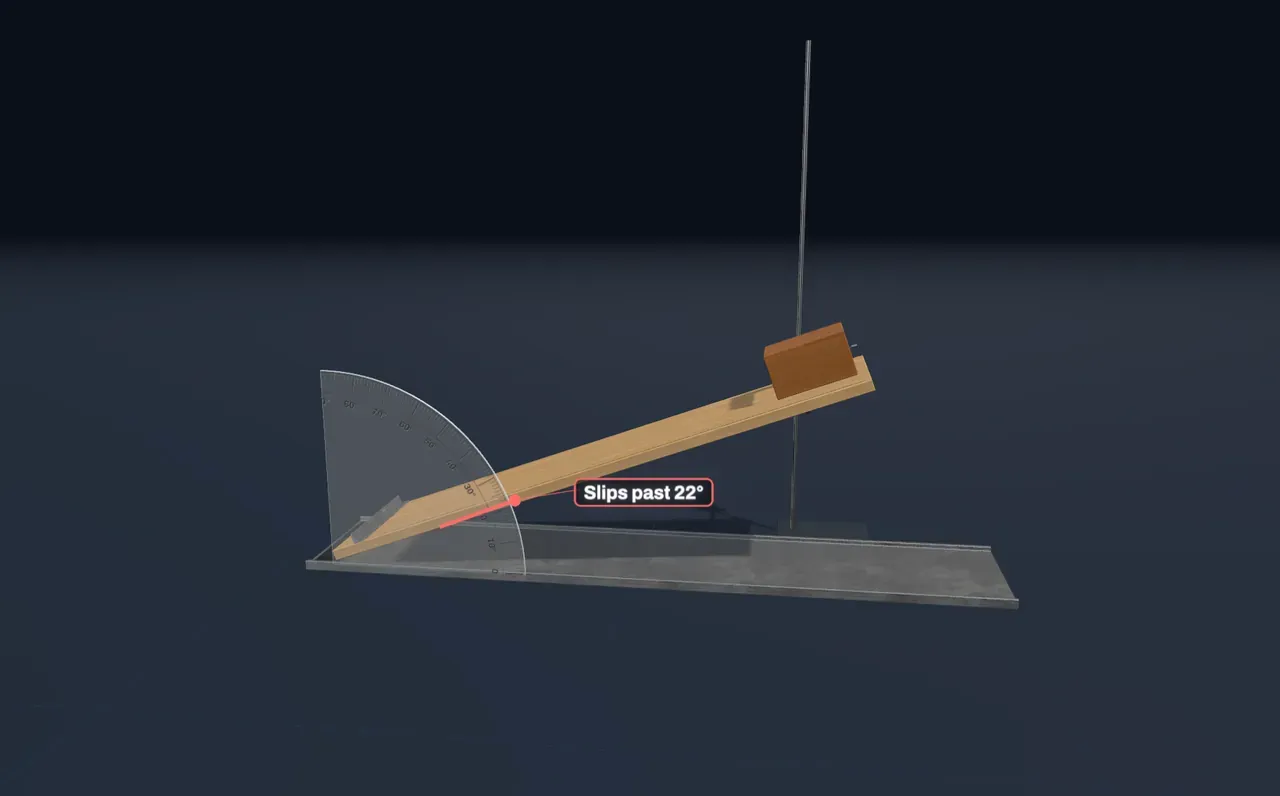
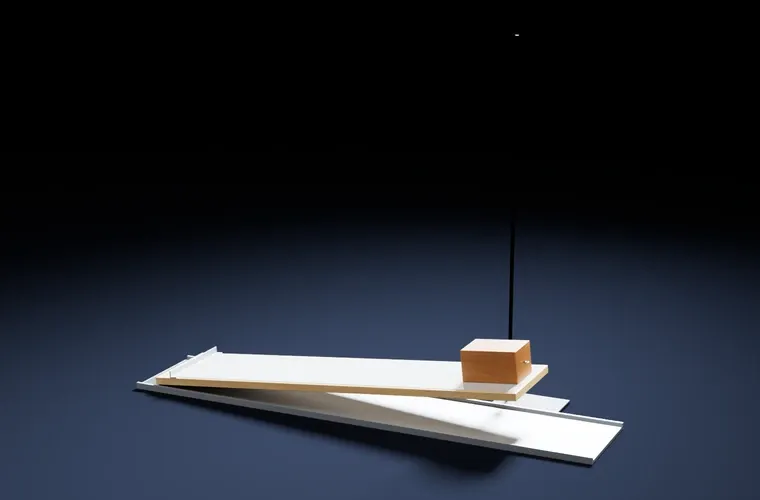
Tilt the board slightly and the block stays put. Part of its weight now pulls it down the slope, and static friction pushes back up the slope by exactly the same amount, no more. It is a matching force: it grows to meet whatever tries to move the block, up to a limit of μ times the normal force.
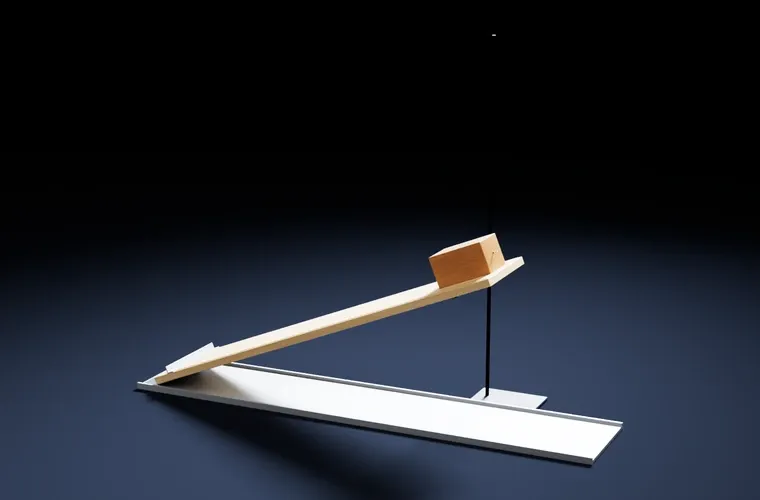
Tilting the board does two things at once. It increases the part of the weight that pulls along the slope, and it decreases the part that presses into the board, which lowers the limit. At one angle the pull wins. That angle depends only on the surface: it is the angle whose tangent equals μ. Mass cancels out, so a heavy block and a light one of the same wood slip at the same tilt.
Try it: set Surface grip to 0.4, wood on wood, and raise Slope angle a degree at a time until the block slips past the red mark. Then try 0.1, a sheet of ice, and 0.8, rubber, and watch the mark move.
Sliding: kinetic friction
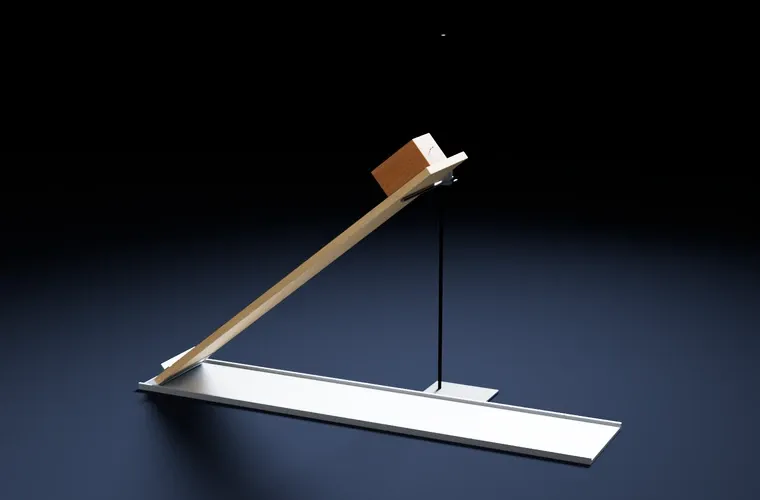
Once the block moves, the bumps have less time to settle into each other and the friction usually drops. This kinetic friction is why something that has just started to slide often keeps going and speeds up, and why a heavy piece of furniture is hardest to move at the very start. In the scene, the arrow changes its label from static to kinetic at that moment, and the net force appears: the difference between the pull down the slope and the friction holding it back.
What this model leaves out
The model uses the textbook description of friction: a fixed coefficient for each surface, independent of speed and of how large the contact area is. That description works surprisingly well for dry solids but is only an approximation. Real coefficients change with moisture, temperature, dust and wear, and lubricated or very soft surfaces behave quite differently. The block never tips or bounces, and the grip values are typical figures, not measurements.