How much friction can hold, at what angle a block starts to slide, and how fast it then speeds up.
Step 1 of 6 · The limit of static friction
In the last lesson you saw static friction hold a block on a slope with exactly the force needed. But friction has a limit, and what happens past the limit is different from what happens before it.
Step 1 of 6
The limit of static friction
Static friction acts between surfaces that are not sliding over each other. It matches the force trying to move them, but only up to a limit that depends on the surfaces and the normal force:
is the coefficient of static friction, a number with no units that depends on the two surfaces: about for ice, for wood on wood and for rubber. Surface grip in the Scene is .
On a slope the block holds as long as the component pulling down the board does not pass the limit: . Divide both sides by :
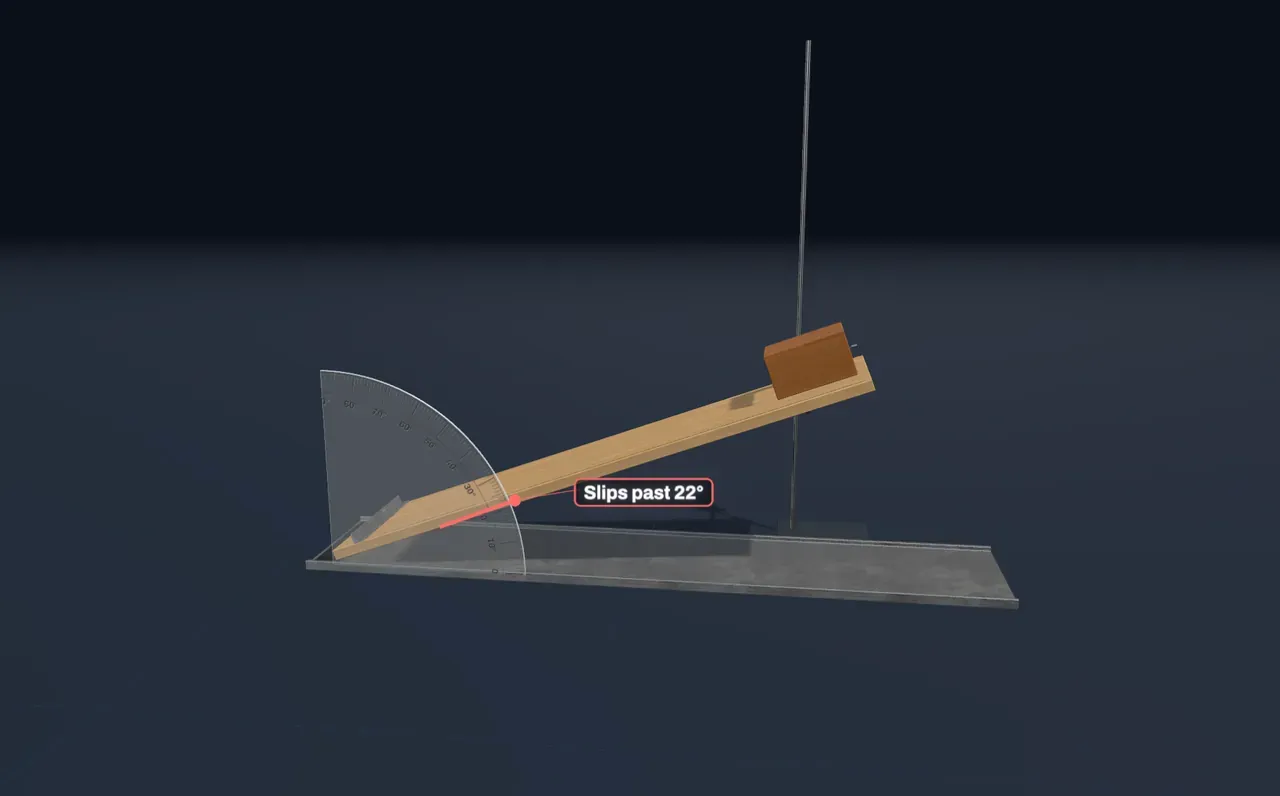
The block starts to slide at the angle whose tangent is . That is the red mark on the protractor.
The board is fixed at and the surface is ice, so the block slides. Work out the smallest that holds it in place, then raise Surface grip and check.
Step 2 of 6
A heavier block
The condition you found, , has no mass in it at all: it cancelled. Now the board is at and the surface is wood, , and the 1 kg block holds. You will double the block’s mass. Predict what will happen.
Step 3 of 6
Kinetic friction
Once the block is sliding, the friction on it is kinetic friction. It no longer adjusts itself: it is constant, against the direction of sliding, and its size is
The coefficient of kinetic friction is usually smaller than . That is why a heavy wardrobe is harder to start moving than to keep moving. In the Scene is three quarters of : for wood, .
Now the board is at and the 1 kg block slides. Work out the friction force on it. Then choose On under Show the forces: the label of the arrow up the board now says kinetic friction.
Step 4 of 6
Down the slope
Along the board two forces act on the sliding block: the weight’s component down the slope, , and kinetic friction up it, . The net force is the difference between them, and the second law gives the acceleration:
Here too the mass cancels. Work out the block’s acceleration down the board, at and with .
Step 5 of 6
Choosing an acceleration
Now the other way round: choose the acceleration and look for the slope. The board is at and the block holds. Change Slope angle so that the block slides with an acceleration of about 2 m/s². The label of the green arrow shows the net force, and for a 1 kg block its number equals the acceleration.
Step 6 of 6
In summary
- Static friction matches the force trying to move a body, up to a limit: .
- On a slope a block starts to slide when , whatever its mass.
- Kinetic friction acts against the sliding, and its size is constant: , usually with .
- A block sliding down a slope accelerates at , also independent of its mass.
Loading the interactive version…
Loading the interactive version…
Each step sets up the Scene for you, and a control marked “fixed” stays put for that step.
Practice · Calculate
The board is tilted at . What is the smallest that holds the block in place? Answer to two decimal places.
Practice · Calculate
The board is tilted at . What is the smallest that holds the block in place? Answer to two decimal places.
Practice · Predict, then look
At on wood, , the 1 kg block holds. You will swap it for a 2 kg block of the same wood. What will happen?
Practice · Predict, then look
At on wood, , the 1 kg block holds. You will swap it for a 2 kg block of the same wood. What will happen?
Practice · Calculate
The block, 1 kg, slides down a wooden board tilted at . The coefficient of kinetic friction is . How big is the friction force on it?
Practice · Calculate
The block, 1 kg, slides down a wooden board tilted at . The coefficient of kinetic friction is . How big is the friction force on it?
Practice · Calculate
The same block slides down the board at , with . What is its acceleration?
Practice · Calculate
The same block slides down the board at , with . What is its acceleration?
Practice · Reach the target
On a wooden board, . Change Slope angle so that the block slides down with an acceleration of about 2 m/s², and press Check.
Practice · Reach the target
On a wooden board, . Change Slope angle so that the block slides down with an acceleration of about 2 m/s², and press Check.
Lesson complete. Every practice question here is done.