A force that moves a body does work on it: the force times the distance moved along it. Forces at right angles to the motion do no work, friction does negative work, and the net work is the kinetic energy the body gains.
Step 1 of 6 · A force over a distance
In the forces Unit you saw what a force does to motion at a given moment: it gives an acceleration. Here the question is different: what does a force achieve over a distance? The answer is a new idea, work, and it is the first step towards energy.
Step 1 of 6
A force over a distance
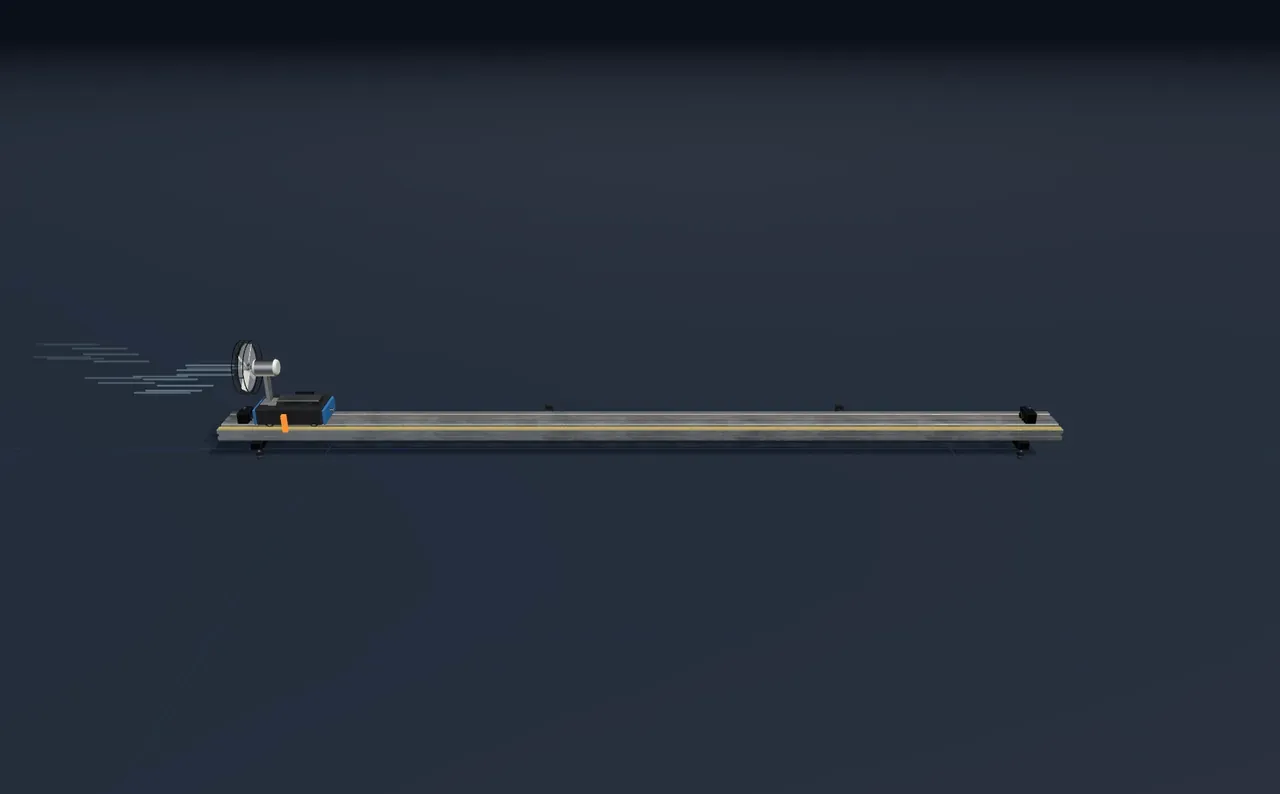
The fan pushes the cart forward with a steady force, and the cart moves in the direction of the push. When a force acts on a body that moves a distance in the direction of the force, the force does work on it:
The unit of work is the newton times the metre, called the joule: 1 J = 1 N·m. One joule is roughly the work you do lifting an apple by a metre.
Notice that there is no time in the formula. A force that pushes on a wall for an hour, while the wall does not move, does no work on it at all.
Step 2 of 6
Forces that do no work
Show the forces is On: see every force on the cart. The air’s push acts along the track, in the direction of motion. But the weight pulls down and the normal force pushes up: both are at right angles to the motion.
A force at right angles neither carries the cart along the track nor holds it back, so it does no work, however big it is. Only the part of a force along the motion counts.
Step 3 of 6
A force at an angle
When a force pulls at an angle to the motion, split it into components, as you did with vectors. The component along the motion, , does the work, and the perpendicular component does nothing:
At this is again, and at the work is zero, like the weight’s on the track.
Step 4 of 6
Negative work
Now the track is rougher, and Show the forces shows the red friction arrow. Friction pulls backwards, against the motion: the angle between it and the motion is , and . So its work is negative: it takes from the cart instead of giving.
Step 5 of 6
Net work and speed
Add up the work of all the forces on a body and you get the net work, which is also the work of the net force. It equals a new quantity, the body’s kinetic energy, the energy it has because it is moving:
Here is the net work, and this is the work–energy theorem. A body that starts at rest and has net work done on it moves at the speed with . The speed is squared: to double the speed takes four times the work.
Try it: change the Cart mass. The same push over the same distance gives a heavy cart and a light one the same kinetic energy, but the light cart moves faster.
Step 6 of 6
In summary
- A force that a body moves along does work , in joules: 1 J = 1 N·m.
- A force at right angles to the motion, like the weight and the normal force on a level track, does no work. A force against the motion, like friction, does negative work.
- The net work equals the change in kinetic energy, . In the next lesson you will see where the energy goes when a body climbs and falls.
Loading the interactive version…
Loading the interactive version…
Each step sets up the Scene for you, and a control marked “fixed” stays put for that step.
Practice · Calculate
The fan pushes the cart with a force of 0.5 N, and in the first two seconds the cart moves 0.98 m along the track. How much work does the push do on the cart in that time?
Practice · Calculate
The fan pushes the cart with a force of 0.5 N, and in the first two seconds the cart moves 0.98 m along the track. How much work does the push do on the cart in that time?
Practice · Choose
The cart’s weight is 9.8 N. How much work does it do on the cart while the cart travels 0.98 m along the level track?
Practice · Choose
The cart’s weight is 9.8 N. How much work does it do on the cart while the cart travels 0.98 m along the level track?
Practice · Calculate
You pull a suitcase along a level floor with a force of 40 N on its handle, and the handle is at above the horizontal. The suitcase moves 25 m. How much work does the pull do?
Practice · Calculate
You pull a suitcase along a level floor with a force of 40 N on its handle, and the handle is at above the horizontal. The suitcase moves 25 m. How much work does the pull do?
Practice · Calculate
On the rougher track friction pulls the cart back with a force of 0.49 N. In the first two seconds the cart moves 1.02 m forward. How much work does friction do on the cart in that time?
Practice · Calculate
On the rougher track friction pulls the cart back with a force of 0.49 N. In the first two seconds the cart moves 1.02 m forward. How much work does friction do on the cart in that time?
Practice · Calculate
The fan pushes a 0.5 kg cart with a force of 1 N, and friction is negligible. The cart starts from rest. What is its speed after the first metre?
Practice · Calculate
The fan pushes a 0.5 kg cart with a force of 1 N, and friction is negligible. The cart starts from rest. What is its speed after the first metre?
Lesson complete. Every practice question here is done.