How a nerve cell passes a message on: the resting potential, the threshold, an impulse that is all or nothing, strength coded as rate, and myelin that speeds the impulse a hundredfold.
Step 1 of 7 · A cell at rest
Step 1 of 7
A cell at rest
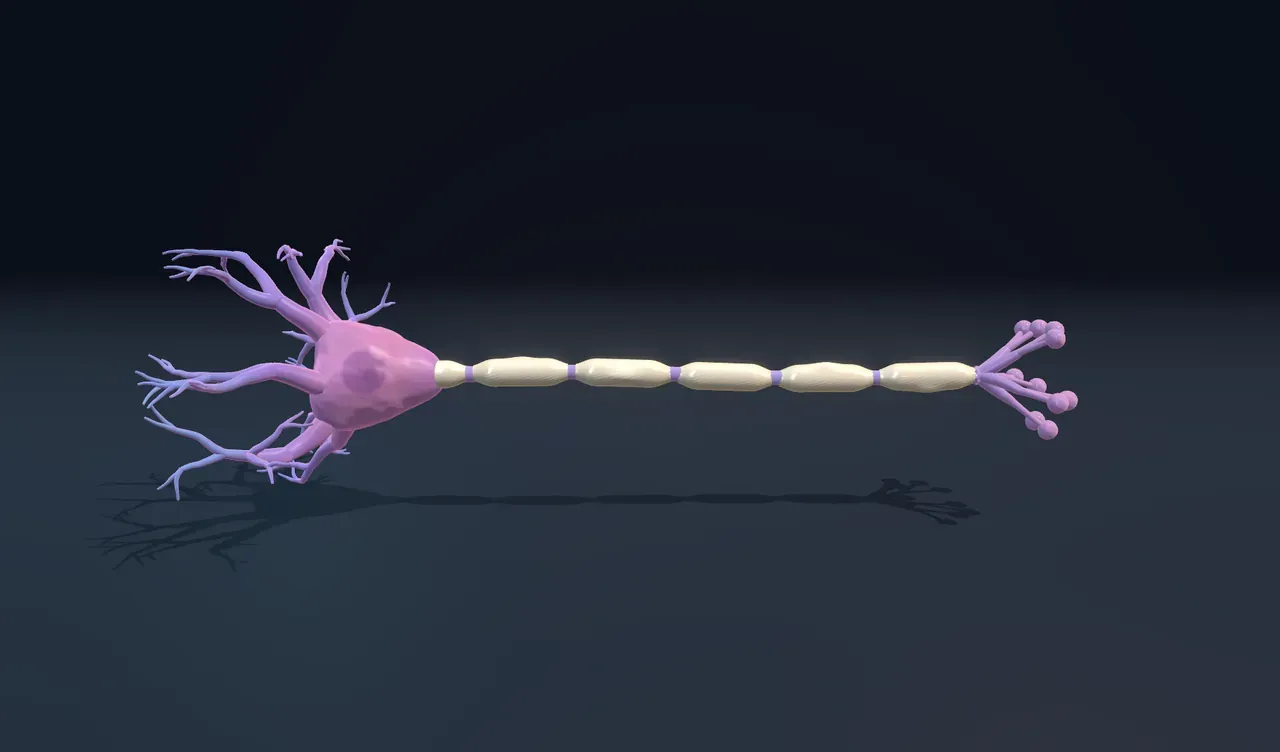
The nervous system, the brain, the spinal cord and the nerves, carries messages through the body faster than any other system. Its unit is the nerve cell (neuron): branching dendrites gather signals, the cell body adds them up, and a long axon carries the result on, sometimes a metre or more.
Even when a nerve cell is quiet, it is not switched off. Pumps in its membrane push sodium ions out and bring potassium ions in, which sets up a steady voltage between the inside of the cell and the outside. Stimulus is now fixed at zero.
Step 2 of 7
The threshold
Signals arriving at the dendrites raise the voltage in the cell body, each a little. If the voltage reaches the threshold, about −55 mV, the cell fires a nerve impulse, also called an action potential, along the axon. If not, the small effects fade and nothing goes out. The threshold of the cell in the Scene is fixed.
Step 3 of 7
All or nothing
When the cell crosses the threshold, gates in the membrane open and sodium ions rush in, until the inside of the cell turns positive for a moment. The size of the impulse is set by the gates and the ions, not by the stimulus that started it. This is the all-or-nothing rule.
Step 4 of 7
Strength as rate
If every impulse is the same size, how does the brain know whether you were touched lightly or pressed hard? Count the impulses. Stimulus is now fixed a little above the threshold.
Step 5 of 7
What travels along the axon
Show the ions is On. Watch the dots crossing the membrane just ahead of the impulse’s glow and behind it. The flip of the voltage in one patch opens the gates in the next, and so the impulse moves on.
Step 6 of 7
How fast
Most fast nerves are wrapped in myelin, a fatty sheath laid down in segments, with small gaps between them. Under the sheath the impulse cannot leak, so it jumps from gap to gap. A myelinated axon conducts at about 100 m/s. In the Scene the impulses are slowed about a thousandfold, so you can see them.
Step 7 of 7
Without myelin
A bare axon conducts an impulse at about a metre a second. In the Scene the bare impulse looks only three times slower, so that both cases fit on the screen; the real difference you will work out yourself.
Loading the interactive version…
Loading the interactive version…
Each step sets up the Scene for you, and a control marked “fixed” stays put for that step.
Practice · Calculate
Stimulus is fixed at 0%. What is the voltage across the membrane, inside against outside, when the nerve cell is at rest? Answer in millivolts.
Practice · Calculate
Stimulus is fixed at 0%. What is the voltage across the membrane, inside against outside, when the nerve cell is at rest? Answer in millivolts.
Practice · Reach the target
Myelin sheath is fixed. Raise Stimulus step by step, and find the weakest stimulus that makes the cell fire. Leave it there and press Check.
Practice · Reach the target
Myelin sheath is fixed. Raise Stimulus step by step, and find the weakest stimulus that makes the cell fire. Leave it there and press Check.
Practice · Predict, then look
At a stimulus of 50% each impulse peaks at +40 mV. What will the peak be when the stimulus rises to 100%?
Practice · Predict, then look
At a stimulus of 50% each impulse peaks at +40 mV. What will the peak be when the stimulus rises to 100%?
Practice · Predict, then look
A stimulus of 45%, a little over the threshold. What will change when the stimulus rises to 90%?
Practice · Predict, then look
A stimulus of 45%, a little over the threshold. What will change when the stimulus rises to 90%?
Practice · Choose
Show the ions is On. What moves along the axon as an impulse passes?
Practice · Choose
Show the ions is On. What moves along the axon as an impulse passes?
Practice · Calculate
A nerve 1 m long carries an impulse from the toe to the spinal cord. With myelin the impulse travels at about 100 m/s. How many milliseconds does the trip take?
Practice · Calculate
A nerve 1 m long carries an impulse from the toe to the spinal cord. With myelin the impulse travels at about 100 m/s. How many milliseconds does the trip take?
Practice · Predict, then look
With myelin the impulse covers the metre in 10 ms. What will happen when you switch off Myelin sheath?
Practice · Predict, then look
With myelin the impulse covers the metre in 10 ms. What will happen when you switch off Myelin sheath?
Lesson complete. Every practice question here is done.