How the body holds 37 degrees: a cool room and a freezing night, what happens with the thermostat switched off, why sweat cools, the band where you neither shiver nor sweat, and what negative feedback is.
Step 1 of 6 · Thirty-seven degrees
Step 1 of 6
Thirty-seven degrees
The body’s cells work within narrow conditions: temperature, water, sugar and salts in the blood. Enzymes, for example, work best around 37 °C. Keeping those conditions steady whatever happens outside is called homeostasis.
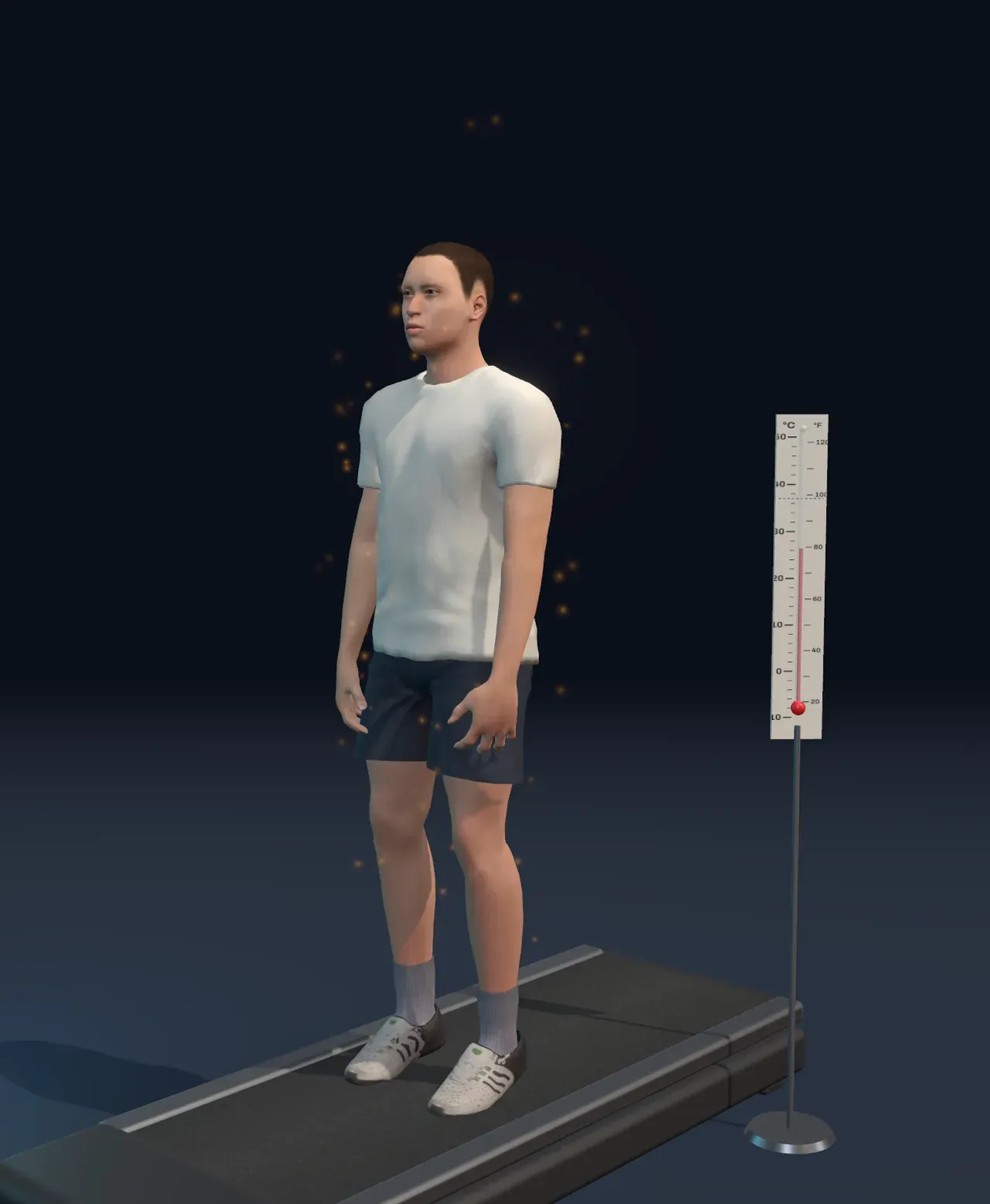
In the Scene a person stands for an hour in a room. The thermometer shows the core temperature, of the brain and the inner organs, and the chart shows how it changes through the hour. The room is now cool, 10 °C, like a winter night in an unheated house.
Step 2 of 6
A freezing night
Temperature is measured in the hypothalamus, a small region at the base of the brain, and by sensors in the skin. When the body cools, the hypothalamus narrows the vessels in the skin, so less warm blood reaches the surface, and starts shivering: quick contractions of muscles that make heat. In the heat it does the opposite: it widens the skin’s vessels and switches on the sweat glands.
Step 3 of 6
The thermostat
The hypothalamus works like a thermostat in a house: it compares the temperature with a set point and switches heating or cooling on. What happens when it does not work? In the Scene you can switch it off: skin blood flow, sweating and shivering stay as they were in a pleasant room, whatever happens outside.
Step 4 of 6
Hotter than the skin
Zoom to the skin is at Skin up close: the layers of the skin, the blood vessels, the sweat glands and the hair muscles. Heat always flows from hot to cold. As long as the air is cooler than the skin, the skin gives it heat by radiation and convection. But on a 40 °C day the air is hotter than the skin.
Step 5 of 6
The comfort zone
Between the cold that makes you shiver and the heat that makes you sweat there is a band where the body manages the cheapest way: it only widens and narrows the skin’s vessels, setting how much heat reaches the surface. Exercise and Thermostat are fixed, and Air temperature is yours.
Step 6 of 6
Negative feedback
Everything you have seen is built from the same loop: a sensor measures, a control centre compares with the set point, and effectors change the state in the direction opposite to the drift. The loop is called negative feedback, and it also holds the body’s blood sugar, its water and its blood pressure.
Loading the interactive version…
Loading the interactive version…
Each step sets up the Scene for you, and a control marked “fixed” stays put for that step.
Practice · Calculate
A person stands for an hour in a room where Air temperature is 283 K, that is 10 °C. What is their core temperature at the end of the hour, in degrees Celsius?
Practice · Calculate
A person stands for an hour in a room where Air temperature is 283 K, that is 10 °C. What is their core temperature at the end of the hour, in degrees Celsius?
Practice · Predict, then look
Now Air temperature will drop to 263 K, a freezing night of −10 °C, for an hour. What will happen to the core temperature?
Practice · Predict, then look
Now Air temperature will drop to 263 K, a freezing night of −10 °C, for an hour. What will happen to the core temperature?
Practice · Predict, then look
The same freezing night. Now Thermostat will switch to Switched off: skin blood flow, sweating and shivering stay as they were in a pleasant room. What will happen to the core within an hour?
Practice · Predict, then look
The same freezing night. Now Thermostat will switch to Switched off: skin blood flow, sweating and shivering stay as they were in a pleasant room. What will happen to the core within an hour?
Practice · Predict, then look
Air temperature will rise to 313 K, that is 40 °C: hotter than the skin. How will the body lose the heat it makes?
Practice · Predict, then look
Air temperature will rise to 313 K, that is 40 °C: hotter than the skin. How will the body lose the heat it makes?
Practice · Reach the target
Exercise and Thermostat are fixed. Change Air temperature until the body neither shivers nor sweats, and press Check.
Practice · Reach the target
Exercise and Thermostat are fixed. Change Air temperature until the body neither shivers nor sweats, and press Check.
Practice · Choose
The body’s heat control is an example of negative feedback. What makes it negative feedback?
Practice · Choose
The body’s heat control is an example of negative feedback. What makes it negative feedback?
Lesson complete. Every practice question here is done.