Chemical messengers in the blood: how insulin and glucagon hold blood sugar steady, when sugar peaks after a meal, where the sugar comes from when you skip a meal, and what happens without insulin.
Step 1 of 7 · Messengers in the blood
Step 1 of 7
Messengers in the blood
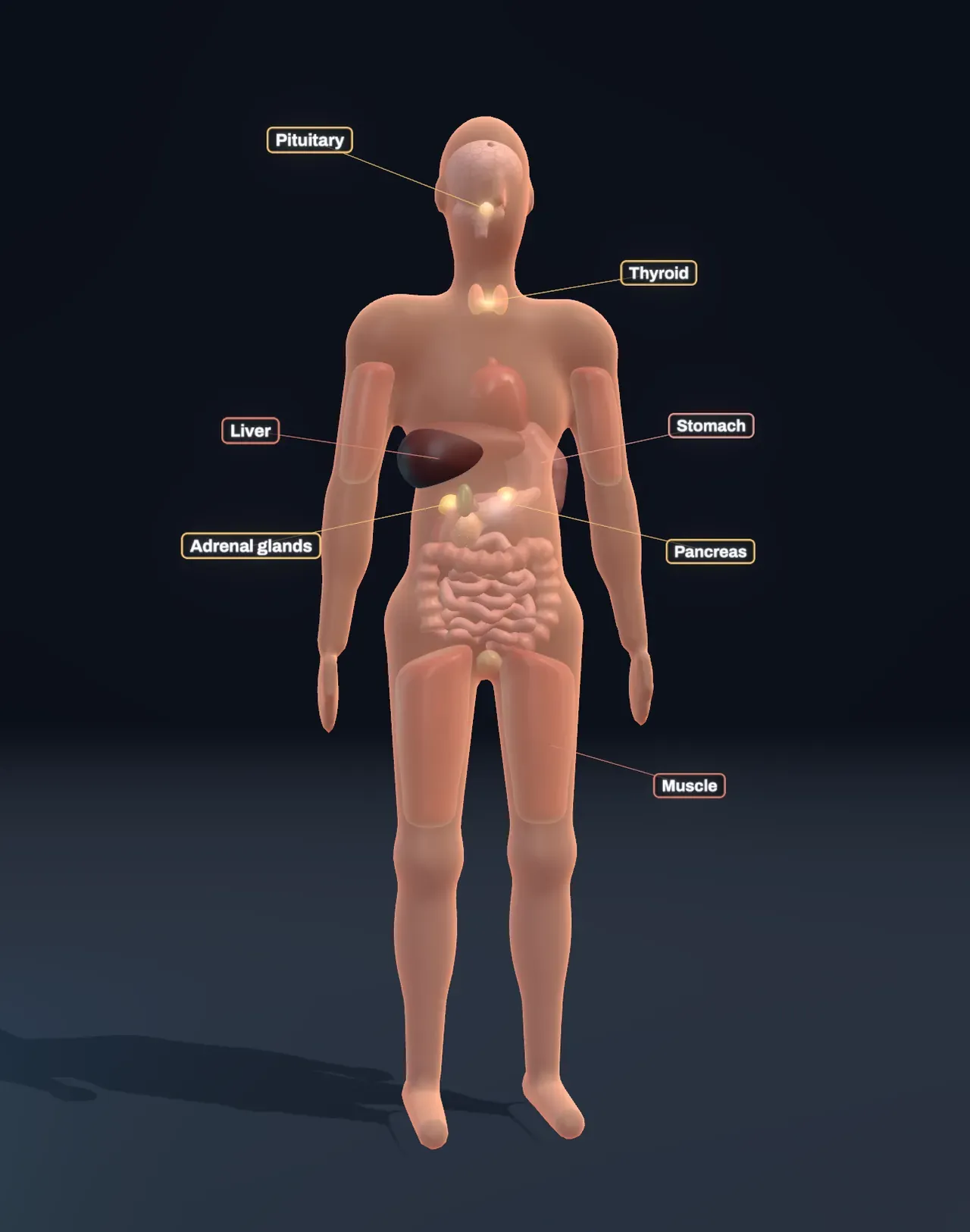
The nervous system sends fast messages to one exact place. The body has another way: hormones, chemicals released by glands. Together these glands make up the endocrine system: the pituitary, the thyroid, the adrenals, the pancreas and more.
Show the hormones is On. In this Lesson you will follow one pair of hormones, from the pancreas, that holds blood sugar, glucose, within a narrow range.
Step 2 of 7
Sugar in the blood
Blood sugar is measured in millimoles per litre. In a healthy body, after a night without food, it is about 5 mmol/L. Many countries measure it in milligrams per decilitre, and you get from one unit to the other with the mass of a glucose molecule.
Step 3 of 7
Insulin
When blood sugar rises, the beta cells of the pancreas release insulin. Insulin tells muscle and fat to take in glucose, and the liver to store it as glycogen, long chains of glucose. So the blood sugar falls. Show the hormones is still On: watch the specks of the two hormones as time moves on.
Step 4 of 7
The peak
After a meal sugar from the gut enters the blood, and insulin clears it. At first the sugar arrives faster, and the level rises; then insulin catches up, and it falls. Carbohydrate in the meal and Body are fixed, and Time since eating is yours.
Step 5 of 7
Glucagon
Four hours after the meal the sugar from the gut has run out. As blood sugar starts to fall, the alpha cells of the pancreas release a second hormone, glucagon. It works in the opposite direction to insulin. Together the two hormones are a negative feedback loop: each corrects a drift one way.
Step 6 of 7
Between meals
The brain alone uses about five grams of glucose an hour, even when you are not eating. So what if you skip a meal? Carbohydrate in the meal is at Skipped meal.
Step 7 of 7
Without insulin
In type 1 diabetes the immune system destroys the beta cells, and the pancreas makes no insulin. In type 2 diabetes the pancreas makes insulin, but the cells answer it weakly. Once you predict, Body will switch; watch the line on the chart that marks the kidneys’ threshold.
Loading the interactive version…
Loading the interactive version…
Each step sets up the Scene for you, and a control marked “fixed” stays put for that step.
Practice · Choose
Show the hormones is On. The pancreas sits in the belly, and the muscles that answer insulin are all over the body. How does insulin reach them?
Practice · Choose
Show the hormones is On. The pancreas sits in the belly, and the muscles that answer insulin are all over the body. How does insulin reach them?
Practice · Calculate
Before the meal blood sugar is 5.0 mmol/L. A millimole of glucose weighs 180 mg. How many milligrams of glucose are in a decilitre of blood, 0.1 L?
Practice · Calculate
Before the meal blood sugar is 5.0 mmol/L. A millimole of glucose weighs 180 mg. How many milligrams of glucose are in a decilitre of blood, 0.1 L?
Practice · Predict, then look
A healthy person ate a meal with 50 g of carbohydrate. Which hormone will rise in the blood an hour after the meal?
Practice · Predict, then look
A healthy person ate a meal with 50 g of carbohydrate. Which hormone will rise in the blood an hour after the meal?
Practice · Reach the target
Carbohydrate in the meal and Body are fixed. Move Time since eating to the moment blood sugar is at its peak, and press Check.
Practice · Reach the target
Carbohydrate in the meal and Body are fixed. Move Time since eating to the moment blood sugar is at its peak, and press Check.
Practice · Choose
What is glucagon?
Practice · Choose
What is glucagon?
Practice · Predict, then look
Skip a meal: Carbohydrate in the meal at 0 g. What will blood sugar be four hours later?
Practice · Predict, then look
Skip a meal: Carbohydrate in the meal at 0 g. What will blood sugar be four hours later?
Practice · Predict, then look
Two hours after the meal, in a healthy body, the sugar is almost back to 5 mmol/L. What will it be in a body whose pancreas makes no insulin at all, Type 1, no insulin?
Practice · Predict, then look
Two hours after the meal, in a healthy body, the sugar is almost back to 5 mmol/L. What will it be in a body whose pancreas makes no insulin at all, Type 1, no insulin?
Lesson complete. Every practice question here is done.