Messages in the blood
Your body has two ways of sending a message. Nerves are wires: a nerve signal runs along one fibre to one place in a few thousandths of a second. Hormones are broadcasts. A gland releases them into the blood, the blood carries them past every cell in the body within about a minute, and only the cells that carry the matching receptor, a protein shaped to catch that one hormone, take any notice.
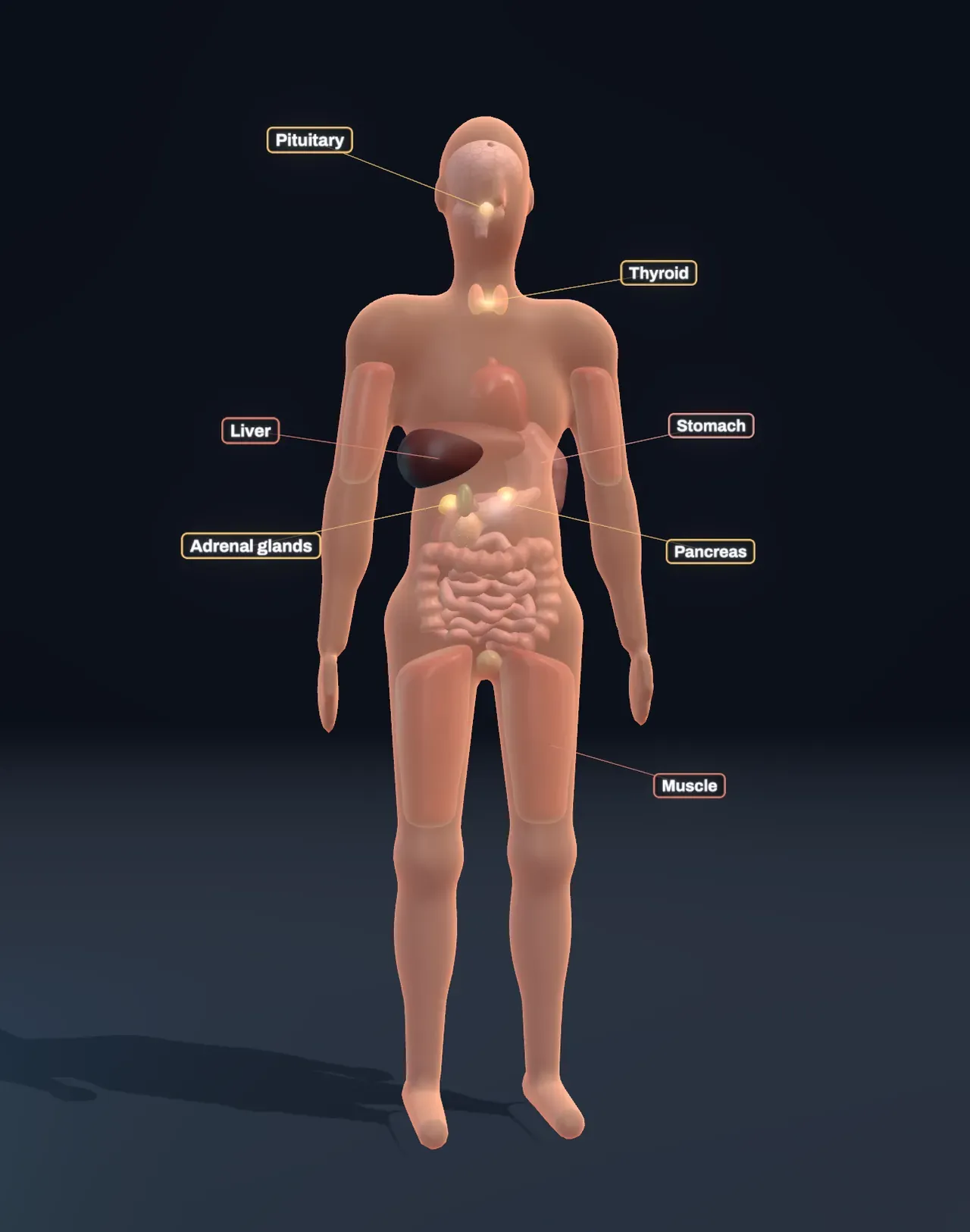
The glands that work this way make up the endocrine system: glands without ducts, which empty straight into the blood rather than into the gut or onto the skin. The main ones are lit in the Scene. The pituitary, the size of a pea, hangs under the brain and takes its orders from the hypothalamus just above it, the part of the brain that links the nervous system to the hormones. The thyroid, shaped like a butterfly in the front of the neck, sets how fast the body’s cells burn fuel. The adrenal glands sit like caps on top of the kidneys and make adrenaline and cortisol. The pancreas, behind the stomach, makes the two hormones this Scene is about. The ovaries and testes, the pineal gland and the parathyroids belong to the same system, and so, it turns out, do the gut, the heart, the kidneys and even fat, which all release hormones of their own.
Try it: with Show the hormones at Off, drag the body round to see how the pancreas tucks in behind the stomach, and how the adrenal glands sit on the back of the kidneys.
Sugar, the body’s fuel
Every cell can burn sugar, glucose, for energy in cellular respiration. The brain runs almost entirely on it, about 120 grams a day, and cannot store any. So the blood has to carry a steady supply: about 5 millimoles in each litre (mmol/L), or 90 milligrams in each decilitre (mg/dL), the units on most glucose meters. In all five litres of an adult’s blood that is only four or five grams of sugar, about a teaspoonful.
Too little is dangerous at once: below about 3.9 mmol/L the brain starts to falter, and a person becomes shaky, confused and can faint. Too much does its harm slowly: sugar sticks to proteins, and over years high blood sugar damages small blood vessels in the eyes, kidneys and nerves. So the body keeps it between about 4 and 8 mmol/L, through a big meal, a night’s sleep or a skipped lunch.
After a meal: insulin
Digestion breaks the starch in bread, rice or pasta into glucose, which crosses the wall of the gut into the blood. All of it flows first through the portal vein to the liver, so the liver is the first organ to meet a meal.
Scattered through the pancreas are about a million tiny clusters of cells, the islets of Langerhans. Most of their cells are beta cells, which sense the sugar in the blood flowing past them. As it rises they release insulin, and the more sugar, the more insulin. Hormones from the gut, released as the meal arrives, make them release even more. Insulin reaches the liver first and then every other organ, and it says one thing: sugar is plentiful, take it in.
The liver stops releasing sugar of its own and starts storing it as glycogen, a branching chain of glucose molecules packed into granules; a fed liver holds about 100 grams. Muscle and fat cells answer insulin by moving sugar doors, transporter proteins called GLUT4, from inside the cell to its surface, so sugar can flow in. Muscle stores sugar as glycogen too, about 400 grams in all, but only for its own use.
Try it: press Breakfast, then slide Time since eating from 0 to 120 min. Sugar peaks near 7 mmol/L about 40 minutes after the meal, with insulin climbing behind it, and is back near 5 by two hours. Choose On under Show the hormones at 30 min to see insulin pour out of the pancreas.
Between meals: glucagon
The same islets hold a second kind of cell, the alpha cells. They do the opposite: as sugar falls, and as insulin falls with it, they release glucagon. Glucagon works almost only on the liver, and it says: sugar is short, let some out. The liver breaks glycogen back into glucose and releases it into the blood, and it can also make new glucose from scratch, from the building blocks of proteins and fats.
After a night without food the liver is releasing about 0.14 grams of sugar a minute, just as fast as the brain and the rest of the body use it, so blood sugar holds still. About half its glycogen is already gone by breakfast, which is why a long fast leans more and more on the sugar it makes new.
Try it: press Skipped meal. Blood sugar stays at 5 mmol/L for all six hours, insulin stays low, glucagon stays up, and with Show the hormones at On, the liver glows amber as it releases sugar into the blood.
A loop that holds itself steady
Insulin and glucagon pull in opposite directions, and blood sugar is what decides between them. Sugar up, more insulin, less glucagon: sugar comes down. Sugar down, less insulin, more glucagon: sugar goes up. Each change sets off a response that undoes it. This is negative feedback, the same idea a thermostat or a balancing robot uses, and it is why the line on the chart bends back to where it started. The body holds its temperature, water and salt steady with loops of the same kind; Homeostasis follows the one for temperature.
The loop is fast. Insulin lasts only about five minutes in the blood before the liver and kidneys clear it, so the pancreas can turn it up or down within minutes. That is why the pancreas has to release it all the time, in step with the sugar, rather than once.
Try it: compare An apple with Big pasta dinner. Six times as much carbohydrate raises the peak by only about two millimoles, because the pancreas answers a bigger meal with far more insulin.
When the loop breaks: diabetes
In type 1 diabetes the immune system destroys the beta cells, usually in childhood or youth, and the body makes no insulin at all. Muscle and fat cannot take sugar in, the liver never hears that sugar is plentiful, and blood sugar climbs even without food. Above about 10 mmol/L the kidneys cannot take all the sugar back from the urine they make, so sugar spills out, and water follows it: great thirst, a lot of urine and weight loss are the first signs. Starved of sugar, the body burns fat so fast that acids build up in the blood. Before insulin was first purified, in Toronto in 1922, type 1 diabetes was fatal; now people inject or pump the insulin their pancreas no longer makes.
Type 2 diabetes, about nine cases in ten, starts with insulin resistance: muscle, fat and liver answer insulin weakly, so the pancreas has to make more and more of it to get the same effect, until it cannot keep up. Being overweight and inactive make it much more likely, and so do one’s genes. It is diagnosed when blood sugar is 7.0 mmol/L or more after a night’s fast, or 11.1 or more two hours after a 75-gram glucose drink. The name diabetes mellitus is Greek and Latin for “passing through, sweet as honey”: doctors once tasted the urine.
Try it: choose Type 2 diabetes and press Glucose test drink, then slide Time since eating to 120 min. Sugar started at 7.8 and is still over 11 two hours later, though the chart shows the pancreas making as much insulin as a healthy one does. Then choose Type 1, no insulin, and the insulin strip goes flat.
Other glands, other speeds
Insulin and glucagon act in minutes. Other hormones work on very different clocks. Adrenaline, from the adrenal glands, acts within seconds of a fright, speeding the heart and telling the liver to release sugar for the muscles, and is gone in two or three minutes. Cortisol, from the same glands, rises over the morning and in long stress, and raises blood sugar over hours. Thyroid hormone lasts about a week in the blood, so a change in the thyroid takes weeks to show. The pituitary sets the pace for several of these glands, releasing hormones that tell the thyroid, the adrenal glands, the ovaries and the testes how hard to work, and it makes growth hormone itself.
What this model leaves out
The Scene follows one resting 70 kg adult for six hours after a meal eaten after a night’s fast. Sugar is treated as spreading through one pool of about 12 litres of body water; insulin, glucagon and their effects follow simple equations with round textbook values, chosen so that a healthy person fasts at 5 mmol/L and a type 2 body crosses the lines doctors use. Real people differ widely, and so does the same person from one day to the next.
A real meal is not sugar water: fat, protein and fibre slow digestion, and some carbohydrates are absorbed far faster than others. The model leaves out exercise, which lets muscles take in sugar even without insulin, and adrenaline, cortisol and the nerves, which all change blood sugar too. Fat is counted with muscle as one store, and the brain’s use stays fixed. The type 1 body is untreated, which nobody should be.
The body is a stylised figure. The organs are about the right size and place, but the glands are enlarged so that they can be found, and the blood is drawn as a few vessels with specks far larger than any molecule, moving much more slowly than blood really does.