A virus lands
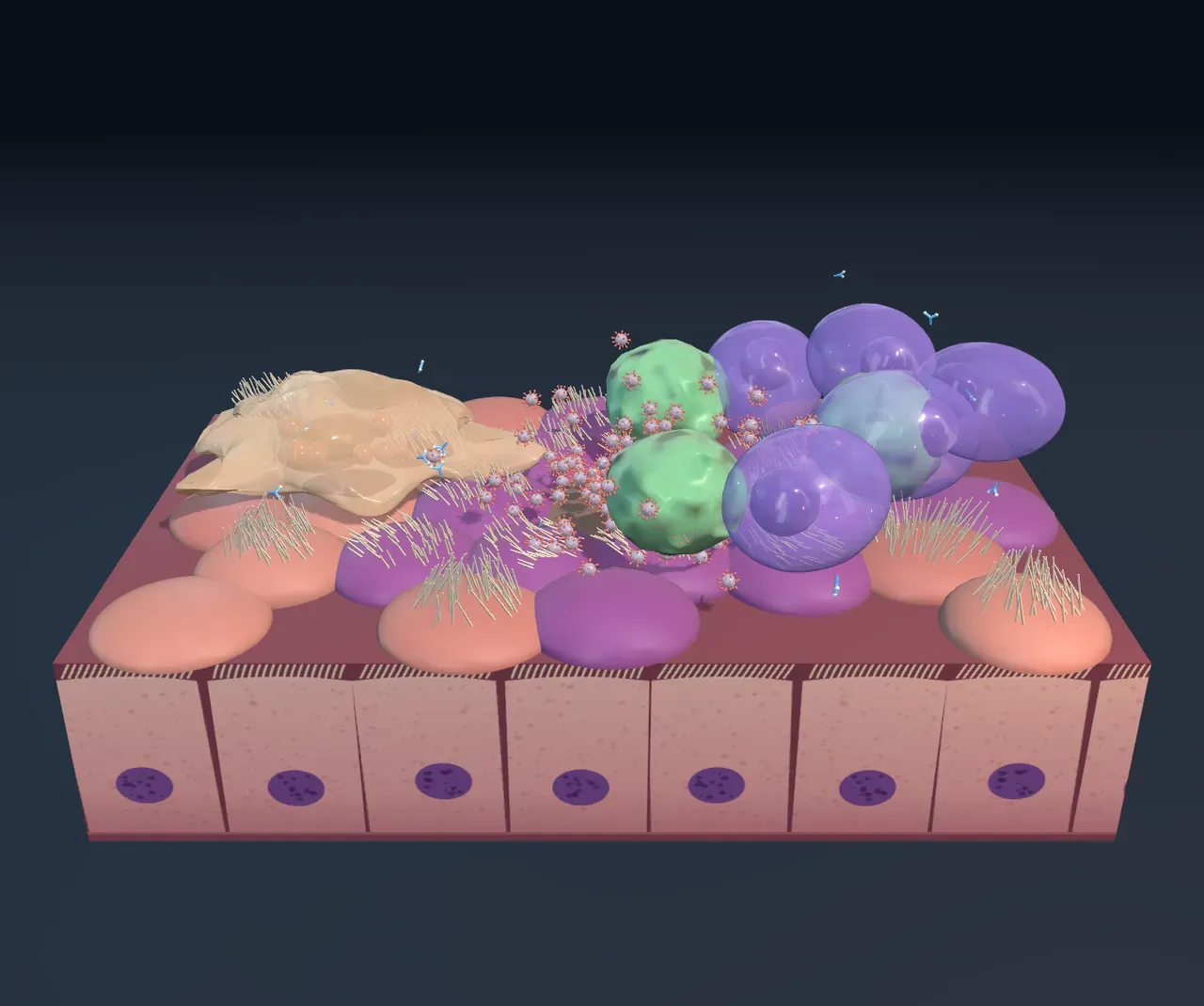
Every day you breathe in, swallow and touch things carrying viruses and bacteria. Most never get anywhere. The Scene shows what happens when one does: a small dose of a respiratory virus lands on the lining of an airway, a carpet of cells whose tiny hairs, the cilia, beat to sweep mucus and dirt up and out. The particles stick to the cells, get inside, and turn each cell into a factory that releases thousands of new copies.
The body has two lines of answer. The first, innate immunity, is the same for every intruder and is ready at once: mucus and cilia, chemical alarms that put nearby cells on guard, and roaming cells such as the macrophage, a large cell that crawls over tissue and swallows debris, bacteria and virus particles. It slows an infection down but rarely ends one alone. The second line, adaptive immunity, is made to measure for each germ. It is slow the first time and fast every time after, and it is the part a vaccine trains.
Try it: drag Days since infection slowly from Virus lands until the chart beside the Scene reads day 6. The particles multiply, the lining cells around where they landed turn purple one after another, and their cilia droop. On the chart the red curve climbs about tenfold a day and crosses the line where you would start to feel ill.
The cells that fit
The adaptive answer is carried by two kinds of white blood cell, B cells and T cells. Each one carries receptors of a single shape, made by shuffling pieces of its genes as it matured, so between them the body holds billions of different shapes. Before any infection, almost none of them fit a given virus: perhaps one B cell in a hundred thousand has a receptor that grips some part of it, the shape called an antigen.
Finding those few takes days. Pieces of the virus are carried to the nearest lymph nodes, where B and T cells pass through in their millions. A cell whose receptor fits is woken, checked by other immune cells, and then starts to divide, about twice a day, into a clone of identical cells. Only when the clones are large does the answer show: in the Scene the B cells multiply around day 5, and many swell into plasma cells, factories that each pour out about two thousand antibody molecules every second.
Killer T cells, the green cells in the Scene, multiply alongside. They cannot see virus floating outside cells. Instead, every cell in the body shows short pieces of the proteins it is making on its surface, and a killer T cell that recognises a viral piece makes that cell destroy itself, along with the virus factory inside it.
Try it: keep Vaccine at None and stop Days since infection at day 9. The virus has passed its peak and is falling fast. Green killer T cells sit on the last infected cells, the lining cells that were infected first have been killed and turned grey, and the first antibodies are only just appearing.
Antibodies
An antibody is a Y-shaped protein about 15 millionths of a millimetre across, several times smaller than the virus it grips. The tips of its two arms fit one antigen, and only that one, like a key cut for a lock. An antibody that grips a virus’s surface proteins stops them from latching onto a cell, so the particle can no longer get in. Because each antibody has two arms, it can hold two particles at once, and many of them bind particles together into clumps. Macrophages and other cells recognise the stems of the antibodies and swallow the clumps whole.
In a first infection the antibodies come late. In the Scene, with no vaccine, the virus peaks around day 7 and is cleared by day 9 or 10, mostly by the innate defences and the killer T cells, while the antibodies rise for another week and peak around day 18. They still matter: they mop up the last particles, protect against catching the same virus again soon, and, together with the cells that made them, leave something behind.
Memory
When the virus has gone, most of the expanded clones die off. A small share of them do not. They become memory cells, long-lived B and T cells that carry the receptors that worked, and some plasma cells settle in the bone marrow and keep making antibodies for years. The next time the same virus arrives, there are hundreds of times more cells that fit it, they are already checked, and they wake to a smaller dose of virus. The memory B cells have also been through a round of improvement in the lymph nodes, so their antibodies fit more tightly.
That is the second response: antibodies rise within two or three days instead of a week or more, and climb many times higher. On the chart the dashed grey curves show the first meeting; the solid curves show the same virus meeting a body that remembers it.
Try it: choose Last month under Vaccine and drag Days since infection again. Gold memory cells and plenty of antibodies are already waiting. The virus barely gets going; by day 3 it is gone, and you would never know you had met it. The antibodies still jump from about 30 units to about 600.
How a vaccine teaches
A vaccine gives the body that first meeting without the illness. It shows the immune system the antigens of a germ in a form that cannot make you ill: a germ that has been killed, a weakened live one, purified pieces of its proteins, or genetic instructions such as mRNA, which tell a few of your own cells to make one viral protein for a few days before the instructions are broken down. The body answers as it would a real infection, slowly, and keeps the memory cells. Many vaccines need two doses or a later booster: each meeting makes the memory larger and the antibodies better.
The idea is older than the knowledge of germs. In 1796 Edward Jenner showed that people given material from cowpox sores were protected from smallpox. Vaccination later wiped smallpox out entirely: the last natural case was in 1977, and the World Health Organization declared it gone in 1980.
Antibody levels fall over the months and years after a vaccine, but that does not mean the protection is gone. Choose Ten years ago: hardly any antibodies are left, so the virus grows for two or three days. Then the memory cells wake, antibodies surge past anything a first infection makes, and the virus is cleared by day 5, before it reaches the level where you would feel ill. Against many diseases, protection from serious illness lasts much longer than the antibodies do. A vaccinated person who meets the virus often clears it fast enough that they pass it on less, which is why vaccinating enough people can stop an outbreak altogether; Epidemics and the SIR model shows that herd immunity in a crowd.
Try it: stop Days since infection at day 5 and switch between the three choices. With no vaccine the virus is still climbing and there are no antibodies to speak of. With either vaccine the virus is already gone, and the antibodies are higher than a first infection ever makes them.
Side effects
The sore arm, tiredness or mild fever that can follow a vaccine are the innate defences raising the alarm, the same alarm that makes an infection feel like illness. They usually pass in a day or two. Serious side effects are rare, and vaccines are tested on tens of thousands of people before they are approved, then watched in millions more. Whether to use a vaccine comes down to a comparison: its risks against the risks of the disease it prevents.
What this model leaves out
The curves come from a small model: virus copying itself in the lining, an innate alarm, B and T cell clones that start to grow after a delay of three days the first time and one day with memory, and antibodies made by the B cells. Its numbers are typical of a respiratory virus such as flu, chosen to give the familiar shapes, not fitted to one disease. Real infections vary a lot from person to person and dose to dose, and how ill someone feels depends on much more than the amount of virus.
The Scene puts every player in one patch of tissue. In reality the B and T cells find their match and multiply in lymph nodes, plasma cells mostly sit in lymph nodes and bone marrow, and antibodies reach the airway through the blood and as a special kind made in the lining itself. Virus particles and antibodies are drawn many times larger than life, and the Scene shows a few hundred where there are millions. It leaves out many other cells, including the helper T cells that B cells and killer T cells need, and the chemical signals they trade.
The vaccine is assumed to match the virus exactly. Viruses such as flu change their surface proteins from year to year, so older memory fits less well, which is one reason some vaccines are updated.