A second meeting with the same virus: memory cells, a vaccine from last month and from ten years ago, how low the virus stays, and how many antibodies a secondary response makes.
Step 1 of 6 · A second meeting
Step 1 of 6
A second meeting
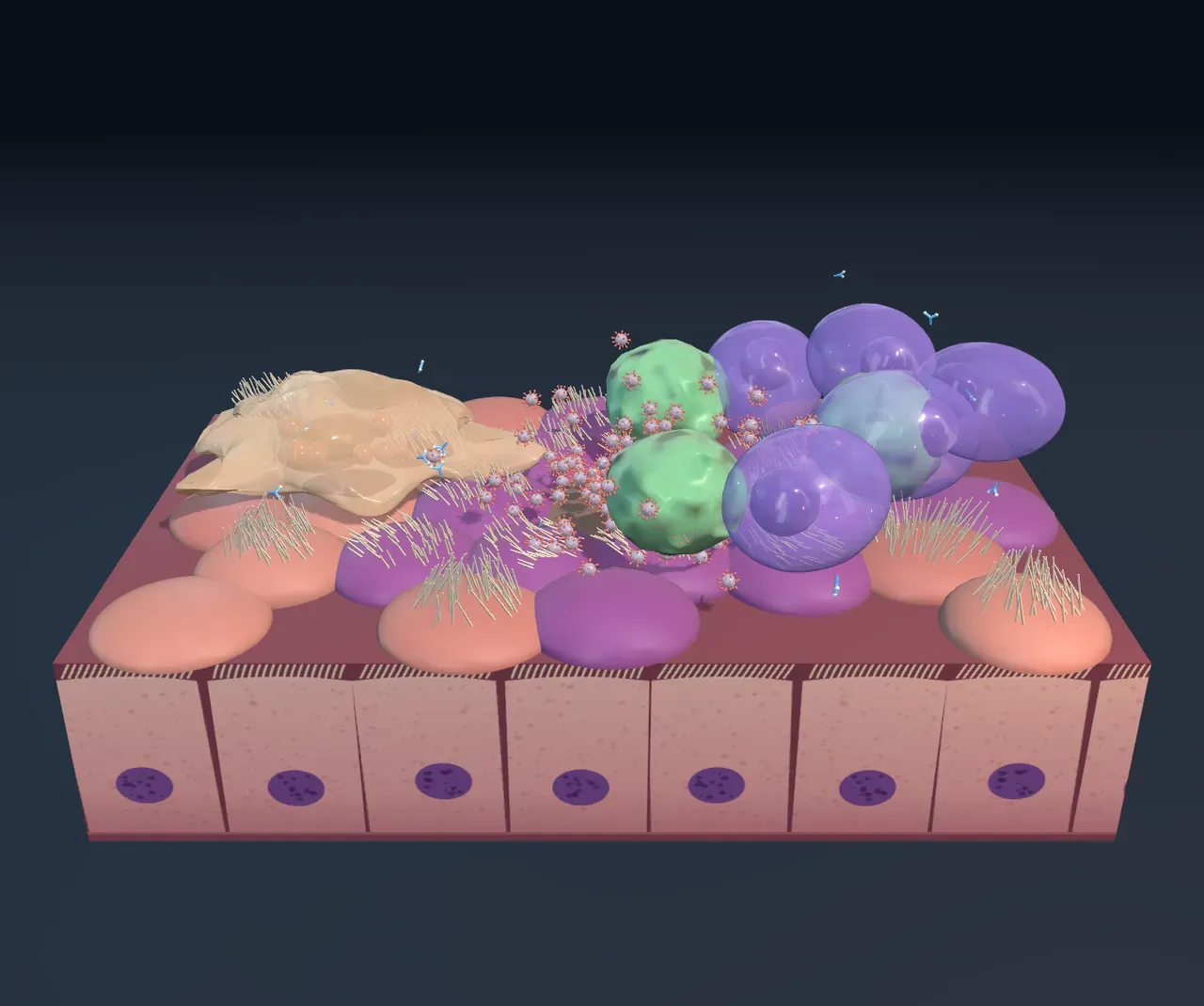
After the virus is cleared, most of the plasma cells die, and the antibodies in the blood slowly fade. But some of the B and T cells that divided stay in the body as memory cells, sometimes for decades. They already fit the virus, and there are many more of them than at the first meeting.
A vaccine lets the body go through the first meeting without the illness. In the Scene you can choose in Vaccine a case in which the person was vaccinated before the virus landed. Days since infection stands at Three weeks on; after a vaccine, the chart shows the first meeting as a dashed grey line.
Step 2 of 6
Ten years on
The antibodies a vaccine makes do not stay in the blood for ever. Ten years after a vaccine very few are left. Vaccine is fixed at Ten years ago, and Days since infection at the day the virus lands.
Step 3 of 6
How high it gets
Even when you do not feel ill, the virus still gets in and multiplies a little before it is cleared. The upper chart shows how high it climbs, against the grey line of the first meeting.
Step 4 of 6
A stronger answer
The secondary response is not only faster. At every meeting the cells whose antibodies grip best divide most, so the antibodies improve. The lower chart shows the antibodies on a logarithmic scale.
Step 5 of 6
Staying well
Vaccine is yours. Switch between the three settings, and compare the virus on the upper chart with the dashed line of illness.
Step 6 of 6
What a vaccine does
Vaccines are built in several ways: a killed virus, a weakened one, one protein of the virus, or instructions our cells read to build that protein themselves. In the end they all do the same thing.
Loading the interactive version…
Loading the interactive version…
Each step sets up the Scene for you, and a control marked “fixed” stays put for that step.
Practice · Predict, then look
Without a vaccine you feel ill for about six days. What will happen if the same person had the vaccine Last month?
Practice · Predict, then look
Without a vaccine you feel ill for about six days. What will happen if the same person had the vaccine Last month?
Practice · Predict, then look
A vaccine Ten years ago: on the day the virus lands there are only 2 units of antibody in the blood, against 30 after last month’s vaccine. Will the person fall ill?
Practice · Predict, then look
A vaccine Ten years ago: on the day the virus lands there are only 2 units of antibody in the blood, against 30 after last month’s vaccine. Will the person fall ill?
Practice · Calculate
Without a vaccine the virus peaks at about 3,750,000 copies per millilitre; with a vaccine ten years ago, at about 52,500. How many times lower is the peak with the old vaccine?
Practice · Calculate
Without a vaccine the virus peaks at about 3,750,000 copies per millilitre; with a vaccine ten years ago, at about 52,500. How many times lower is the peak with the old vaccine?
Practice · Predict, then look
At a first meeting the antibodies reach about 80 units on day 21. How many units will there be on day 21 after the virus meets someone vaccinated ten years ago? Predict a number.
Practice · Predict, then look
At a first meeting the antibodies reach about 80 units on day 21. How many units will there be on day 21 after the virus meets someone vaccinated ten years ago? Predict a number.
Practice · Reach the target
Choose a Vaccine setting in which the person does not feel ill for a single day, and press Check.
Practice · Reach the target
Choose a Vaccine setting in which the person does not feel ill for a single day, and press Check.
Practice · Choose
How does a vaccine prepare the body for a virus?
Practice · Choose
How does a vaccine prepare the body for a virus?
Lesson complete. Every practice question here is done.