How a disease spreads through a crowd: exponential growth over generations of infection, the basic and effective reproduction numbers, the herd-immunity threshold, measles, and why vaccination also protects the unvaccinated.
Step 1 of 7 · Chains of infection
Step 1 of 7
Chains of infection
An epidemic is many chains of infection: one case infects a few people, each of them infects a few more, and so on. The average number of people one case infects in a crowd where nobody is immune yet is the basic reproduction number, . For seasonal flu it is about , for COVID in 2020 about , and for measles about .
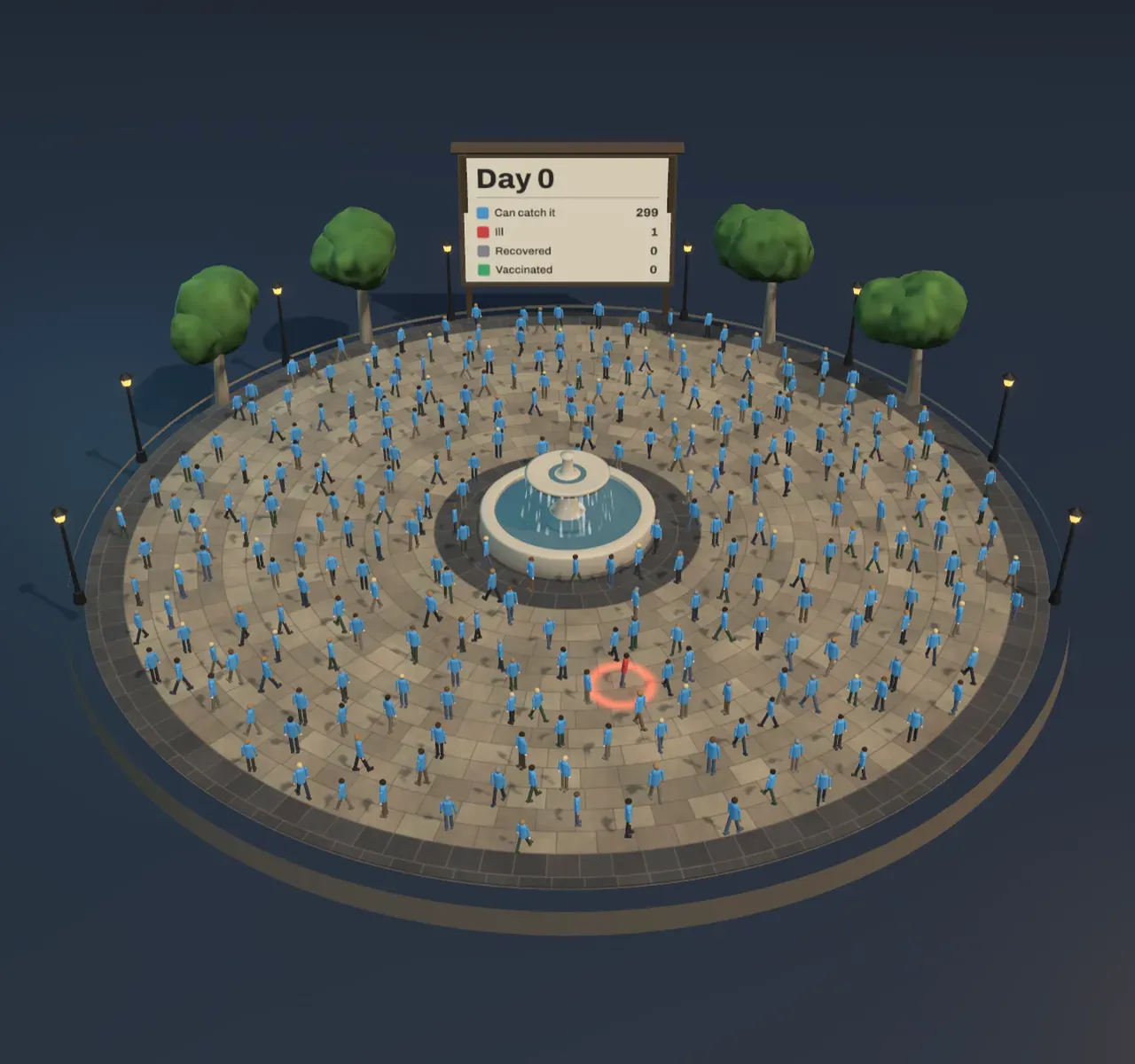
In the Scene a crowd of 300 people in a square, and one first case. Days runs the time from the first case to day 120.
Step 2 of 7
Faster spread
At the start of an epidemic almost everyone is susceptible, and the numbers grow exponentially. But everyone who has been ill and recovered is now immune, so as time goes on each case has fewer people to infect. The chart shows three groups: susceptible (S), infected (I) and recovered (R). Hence the name, the SIR model.
Step 3 of 7
The effective number
When part of the crowd is vaccinated, a case meets the same number of people, but only some of them can catch it. The number it really infects is the effective reproduction number:
Here is the vaccinated share. As long as is above one, the outbreak grows; once it is below one, it dies away.
Step 4 of 7
The threshold
Stopping an outbreak does not need everyone vaccinated. It only needs brought below one. The vaccinated share that does it is the herd-immunity threshold.
Step 5 of 7
Stopping an outbreak
R₀: people one case infects is fixed, and Vaccinated is yours. Once falls below one, the Scene shows the first case infecting one or two, and the chain breaking.
Step 6 of 7
Measles
The larger , the higher the threshold. Measles spreads through the air, lingers in a room for up to two hours after the sick person has left, and infects nearly everyone who is not immune.
Step 7 of 7
Herd immunity
Vaccination protects the vaccinated themselves, but that is not all it does. Vaccinated is fixed at 70%, above the threshold. Follow the 90 people who were not vaccinated.
Loading the interactive version…
Loading the interactive version…
Each step sets up the Scene for you, and a control marked “fixed” stays put for that step.
Practice · Calculate
Each case infects people on average. Start from one case. How many new cases will there be in the fourth generation of infection, if everyone is still susceptible?
Practice · Calculate
Each case infects people on average. Start from one case. How many new cases will there be in the fourth generation of infection, if everyone is still susceptible?
Practice · Predict, then look
With and no vaccine, the number ill at once peaks around day 20. What will happen to the peak when R₀: people one case infects rises to 4?
Practice · Predict, then look
With and no vaccine, the number ill at once peaks around day 20. What will happen to the peak when R₀: people one case infects rises to 4?
Practice · Calculate
, and 30% of the crowd are Vaccinated. How many people does each case infect on average at the start of the outbreak?
Practice · Calculate
, and 30% of the crowd are Vaccinated. How many people does each case infect on average at the start of the outbreak?
Practice · Calculate
For a disease with : what percentage of the crowd must be immune so that each case infects one person or fewer on average?
Practice · Calculate
For a disease with : what percentage of the crowd must be immune so that each case infects one person or fewer on average?
Practice · Reach the target
R₀: people one case infects is fixed at 2.5. Change Vaccinated until each case infects fewer than one person on average, but no more than needed, and press Check.
Practice · Reach the target
R₀: people one case infects is fixed at 2.5. Change Vaccinated until each case infects fewer than one person on average, but no more than needed, and press Check.
Practice · Reach the target
Measles is one of the most contagious diseases: R₀: people one case infects is fixed at 15. Find the smallest whole percentage Vaccinated at which each case infects fewer than one person, and press Check.
Practice · Reach the target
Measles is one of the most contagious diseases: R₀: people one case infects is fixed at 15. Find the smallest whole percentage Vaccinated at which each case infects fewer than one person, and press Check.
Practice · Predict, then look
, and 70% of the crowd are vaccinated. About 90 of the 300 people are not. How many people will have caught it by day 120?
Practice · Predict, then look
, and 70% of the crowd are vaccinated. About 90 of the 300 people are not. How many people will have caught it by day 120?
Lesson complete. Every practice question here is done.