Holding steady
Put a thermometer under your tongue on a winter morning or a summer afternoon and it reads close to 37 °C. The air around you can swing by thirty degrees in a day; your core, the brain, heart and organs deep in the trunk, moves by less than one. The enzymes that run every cell work best in that narrow range. A few degrees too warm and proteins start to lose their shape; a few degrees too cold and every reaction in the body slows down.
Keeping something steady inside while the outside changes is called homeostasis, from Greek words for “staying the same”. The French physiologist Claude Bernard wrote in the 1850s and 1860s that the body keeps a stable “inner environment” for its cells, and the American physiologist Walter Cannon gave the idea its name in 1926. Temperature is only one of the things held steady. The blood’s sugar, water, salt, acidity, oxygen and carbon dioxide all are too, each by its own loop. This Article follows temperature, because it is the one you can feel.
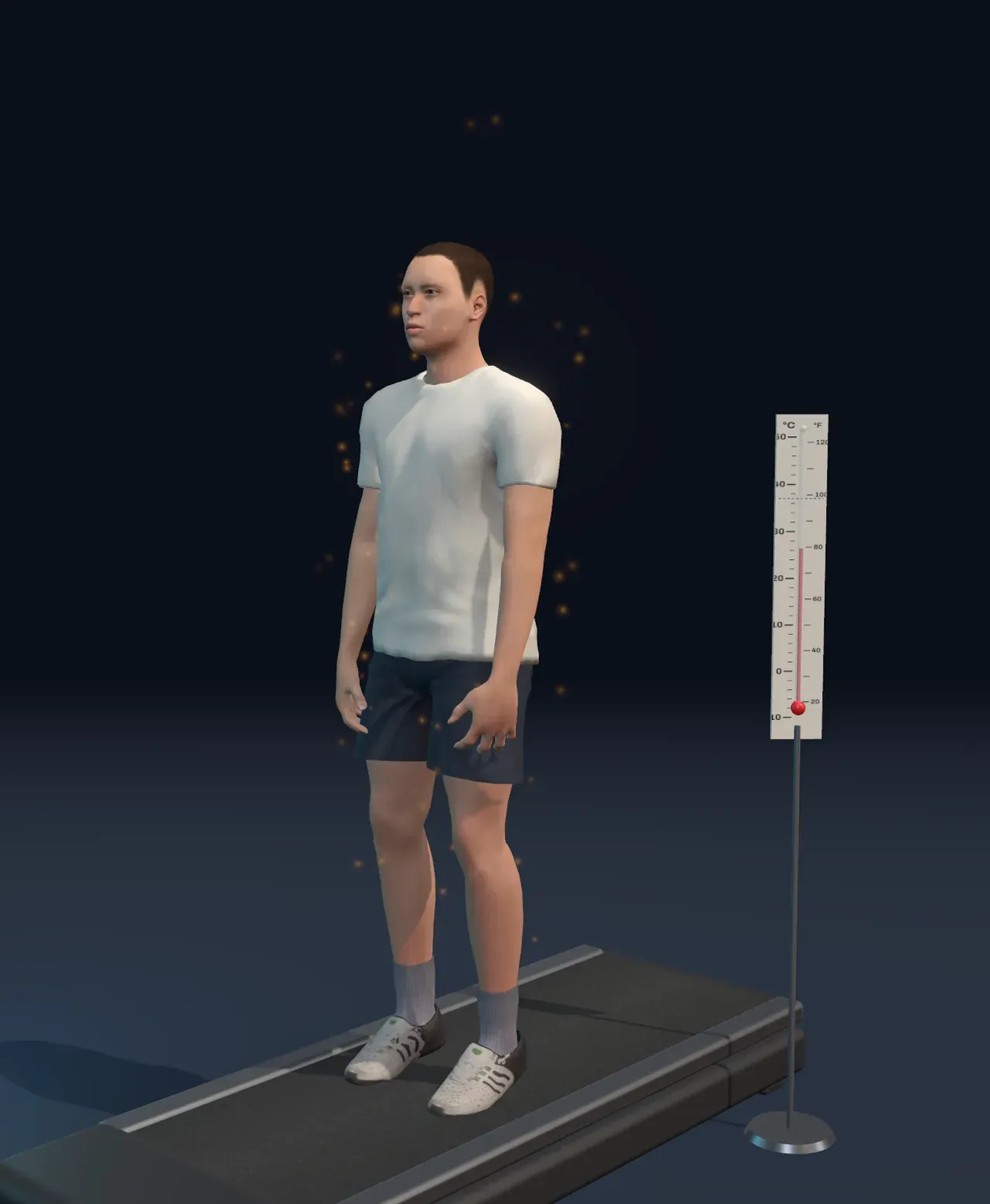
Try it: with Exercise at Standing still, slide Air temperature from −10 °C to 43 °C. The thermometer climbs more than fifty degrees; the chart’s core line stays within half a degree of 37.
Heat in, heat out
A body is always making heat. Every cell burns fuel in cellular respiration, and most of the energy ends up as heat: about 100 watts for an adult standing still, as much as a bright old-fashioned light bulb, and nearly 1000 watts on a hard run. If none of it escaped, a resting body would warm by more than a degree an hour.
Heat leaves the skin in four ways, the ones described in Heat and temperature. The skin radiates infrared light to anything cooler around it. Air touching the skin is warmed and carried away by convection. A little heat conducts into whatever you touch. And water that evaporates from the skin takes a great deal of heat with it: every gram of sweat that turns to vapour carries off about 2.4 kilojoules, so a litre an hour is close to 700 watts. The breath takes a little too, warm and moist going out.
The core stays at one temperature only when heat in and heat out balance. The bars under the chart show that budget: what the body makes, and what it loses to the air, to evaporating sweat and in the breath. When the air is hotter than the skin, radiation and convection run backwards and bring heat in, and evaporation is the only way left to get rid of it.
A thermostat in the brain
The balance is kept by a feedback loop, the same idea a house thermostat or a balancing robot uses. It has three parts.
The sensors are nerve endings. Some lie in the skin and report whether it is warming or cooling; others, in the brain itself, the spinal cord and the organs, report the temperature of the core. The control centre is the hypothalamus, a region the size of an almond at the base of the brain. It compares what the sensors report with its set point, about 37 °C, and sends commands through the nervous system. The effectors carry them out: the blood vessels of the skin, the sweat glands, the muscles, and the person, who puts on a jumper or looks for shade.
The loop is negative feedback: any change sets off a response that pushes the other way. Warmer, and the body loses heat faster. Colder, and it keeps heat in and makes more. Skin sensors let it act early, before the core has moved at all, the way a cold draught makes you shiver before your core has cooled.
Try it: switch Zoom to the skin to Skin up close. As the person steps aside, the hypothalamus lights up, and signals run down the spinal cord and along a nerve to the arm: amber when it is asking the body to shed heat, sky blue when it is asking it to keep heat in.
Too warm: open the vessels, then sweat
Heat made in the muscles and organs reaches the skin mainly in the blood. When the hypothalamus senses too much heat, it lets the arterioles of the skin, the small arteries that feed it, relax and widen. This is vasodilation. Blood that barely trickled through the skin at about 0.3 litres a minute can pour through at several litres a minute, a large share of everything the heart pumps (see Circulation). The skin warms and reddens, and more heat crosses it to the air.
When that is not enough, the body sweats. About two to four million sweat glands lie coiled in the deep skin, each a tangled tube with a duct spiralling up to a pore. They pull water and salt out of the blood around them, and as the sweat runs up the duct, much of the salt is taken back before the water reaches the surface. What matters is not making sweat but evaporating it: sweat that drips off carries almost no heat away.
Try it: slide Air temperature up to 35 °C, then 43 °C. The vessels widen and sweat appears, and the heat budget shows sweat doing nearly all the work while the air pours heat in. Then press Hard run with the air at 25 °C: the core settles near 38.5 °C, sweat runs at about a litre an hour and blood floods the skin at five litres a minute.
A working body runs a little warm on purpose. During exercise the core rises a degree or so and holds there, which keeps the sweat and blood flow high enough to match the heat the muscles make.
Too cold: close the vessels, then shiver
In the cold the hypothalamus does the opposite. Nerves tell the arterioles of the skin to tighten, vasoconstriction, and warm blood is kept deep inside. The skin, especially of the hands, feet, nose and ears, cools and pales or turns bluish. The skin and the fat under it become a layer of insulation round the core. The veins deep in the arms and legs also lie alongside the arteries, so warm blood going out passes its heat to cold blood coming back.
Each hair has a tiny erector muscle that pulls it upright, raising goosebumps. In a furry animal this thickens the coat and traps more still air; in a human, with little hair, it hardly helps, a leftover from ancestors with fur.
If the core still cools, the muscles shiver: they contract in quick, small bursts that do no useful work and turn their fuel straight into heat, raising the body’s heat output to two or three times its resting rate for hours, and higher in short bursts. Babies, who cannot shiver well, burn brown fat, a tissue packed with mitochondria that makes heat directly.
Try it: slide Air temperature down to 16 °C, then −10 °C, and switch Zoom to the skin to Skin up close. The arteriole narrows, few blood cells creep through the capillary loops, the hairs stand up on goosebumps and the muscles shiver. At −10 °C shivering is flat out, and the chart shows the core still slowly losing ground.
When the loop is overwhelmed
Every effector has a limit. Skin blood flow cannot rise for ever, a person can sweat at most two litres or so an hour, and how much of it evaporates depends on the air: hot, humid air can take little more vapour, so sweat drips instead. Then heat comes in faster than it leaves and the core climbs. Above about 40 °C the brain itself begins to fail, the sweating can stop, and heat stroke kills unless the body is cooled fast. Infants, old people and people working hard in humid heat are most at risk.
In the cold, once the skin is as cool as it can safely get and shivering is flat out, the core falls. Below 35 °C is hypothermia: clumsiness and confusion first, then shivering stops, the heart’s rhythm falters and the person drifts into unconsciousness.
Try it: press Hard run and slide Air temperature up to 43 °C. The vessels are wide open, sweat is running off unevaporated, and the core passes 40 °C within the hour. Then set Thermostat to Switched off: with no sweating, shivering or change in blood flow, even a walk in a mild room drives the core up, and standing still on a freezing night takes it below 35 °C, into hypothermia.
Fever: turning the thermostat up
A fever is not a broken thermostat but a reset one. When the immune system fights an infection, it releases chemical signals that reach the hypothalamus and raise its set point by one to three degrees. The body at 37 °C now feels too cold: the skin vessels close, you feel chilled and shiver under the blankets, and the core climbs until it reaches the new set point. When the fever breaks, the set point drops back, and the body, now too hot for it, flushes and sweats. A moderate fever seems to help the defences, slowing some microbes and speeding up immune cells.
Other things the body holds steady
The same pattern, sensor, control centre and effectors pulling against any change, runs through the whole body.
Blood sugar is held near 5 millimoles a litre by insulin and glucagon from the pancreas, as Hormones and the endocrine system shows. Water and salt are watched by the hypothalamus too. When sweating or a salty meal makes the blood too concentrated, it makes you thirsty and tells the pituitary to release antidiuretic hormone, which makes the kidneys take more water back and pass a smaller amount of darker urine; water moves between blood and cells by osmosis, so cells shrink or swell if the balance is lost. Carbon dioxide is sensed in the brainstem, which speeds or slows breathing to keep the blood’s acidity steady.
Not every loop in the body works this way. A few use positive feedback, where a change makes more of itself: a blood clot gathers more clotting factors the more it grows, and labour contractions push the baby down, which triggers stronger contractions. Positive feedback drives something to completion; negative feedback holds it steady.
What this model leaves out
The Scene’s body is two compartments, a core and a skin, as in the classic two-node models of human thermoregulation. The core holds 90% of the body’s heat capacity and makes all its heat; the skin loses heat to still air at 40% humidity through a T-shirt and shorts. The hypothalamus’s three answers, skin blood flow, sweating and shivering, follow simple rules with round textbook values, chosen so that a person standing in a 26 °C room sits at 37 °C and a hard run settles near 38.5 °C. The person always walks in from a comfortable room and stays an hour, so the chart shows how far the core moves in that time, not where it would end up after a day.
Real bodies differ a great deal. A large or well-padded person loses heat more slowly than a small, lean one; someone used to the heat sweats sooner and more; older people sweat and shiver less. Wind, sunshine, wet clothes and humidity change heat loss as much as the air temperature does, and the model leaves out brown fat, the countercurrent exchange in the limbs, the slow fall of temperature overnight and the body’s own behaviour, such as taking off a layer or moving into the shade. Switching the thermostat off is a thought experiment: no living person can do it, though some drugs, injuries to the brain and old age weaken the loop.
The person is modelled on a real adult, with a walking and running stride taken from Eadweard Muybridge’s photographs of a man in motion; the redness, sweat and shivering on their skin are drawn larger than life so they show from across the room. The block of skin is magnified about a hundred times, its blood cells, capillaries and nerves are drawn far thicker than they are, and the amber specks of heat and white specks of vapour are symbols: heat flows from the whole skin at once, and water vapour is invisible.