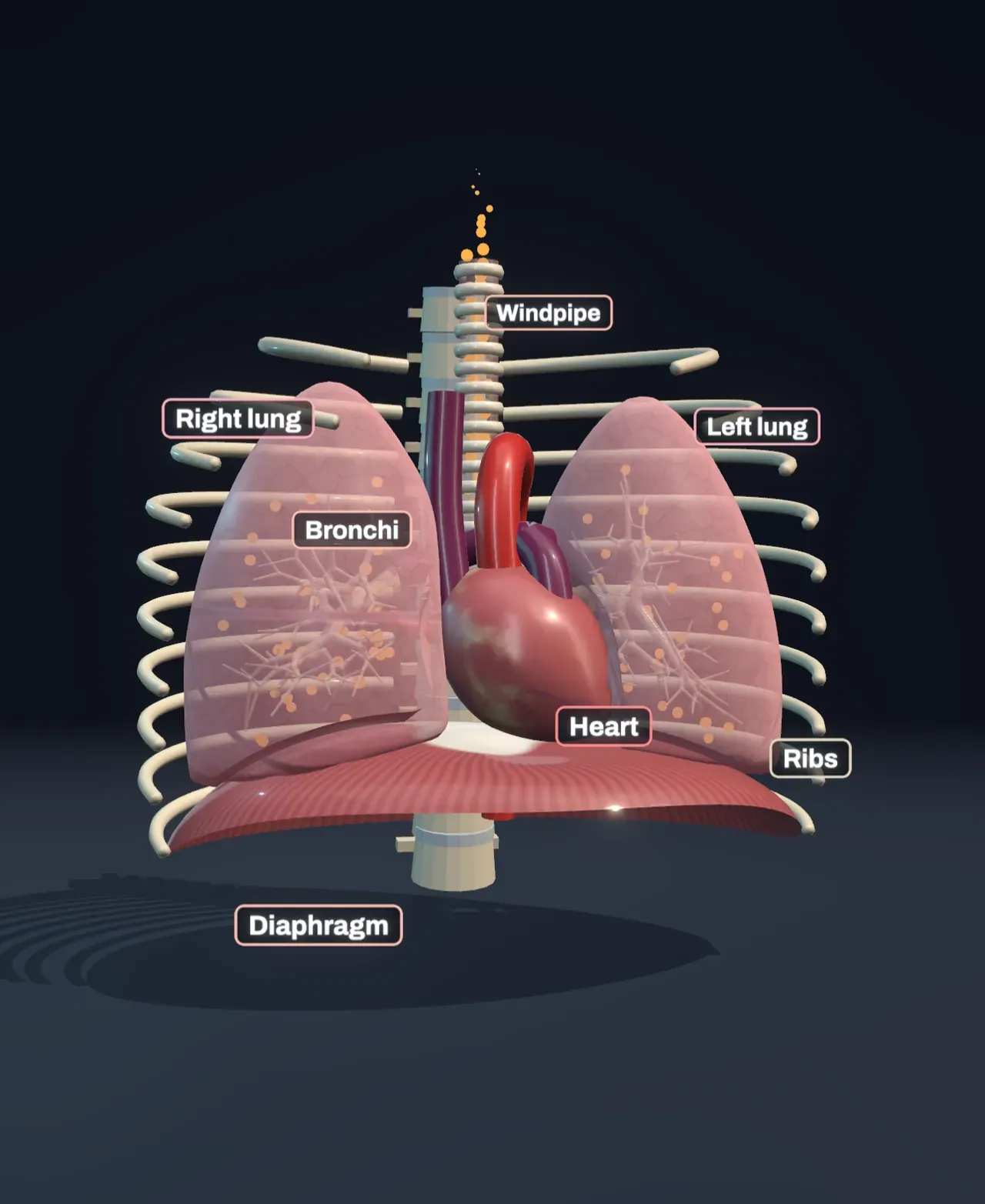
How air gets in
Lungs have no muscle of their own to pull air in. They hang in the chest inside a thin, slippery double layer, the pleura, which keeps them stuck to the inside of the chest wall the way a wet glass sticks to a table. Whatever the chest does, the lungs follow.
Breathing in is work. The diaphragm, a dome of muscle under the lungs, contracts and flattens, pulling the bottom of the lungs down. In a deeper breath the muscles between the ribs also swing the ribs up and out, like the handle of a bucket being lifted, so the chest grows wider and deeper too. The lungs get bigger, the air inside them spreads into more room and its pressure falls a little below the air outside: only about one millimetre of mercury, but enough for air to flow in through the nose and mouth.
Breathing out at rest takes no effort at all. The diaphragm relaxes, the stretched lungs spring back like a balloon letting go, and the air is pushed out. Only when you breathe hard, or blow out a candle, do muscles in your belly and between the ribs squeeze the air out faster.
Try it: slide Breath depth from 500 mL up to 2,500 mL. The diaphragm drops much further, and the lower ribs swing out and forward.
Down the airways
Air goes down the windpipe, or trachea, a tube about 12 centimetres long held open by C-shaped rings of cartilage. Behind the windpipe, where the rings are open, lies the gullet. At the bottom it splits into two bronchi, one for each lung, and these split again and again, about 23 times in all, into narrower and narrower tubes. The last ones open into clusters of tiny air sacs, or alveoli: about 400 million of them, each about a fifth of a millimetre across. Spread flat, their walls would cover about 70 square metres, the floor of a small flat.
The airways only carry air; no oxygen crosses their thick walls. Together they hold about 150 millilitres, the dead space. At the end of every breath out they are full of air that has just come up from the air sacs, so that is the first air the next breath pushes back down. Then, at the end of every breath in, the last 150 mL of fresh air is still sitting in the airways, and it comes straight back out.
The Scene shows this with colour. Fresh air is sky blue; air that has been down in the air sacs comes back amber. Watch the windpipe as you breathe out: the first air out is blue, fresh air that never reached the air sacs, and only after it comes the amber air from deep in the lungs.
The airways also clean the air. They are lined with sticky mucus that catches dust and germs, and tiny beating hairs on their cells sweep it up to the throat, where you swallow it.
Where oxygen crosses
Choose Air sac under Zoom to an air sac and the Scene dives down the airways to one cluster of air sacs. Each is wrapped in a net of capillaries, the narrowest blood vessels, so narrow that red cells pass through them in single file. Between the air and the blood are two thin walls, the air sac’s and the capillary’s, together less than a thousandth of a millimetre thick.
Nothing pumps the gases across. Each one moves by diffusion, down its own partial pressure: the share of the air’s pressure that one gas provides. Air is 21% oxygen, so at sea level, where the air’s pressure is 760 millimetres of mercury (mmHg), oxygen provides about 160 of it. In the air sacs the fresh air mixes with the old air and water vapour that are already there, and the oxygen settles at about 100 mmHg. Blood coming back from the body arrives at about 40, so oxygen pours into it. Carbon dioxide, made in every cell by cellular respiration, arrives at about 46 and leaves at 40, so it crosses the other way.
Almost all the oxygen the blood carries rides on haemoglobin, the red protein that fills red cells. Each molecule can carry four oxygen molecules, and the chart beside the Scene draws how loaded it is at each oxygen pressure. The curve is S-shaped: steep between 20 and 60 mmHg, flat above about 80. Blood arrives three-quarters loaded and leaves about 98% loaded, which is why it changes from dark plum to scarlet, as in circulation.
Try it: with Zoom to an air sac at Air sac, watch a red cell cross the sac. It turns scarlet in the first quarter of its trip and spends the rest of it already full; oxygen molecules cross the wall where the blood is still short of it.
Faster or deeper?
At rest you breathe about 12 times a minute, half a litre each time: 6 litres of air a minute. But 150 mL of each breath only refills the airways, so the air sacs get 12 × 350 mL, about 4.2 litres. The bar at the bottom of the chart splits each minute’s air this way.
That makes shallow breathing poor value. Twenty-four breaths of 250 mL also move 6 litres a minute, but more than half of each breath is dead space, and the air sacs get only 2.4 litres. Six slow breaths of a litre move the same 6 litres and give the air sacs 5.1.
Try it: set Breathing rate to 24 and Breath depth to 250 mL. The same 6 litres a minute now leave carbon dioxide building up and oxygen falling in the air sacs. Then set them to 6 and 1,000 mL.
Carbon dioxide sets the pace
At rest your body makes about 200 mL of carbon dioxide a minute, and breathing has to carry it away as fast as it is made. The more fresh air reaches the air sacs, the lower the carbon dioxide there settles: double the air and you halve it. The brain watches carbon dioxide closely, through the acidity it gives the blood, and adjusts each breath to hold it near 40 mmHg. Oxygen it watches much less closely; at sea level there is plenty to spare.
So the urge to breathe when you hold your breath comes from carbon dioxide building up, not from oxygen running out. Breathing too much for your needs, as in a panic, washes carbon dioxide out, which makes the blood less acidic and can leave you dizzy, with tingling fingers. In exercise, working muscles make up to ten times as much carbon dioxide, and you breathe faster and much deeper to keep up.
Try it: slide Breathing rate up to 40 with Breath depth at 500 mL. You now breathe more than three times the air you need; carbon dioxide in the air sacs drops to about 12 mmHg, while the blood’s oxygen barely rises, because it was nearly full already.
Thin air
Climb a mountain and the air is still 21% oxygen, but there is less air: its pressure falls by about a third by 3,600 metres and by two-thirds at the top of Everest. Every breath carries fewer oxygen molecules, the partial pressure in the air sacs falls, and the blood leaves the lungs less loaded.
The S-shaped curve explains why you hardly notice the first two thousand metres. Up there the air sacs’ oxygen falls from about 100 to about 64 mmHg, but that is still on the flat top of the curve, and the blood still loads above 90%. Higher up it falls onto the steep part, and every metre costs much more.
The body’s first answer is to breathe more. Carbon dioxide and oxygen share the air sacs, and the less carbon dioxide there is, the more room is left for oxygen. Roughly,
where is the oxygen in the warmed, wetted air breathed in and the carbon dioxide in the air sacs. Every 10 mmHg of carbon dioxide breathed away gives back about 12 of oxygen. Over days and weeks the body also makes more red cells. People born high in the Andes or Tibet carry further adaptations.
Try it: press La Paz, at 3,640 metres. At resting breathing the blood leaves less than 80% loaded. Now raise Breathing rate to 18 and Breath depth to 600 mL, as people living there do, and it climbs back above 90%. Then try Everest summit: at resting breathing there is not enough oxygen to stay conscious. With Breathing rate at 40 and Breath depth at 2,500 mL the blood still loads only about 70%. Climbers who reach the top without bottled oxygen do worse than that, because their working muscles use far more oxygen than a resting body.
What this model leaves out
The Scene is a model of a resting adult in a steady state: it asks where the gases in the air sacs would settle if you kept breathing this way, with the body using 250 mL of oxygen and making 200 mL of carbon dioxide a minute. In life, the brain would quickly change your breathing to stop carbon dioxide drifting far from 40, and at very low or very high breathing nobody stays in a steady state for long.
All the air sacs are treated as one. Real lungs are uneven: the bottom gets more air and more blood than the top, and the two never match perfectly, so blood leaving the lungs has a little less oxygen than the model gives. The dead space is fixed at 150 mL, the blood’s flow at 5 litres a minute, and haemoglobin follows a standard curve that does not shift with acidity or temperature, as real haemoglobin does. Air pressure follows measurements made on Everest; real pressure also changes with the weather and the latitude.
The chest is a simplified drawing. The lungs’ lobes, the heart and the vessels are about the right size and place, but the airways branch far fewer times than real ones, and each speck of air stands for about 2 mL. The air sac, its capillaries and its molecules are drawn at very different scales so that they all show at once.