How air gets into the lungs, how much of it really reaches the air sacs, why a deep breath beats a fast one, and why in thin air the blood carries less oxygen.
Step 1 of 7 · A breath in
Step 1 of 7
A breath in
Every cell in the body needs oxygen to release energy from food, and makes carbon dioxide that has to be got rid of. The breathing system brings air to a place where the gases can cross into the blood and back.
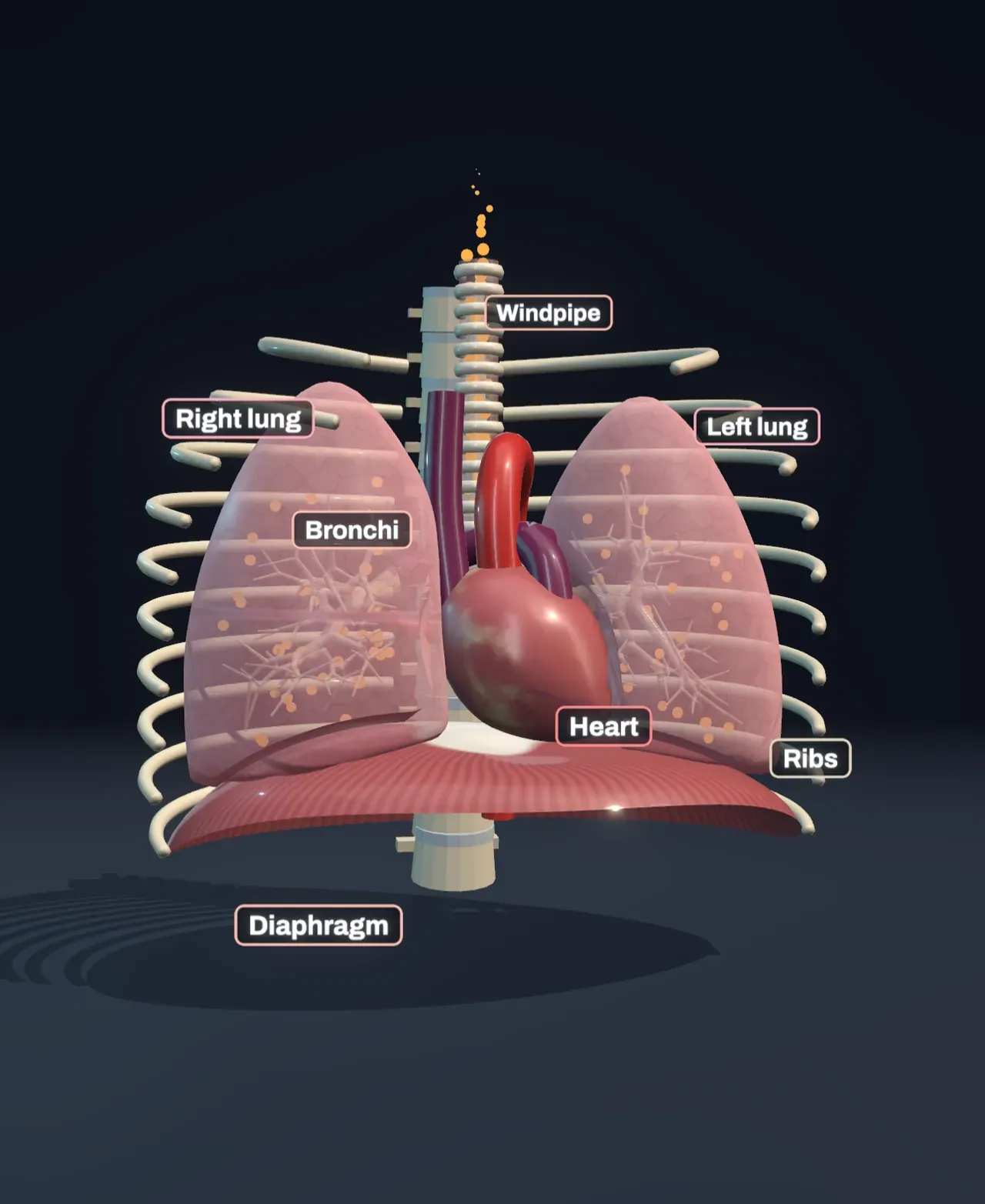
In the Scene the chest is breathing at rest: 12 breaths a minute, about 500 mL each. Watch what moves as the air comes in, and what stays still.
Step 2 of 7
Air a minute
The minute volume is all the air breathed in a minute: the number of breaths times the air in each. Breathing rate and Breath depth are now fixed. Work out the minute volume yourself.
Step 3 of 7
The dead space
Air comes in through the windpipe, which branches into bronchi and smaller and smaller tubes, until it reaches the air sacs (alveoli): tiny bags, hundreds of millions of them, with walls one cell thin wrapped in a net of capillaries. Only there do the gases pass between the air and the blood.
But the tubes leading to the air sacs are full of air too, and it meets no blood. At the end of each breath out they are full of air that was already in the lungs, and on the next breath in it goes back in first. About 150 mL of every breath only refills these tubes, called the dead space.
Step 4 of 7
Panting
The dead space does not depend on how deeply you breathe: it is the same volume of tubes. So it takes a small share of a deep breath and a large share of a shallow one. What happens with many shallow breaths?
Step 5 of 7
Deeper, not faster
When the body needs more air, it can add breaths or deepen them. Every millilitre that deepens a breath goes straight to the air sacs, because the dead space is already filled. Breathing rate is now fixed, and Breath depth is yours.
Step 6 of 7
Inside the air sac
Zoom to an air sac is at Air sac. Oxygen diffuses from the air in the sac into the blood in the capillaries, and binds to the haemoglobin in the red blood cells. Carbon dioxide goes the other way. Each gas moves from where its pressure is high to where it is low.
The chart shows haemoglobin’s loading curve: how much of it carries oxygen at each oxygen pressure. At rest, at sea level, the blood leaving the air sac is nearly full.
Step 7 of 7
Thin air
The higher you go, the lower the air pressure. The air still has the same share of oxygen, about 21%, but each breath takes in fewer molecules, and the pressure pushing oxygen into the blood is smaller. Altitude is yours; the breathing itself stays as it is.
Loading the interactive version…
Loading the interactive version…
Each step sets up the Scene for you, and a control marked “fixed” stays put for that step.
Practice · Choose
With every breath in, air flows into the lungs. What makes it flow in?
Practice · Choose
With every breath in, air flows into the lungs. What makes it flow in?
Practice · Calculate
Breathing rate is fixed at 15 breaths a minute, and Breath depth at 500 mL. How many litres of air are breathed each minute?
Practice · Calculate
Breathing rate is fixed at 15 breaths a minute, and Breath depth at 500 mL. How many litres of air are breathed each minute?
Practice · Calculate
Breathing at rest: 12 breaths a minute of 500 mL. About 150 mL of each breath only refills the airways. How many litres of air reach the air sacs each minute?
Practice · Calculate
Breathing at rest: 12 breaths a minute of 500 mL. About 150 mL of each breath only refills the airways. How many litres of air reach the air sacs each minute?
Practice · Predict, then look
Now pant: 40 shallow breaths a minute of 250 mL each. That is 10 L a minute instead of 6 L. What will happen to the air reaching the air sacs?
Practice · Predict, then look
Now pant: 40 shallow breaths a minute of 250 mL each. That is 10 L a minute instead of 6 L. What will happen to the air reaching the air sacs?
Practice · Reach the target
Breathing rate is fixed at 12 breaths a minute. Change Breath depth until 6 L of air a minute reach the air sacs, and press Check.
Practice · Reach the target
Breathing rate is fixed at 12 breaths a minute. Change Breath depth until 6 L of air a minute reach the air sacs, and press Check.
Practice · Predict, then look
At rest the blood leaving the air sacs is about 98% loaded with oxygen. What will happen to that loading if you breathe twice as fast, 24 breaths a minute, while sitting still?
Practice · Predict, then look
At rest the blood leaving the air sacs is about 98% loaded with oxygen. What will happen to that loading if you breathe twice as fast, 24 breaths a minute, while sitting still?
Practice · Predict, then look
Breathe just as at rest, but in La Paz, 3640 m up, where the air pressure is about two-thirds of that at sea level. How loaded with oxygen will the blood leaving the air sacs be?
Practice · Predict, then look
Breathe just as at rest, but in La Paz, 3640 m up, where the air pressure is about two-thirds of that at sea level. How loaded with oxygen will the blood leaving the air sacs be?
Lesson complete. Every practice question here is done.