Two loops and one heart: where each side of the heart sends the blood, arteries and veins, cardiac output as rate times stroke volume, and what changes as the heart speeds up.
Step 1 of 7 · Two loops
Step 1 of 7
Two loops
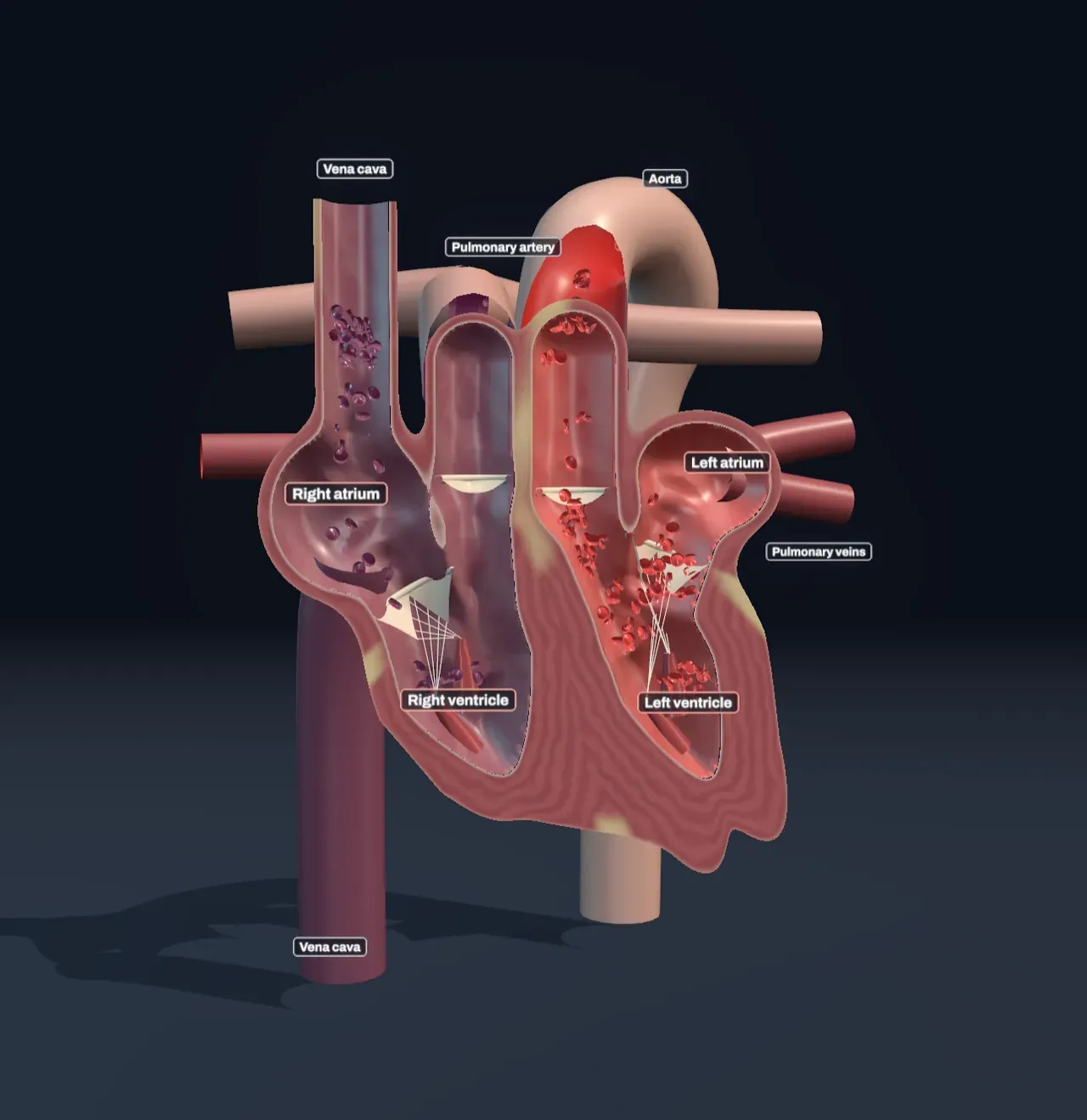
Blood brings every cell oxygen and food and takes its waste away, but only while it flows. The heart is a double pump: two sides, each with an atrium that gathers the returning blood and a ventricle that pushes it out. Valves between the chambers open only one way, so the blood does not flow back.
Show the two loops is On: the heart small in the middle, and the blood leaving it along two routes. Follow the dark blood leaving the right side, and the bright red blood leaving the left.
Step 2 of 7
Arteries and veins
Vessels that carry blood away from the heart are arteries, and vessels that bring it back are veins. Between them, inside the organs, are the capillaries: tubes so thin that blood cells pass through in single file, and oxygen and food cross their walls into the cells. The names follow the direction of flow, not the oxygen.
Step 3 of 7
Litres a minute
On every beat each ventricle pushes out an amount of blood called the stroke volume. The blood the heart pumps each minute, the cardiac output, is the heart rate times the stroke volume. Both sides pump the same amount, or blood would pile up in one of the loops.
Step 4 of 7
Once round
An adult has about five litres of blood. If the heart pumps almost five litres a minute, how long does it take all the blood to pass through it once?
Step 5 of 7
An athlete’s heart
Endurance training, such as long runs or swimming, enlarges and strengthens the left ventricle. An endurance athlete’s resting pulse can be 50 or lower, and the body still gets the blood it needs. How?
Step 6 of 7
In exercise
During exercise the muscles need much more oxygen, and the heart raises its output. Nerves and hormones speed the heart up and also make it squeeze harder, and working muscles push more blood back to it. Heart rate is yours, and Heart is fixed at Typical adult. Read the output at the foot of the chart.
Step 7 of 7
Time to fill
Every beat has two parts: the squeeze, when the ventricles push the blood out, and the relaxed part, when they fill again. The chart shows both on a time line. What happens to them when the heart beats very fast?
Loading the interactive version…
Loading the interactive version…
Each step sets up the Scene for you, and a control marked “fixed” stays put for that step.
Practice · Choose
Show the two loops is On. Where does the right ventricle send its blood?
Practice · Choose
Show the two loops is On. Where does the right ventricle send its blood?
Practice · Choose
The pulmonary artery leads from the right ventricle to the lungs. What blood flows in it?
Practice · Choose
The pulmonary artery leads from the right ventricle to the lungs. What blood flows in it?
Practice · Calculate
A typical adult’s heart beats 70 times a minute, and the left ventricle pushes out about 70 mL each beat. How many litres of blood does it pump each minute?
Practice · Calculate
A typical adult’s heart beats 70 times a minute, and the left ventricle pushes out about 70 mL each beat. How many litres of blood does it pump each minute?
Practice · Calculate
The body holds about 5 L of blood, and the heart pumps about 4.9 L a minute. How many seconds does it take for all the blood to pass through the heart once?
Practice · Calculate
The body holds about 5 L of blood, and the heart pumps about 4.9 L a minute. How many seconds does it take for all the blood to pass through the heart once?
Practice · Predict, then look
An endurance athlete’s heart pumps almost the same 5 L a minute at rest, but at only 50 beats. What will the board show for its stroke volume?
Practice · Predict, then look
An endurance athlete’s heart pumps almost the same 5 L a minute at rest, but at only 50 beats. What will the board show for its stroke volume?
Practice · Reach the target
Heart is fixed at Typical adult. At rest it pumps about 5 L a minute. Change Heart rate until it pumps 10 L a minute, and press Check.
Practice · Reach the target
Heart is fixed at Typical adult. At rest it pumps about 5 L a minute. Change Heart rate until it pumps 10 L a minute, and press Check.
Practice · Predict, then look
At rest the ventricles spend about two-thirds of each beat relaxed, filling. What will happen to that share at 180 beats a minute?
Practice · Predict, then look
At rest the ventricles spend about two-thirds of each beat relaxed, filling. What will happen to that share at 180 beats a minute?
Lesson complete. Every practice question here is done.